The Steps, in Order
- Decide if you need one. A trust earns its cost for multi-state property, blended families, minor children, privacy, or incapacity planning. For a single Florida home, a lady bird deed may do the job for a few hundred dollars. We will tell you straight.
- Choose your trustee and successor. Usually you are your own trustee while alive, with a successor trustee who takes over at incapacity or death.
- Name your beneficiaries and how they inherit (outright, or in protective shares for young or vulnerable heirs). Under Florida law a trust exists only if it has a definite beneficiary, and one Florida family spent a trial and an appeal on a trust whose beneficiary schedule was never filled in.
- Draft and sign it properly (see the Florida signing rules below).
- Fund it. The step that makes or breaks the plan, covered next.
- Add a pour-over will as a backstop for anything you forget to move in.
How to Set Up a Trustee
A trustee is set up by naming the person in the trust document itself, and in most Florida living trusts you name yourself as the first trustee and one or more successor trustees to follow you. No court appoints the trustee of a living trust, and Florida requires no bond unless the trust or a court calls for one.
The first decision is the initial trustee. A single person usually serves alone, and a married couple with a joint trust usually serves together as co-trustees, so the survivor carries on without a gap when one spouse dies. When you are your own trustee, you sign the trust agreement both as the person creating the trust and as trustee, and that signature is your acceptance.
The second decision is the order of successors. Name at least two, in order, because a successor who dies first or declines leaves the next name to step in. When the named list runs out, Florida fills the vacancy by unanimous agreement of the qualified beneficiaries, and by a court appointment when they cannot agree. A successor can be an adult child, a sibling, a trusted friend or a trust company, and the trust can give a named person the power to designate a replacement later, which keeps the choice out of court.
Co-trustees need a rule for disagreement. Florida lets co-trustees who cannot agree act by majority, and two co-trustees who disagree have no majority, so a trust naming two children together should say who breaks a tie or which decisions either one may make alone. Each co-trustee is also expected to take part in the trustee’s work and to use reasonable care to keep the other from committing a breach of trust, so a child named as co-trustee in name only still carries real duties.
A successor trustee accepts by following the method the trust sets out, usually a signed written acceptance, or by taking delivery of the trust property or acting as trustee. A named successor who does nothing for a reasonable time after learning of the appointment is treated as having declined, and a successor can act to protect trust property in an emergency and then decline in writing.
Once in office, the successor signs a certification of trust for each bank and brokerage. The certification states the trust’s date, the acting trustee and the trustee’s powers, and the bank may rely on it without seeing who inherits what. For a home held in the trust, the successor records an affidavit so the new trustee’s authority shows in the county’s title records. Trustee pay is whatever the trust sets, or a reasonable fee where the trust is silent.
Do I Need a Lawyer to Set Up a Living Trust in Florida?
People ask me whether Florida requires a lawyer to set up a living trust, and the honest answer is that it does not. Florida requires 2 witnesses on the parts of a revocable trust that pass property at death, a deed recorded in the county where the home sits, and a trust that names a definite beneficiary, and nothing in the Florida Trust Code puts a lawyer in the room. What brings a trust to my desk afterward is a document that failed one of those 3 tests, or passed all 3 and was never funded. A complete plan here is a flat fee of $3,200 for one person and $4,500 for a couple, and the price includes the deed that moves the home into the trust, which is the step a template leaves to you.
The Step DIY Plans Skip: Funding
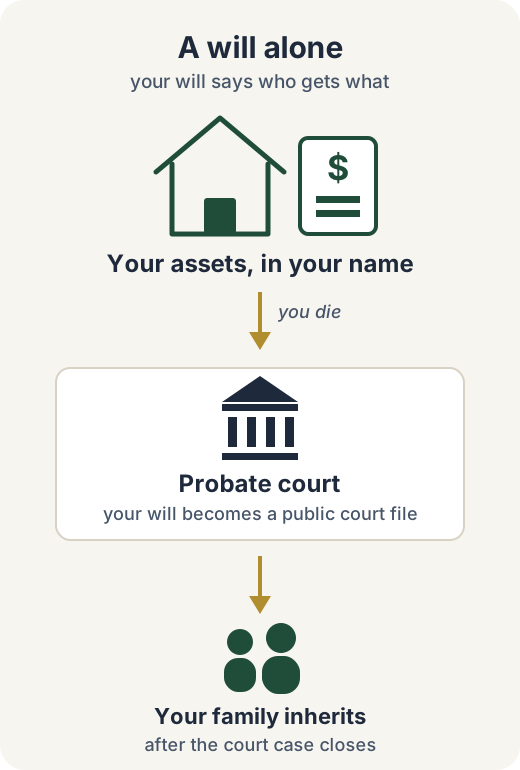
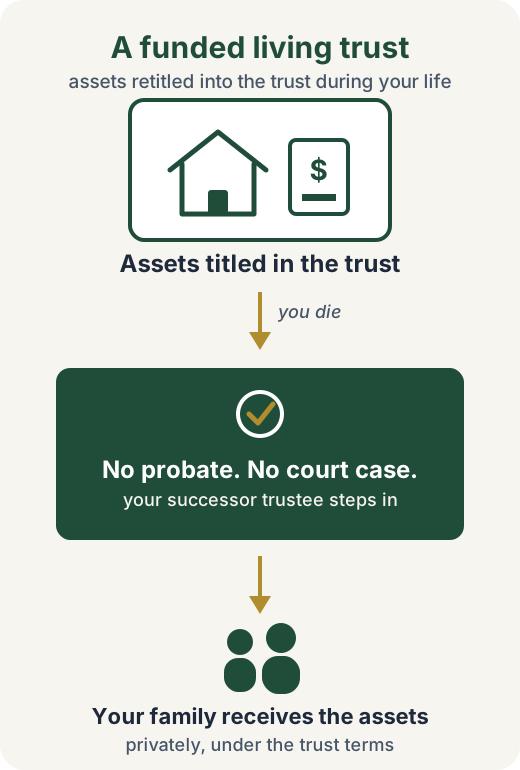
A trust only avoids probate for the assets actually inside it. Funding means recording a new deed to put your home in the trust, retitling your bank and investment accounts into the trust’s name, and updating beneficiary designations where it makes sense. An unfunded trust is just paper, and your family ends up in probate anyway. An unfunded trust is the single most common reason cheap online trusts fail, and the reason our flat fee includes the funding deed and guidance on the rest.
Want it set up and funded right the first time?
Book a No-Cost Phone Consult with Attorney Kevin D. Klagge, Esq. We will map your plan, quote a flat fee, and handle the trust and the funding.
Book a no-cost consultFlorida Signing Rules (Why Templates Backfire)
A revocable living trust that distributes property at your death must be signed with the same formalities as a will, in writing, signed by you in front of two witnesses who also sign. Get this wrong and the trust’s death-time provisions can be unenforceable. The risk is real. A Florida appellate court refused to save a gift of a Bradenton house because the amendment making it had one witness instead of two, and everyone in the case agreed that the gift was what the settlor wanted. The story is the missing second witness. Add Florida’s homestead and spousal rules, which generic forms ignore, and you can see why DIY templates so often fail at the worst possible moment. See how a Florida living trust works →
What It Costs
A complete revocable living trust plan is a flat $3,200 individual / $4,500 couple, including the trust, a pour-over will, durable power of attorney, health-care documents, and the deed that funds your home. See the full cost breakdown →, or if your estate is simple, check whether a lady bird deed is enough.
The funding step is one most Florida families with a trust have already taken. On the 2026 property roll, 600,542 Florida homes are held in trust, and 46 percent of the homes in a family trust carry a homestead exemption, which means the deed into the trust was recorded and the exemption survived it. The figures by county are in Florida homes held in trust by county.
Frequently Asked Questions
How Do I Set Up a Living Trust in Florida?
In short, decide whether you actually need a trust, choose your trustee and a successor, name your beneficiaries, have the trust properly drafted and signed under Florida’s rules, and then, most important, fund it by retitling your assets into it. A trust only avoids probate for what is actually inside it, so the funding step is what makes or breaks the whole plan. Most people pair the trust with a short pour-over will as a backstop. We handle all of it as one flat-fee plan.
Can I Set Up a Living Trust Myself in Florida?
You can buy a template, but DIY living trusts fail far more often than people realize, and you do not find out until it is too late to fix. The two most common failures are not funding the trust (so assets still go through probate) and signing it incorrectly under Florida law. Florida also has homestead and spousal rules that trip up generic forms. A document that is never funded or is improperly executed sends your family straight back to the courthouse, which is exactly what you were trying to avoid.
What Are the Signing Requirements for a Florida Living Trust?
A revocable living trust that distributes property at your death must be signed with the same formalities as a will, in writing and signed by you in the presence of two witnesses who also sign. Getting this wrong can make the trust’s death-time provisions unenforceable. We execute your trust with the proper formalities (and a notary), so it holds up.
What Does It Mean to "Fund" a Trust?
Funding means actually moving your assets into the trust, recording a new deed to put your home in the trust, retitling bank and investment accounts into the trust’s name, and updating beneficiary designations where appropriate. An unfunded trust is just a piece of paper; the probate-avoidance only applies to assets the trust actually holds. Funding is the step DIY plans skip, and the step our flat fee includes, along with the deed for your home.
How Long Does It Take to Set Up?
For most clients, a couple of weeks from the consult. We map the plan, draft the documents, you review and sign at a signing ceremony, and we record the funding deed and guide you through retitling accounts. The process is not rushed, because the details matter, and it is not drawn out either. You will know the flat fee up front.
How Much Does It Cost to Set Up a Living Trust in Florida?
At our firm a complete revocable living trust plan is a flat $3,200 for an individual or $4,500 for a couple, which includes the trust, a pour-over will, durable power of attorney, health-care documents, and one deed to fund your home into the trust. The flat fee is the whole number, not the price of a single document. For a simple estate, we will tell you honestly if a lady bird deed at $399 would do the job instead.
How to Open a Trust in Florida?
A trust in Florida is opened by signing a written trust agreement and then moving assets into it. The trust has to name a definite beneficiary, and the parts that pass property at death must be signed in front of two witnesses who also sign, with a notary added so the document holds up. Opening the trust is half the job, because a trust only avoids probate for assets actually retitled into it, starting with a recorded deed for your home. Before any of that, the decisions you bring are who serves as trustee, who takes over as successor, and who inherits.
When Should You Get a Trust?
A trust earns its cost when your estate has more going on than one Florida home and a simple family. The usual reasons are property in more than one state, young children or a loved one with special needs, a blended family, privacy, and a plan for someone to manage your affairs if you lose capacity. A single Florida home passing to adult children who get along may need only a lady bird deed at $399. The no-cost consult exists to answer that question before you spend anything.
Why Set Up a Trust Instead of a Will?
A funded living trust passes property to your family without probate, while a will sends everything through the probate court first. A trust also lets a successor trustee manage your assets if you lose capacity, and the trust is not filed with the court, so its terms stay private. A will is cheaper up front, a flat fee from $299 at this firm, and the saving is usually spent later on the probate case. Most trust plans still include a short pour-over will as a backstop for anything left outside the trust.
Can You Create a Trust in a Will?
A will can create a trust, called a testamentary trust, and the trust comes into existence only after death. The will has to go through probate before the trust receives anything, so a testamentary trust does not avoid probate. Families use one to hold a minor child’s share until the child is older, and a will with that trust is a flat fee from $299 at this firm. A family that wants to skip probate uses a revocable living trust, signed and funded during life.
How Do I Make Changes to My Revocable Living Trust?
A revocable living trust is changed by signing an amendment, or by restating the whole trust, in the way the trust itself says. Florida also accepts a later will that expressly refers to the trust, or other proof of intent that meets a high standard of evidence, but relying on those invites a court fight. An amendment that changes who inherits at death must be signed in front of two witnesses, and a Florida appellate court refused to enforce a gift of a Bradenton house made in an amendment signed with one. A change is valid only if the signing follows the same rules as the original trust.
Who Can Set Up a Trust for Me?
In Florida only a lawyer may draft a living trust for you, decide whether you need one, and handle the signing and funding. The Florida Supreme Court has held since 1992 that assembling, drafting, executing and funding a living trust is the practice of law, and a nonlawyer may only gather your information. Florida does not require you to hire anyone, so a person can prepare a trust for themselves, and the templates fail most often on funding and on the two witness signing rule. A complete plan here is a flat $3,200 for one person and $4,500 for a couple, with the deed for your home included.
Common Situations
The unfunded template. A man set up an online trust years ago but never retitled his home into it. At his death, the house went through probate anyway, the exact outcome the trust was meant to prevent. We fund trusts as part of the plan so this does not happen.
The right-sized plan. A couple with a Florida home, an out-of-state condo, and young children sets up a funded trust that coordinates everything and names guardians, all in one flat fee.
The kitchen-table signing. A widow bought a trust template online and signed it at home with a notary but no witnesses. Under Florida law, the parts of a revocable trust that pass property at death must be signed like a will, in front of two witnesses who also sign. Signed her way, those death-time provisions were unenforceable, and her estate would have fallen back on the state’s default rules. She caught it in time, and a proper signing ceremony fixed it.
Sources of Law
- Fla. Stat. §736.0403 (annotated) (a revocable trust with testamentary provisions must be executed with the formalities of a will, two witnesses per §732.502). Funding (retitling assets) is required for probate avoidance; Fla. Stat. ch. 736 (Florida Trust Code). (retrieved 2026-06-08)
- Trustees: Fla. Stat. §736.0701 (annotated) (accepting or declining a trusteeship; deemed declination after a reasonable time; acting to preserve trust property before declining in writing); §736.0702 (annotated) (bond only if the court finds it needed or the trust requires it); §736.0703 (annotated) (cotrustees act by majority; duty to participate; reasonable care to prevent a cotrustee’s breach); §736.0704 (annotated)(3) (vacancy filled by the named or designated successor, then unanimous agreement of the qualified beneficiaries, then the court); §736.0708 (annotated) (reasonable compensation where the trust is silent); §736.1017 (annotated) (certification of trust; need not contain the dispositive terms; reliance protected). (retrieved 2026-10-01)
- Creation and revocation: Fla. Stat. §736.0402 (annotated) (a trust is created only if it has a definite beneficiary, among other requirements); §736.0602(3) (annotated) (a revocable trust is revoked or amended by the method the trust states, by a later will that expressly refers to the trust or specifically devises its property, or by any other method proved by clear and convincing evidence of intent). Cases: Bernal v. Marin, 196 So. 3d 432 (Fla. 3d DCA 2016) (a later will that revoked "trust" without naming it or its property; summary judgment for the trustee reversed and remanded for the evidence of intent to be weighed); Megiel-Rollo v. Megiel, 162 So. 3d 1088 (Fla. 2d DCA 2015) (a trust with no remainder beneficiaries named may be reformed on clear and convincing evidence). Both read in full from the official opinion text (retrieved 2026-09-03).
What a Florida Revocation Case Shows About Setting Up a Trust
I draft for the version of this document that gets read out loud in a courtroom. A living trust is signed in a quiet room, and the version that matters is read years later by a judge who never met the person who signed it, with a family on one side of the aisle and a trustee on the other.
I see cases where the trust was set up correctly and the trouble came from a later document that never mentioned it. In 2004 a Miami-Dade woman signed a revocable living trust, named herself trustee and a cousin as successor, and funded it the right way, with her home and her Wells Fargo brokerage account both titled in the trust’s name. The trust left $5,000 to another cousin and the rest to four wildlife charities, and it reserved her right to revoke it without saying how. Four years later she hired a lawyer to write a will, because the man who had moved into her home and looked after her day to day had become the person she wanted to have everything. She told the lawyer she had one trust and wanted it revoked. The lawyer had never revoked a trust before, never saw this one (the cousin had the only copy), and wrote a will leaving everything to the man and revoking every earlier will, trust and codicil, without naming the trust, the house or the account. The woman died in 2013. The cousin, now successor trustee, sued, and the trial court held that the will revoked nothing, because Florida’s statute lets a later will revoke a trust on its own only if it names the trust or specifically leaves the property the trust holds. The house and the account stayed in the trust for the charities. In 2016 the Third District reversed, holding that a will which misses that test can still count as evidence, and sent the case back so the lawyer’s testimony and a 44-year friend’s affidavit could be weighed under the clear and convincing standard. The reversal came 3 years after her death and 12 after the trust, with the house and the account in limbo the whole time.
In reading that opinion, I have a few take-home points.
The first is that a funded trust owns the property, and a will cannot reach what the trust owns unless it undoes the trust in a way Florida law recognizes. A later will revokes a trust without any further proof only if it names the trust or specifically devises the property the trust holds. Anything short of that has to be proved by clear and convincing evidence of what the signer meant, which is a trial with witnesses about conversations the signer is no longer alive to confirm. Practice pointer. Every will I draft for a client who has a trust names the trust by its full title and date, and every trust I draft states how it can be amended or revoked, so a later change never rests on what somebody remembers from a meeting.
Second, funding is what made her trust work, and it is also what made it hard to undo. Her house and her brokerage account were titled in the trust, which is exactly right, and it meant the will alone could not move them. The document that holds the title is the one that controls. Practice pointer. When a client changes a plan, the change goes into the trust itself, by an amendment signed with 2 witnesses, and the deed and the account titles are checked the same day, because a change that reaches only the will reaches nothing the trust holds.
Third, the trust and the will have to be drafted together by someone who has read both. The lawyer in that case wrote a will around a trust she had never seen, and the missing reference cost the family 3 years in court before anyone reached the question of what the woman wanted. Practice pointer. Before I draft a will for someone with an existing trust, I read the trust, and I will not draft around a document I have not been given.
Avoid changing a trust-based plan with a will drafted by someone who has not read the trust, because a will that names neither the trust nor its property leaves the change to be proved after you are gone, by people who were not in the room. What would have kept that family out of court is one sentence in the will naming the trust by its title and date, or a one-page amendment to the trust signed with 2 witnesses. A plan here that includes the trust, the pour-over will and the funding deed, drafted together, is a flat fee of $3,200 for one person and $4,500 for a couple, and an amendment to an existing trust is a flat fee quoted at consult.
The appellate court decided only that the evidence of her intent had to be considered. The opinion does not say who ended up with the house, and I have not seen a later decision that does, so the case shows the cost of the fight and not its result.
Kevin D. Klagge, Esq., admitted in Florida since 2012. Each case described above is a decision of a Florida court rather than a matter handled by this firm. Past results do not guarantee a similar outcome.
Updated on October 1, 2026. Reviewed by Kevin D. Klagge, Esq., Fla. Bar No. 99502. General information about Florida law, not legal advice, and no attorney-client relationship is created. Whether a trust fits depends on your situation. Do not send confidential information until we have agreed to represent you.
More Guides on Florida Revocable Living Trust
- LegalZoom Living Trust vs an Attorney
- Will vs. Living Trust in Florida: Which Do You Need?
- Do I Need a Trust for Out-of-State Property?
- Who Is the Grantor of a Trust?
- What Is a Grantor Trust?
- Do You Need a Will If You Have a Trust?
- Does a Will Override a Trust in Florida?
- Does a Trust Avoid Probate in Florida?
Try the Which Estate Plan Do I Need? (quiz).