What a POA Is, and the Court It Saves You From
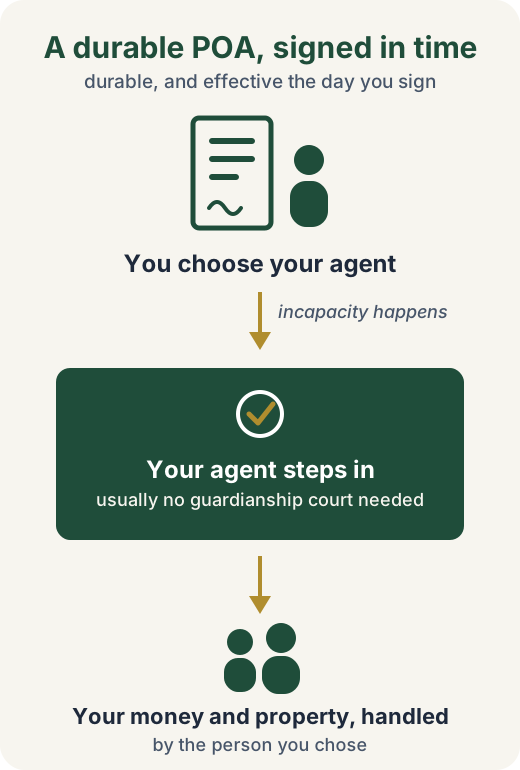
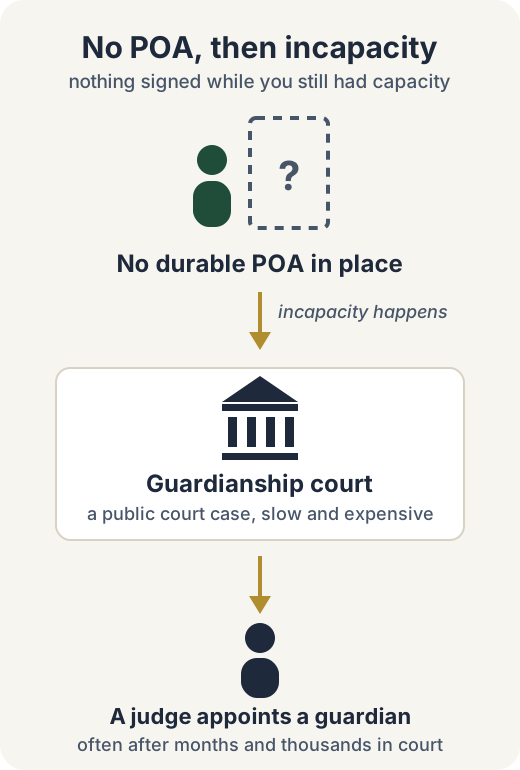
A power of attorney lets someone you choose (your “agent”) handle your money and property. Without one, if you become incapacitated your family has to ask a court to appoint a guardian, a public court case that takes longer than an agent acting under a signed document. A correctly drafted durable POA usually makes the guardianship unnecessary. Chapter 709 of the Florida Statutes, the Florida Power of Attorney Act, governs the document. Setting one up for an aging parent? →
A durable power of attorney does not reach medical decisions in Florida. The document that does is the designation of health care surrogate, and we have the two signed at the same sitting, because the agent who pays the bills and the surrogate who talks to the doctor can be answering different questions on the same afternoon. We prepare the designation of health care surrogate with the living will and the HIPAA release for a flat $350 per person.
People search for this document under several names. You may have looked for a power of lawyer, a DPOA, a durable POA, or a financial power of attorney, and your bank may say something different again. Every one of those names means the same instrument, the Florida durable power of attorney.
Why It Must Be “Durable”
A power of attorney that is not durable ends the moment you lose capacity, which is when your family needs it. A durable POA survives your incapacity, but only if the durability language is in the document. The title alone does not make a POA durable. The document needs a specific sentence stating that it survives your incapacity. The time to check for that sentence is before you need it, which for many Florida families is the week a storm appears in the forecast. Our short storm-season list is in the documents to have ready for hurricane season.
Florida POAs Are Effective When Signed
Florida law makes a POA effective the day you sign it, so your agent can act immediately. Since 2011 you cannot make a Florida POA that takes effect only on incapacity, and the one exception is a military deployment POA.
Clients often worry about that at first, so we build in controls, including a trusted agent, a named successor, and the option to have our office hold the original in escrow and release it only when it is needed.
What Are the Requirements for a Power of Attorney in Florida?
Clients often ask me who has to sign, and in particular, “Does my agent sign it too?” The agent does not. Florida requires the document to be in writing, signed by you in front of two witnesses and a notary, which is a stricter ceremony than a Florida will (a will needs only the two witnesses). Your agent accepts the job later, by using the document, and should not be in the room at signing. The agent must be an adult of at least 18 or a Florida institution with trust powers. A photocopy or an emailed copy carries the same effect as the original for most purposes, so the agent gets a full copy the day it is signed.
“Superpowers” Must Be Separately Initialed
Seven high-risk powers work only if you separately sign or initial next to each one. Those seven are creating a trust, amending or revoking a trust, making a gift, creating or changing survivorship rights, changing a beneficiary designation, waiving survivor rights under an annuity or retirement plan, and disclaiming property. A form that lists them in a block without separate initials grants none of them.
The seven initialed powers are what let an agent handle a Medicaid spend-down or fund a trust. If a witness appears remotely rather than in the room at signing, the POA grants none of the seven powers, so we always sign in person.
An “All Powers” Clause Grants Nothing
Florida does not honor an omnibus “my agent may do everything I could do” clause. Every authority has to be specifically listed. Many DIY forms rely on the general clause and leave out powers the agent later needs.
Does My Power of Attorney Let My Agent Sell a House With a Lady Bird Deed?
A common question I hear from the children of a parent in care is, "Mom has a lady bird deed on the house. Can I sell it with her power of attorney?" The answer depends on three sentences in the power of attorney and one in the deed. The power of attorney has to authorize the agent, in specific words, to sell, convey and mortgage real property, because Florida gives an agent only the authority the document lists and the Florida Bar's title standards treat a general clause as no authority to convey at all. The power of attorney has to be signed before two witnesses and a notary, which every Florida power of attorney signed since 2011 already is, and a deed of homestead by an agent is valid only under a power executed with those deed formalities regardless of where it was signed. And the power of attorney has to be recorded in the county before the deed, because a deed signed under an unrecorded power is not good against a later buyer or creditor.
The sentence in the deed is the one most people never think about. A lady bird deed reserves the power to sell to the owner personally, and Florida treats a personal power of sale as one that cannot normally be handed to someone else. I have not found a Florida appellate decision that says whether an agent may exercise it. A lady bird deed can state that the owner's agent under a durable power of attorney, or a guardian, may exercise every reserved power, and a power of attorney can name the recorded deed and the powers it reserved. Two documents that refer to each other leave a title examiner nothing to question.
Changing who takes the house at death is a different act. Recording a new lady bird deed with a different beneficiary changes a beneficiary designation and survivorship rights, and an agent may do that only where the owner signed or initialed next to those specific powers. Where there is no power of attorney at all, the sale goes through a guardianship, and the guardian may sell or mortgage the ward's real property, homestead included, only after petitioning the court and obtaining an order.
Practice pointer. When the owner already has a lady bird deed, the recorded deed has to be read before the power of attorney is drafted, so the real property authority in the power matches the powers the deed reserved. Avoid an out-of-state power of attorney for a Florida homestead, because the rule that lets a power signed elsewhere follow that state's signing law does not reach homestead, and the two subscribing witnesses are required regardless of where the signing happened.
Your agent needs a POA the bank will accept.
We include the Florida banking language and an agent’s affidavit so it gets honored.
Book a no-cost consultWhen Must a Bank Accept a Florida POA?
When a POA contains Florida’s banking or investment language, four business days is the presumed reasonable time for a bank or broker to accept or reject it. A rejection has to be in writing with a reason, and a wrongful rejection can cost the bank a court order plus damages, attorney fees and costs.
The Florida banking and investment statements have to appear in the POA word for word, and the four-day presumption applies only when they do. We include both in every POA we draft.
The Agent Affidavit Banks Ask For
If a bank is refusing your POA right now, the enforcement rules, deadlines, and escalation steps are on what to do when a bank won't accept your power of attorney. Before honoring a POA, a bank commonly asks the agent to sign a sworn affidavit, and Florida law expressly allows the request. The statute includes a fill-in form. The affidavit confirms the document is still good to use. The affidavit states where the principal is domiciled, that the principal is not deceased, that the POA has not been revoked or terminated (including by a court finding of incapacity), that no incapacity or guardianship proceeding has been started that would suspend it, that a divorce or annulment filing has not ended a spouse-agent’s authority, and, for a successor agent, why the earlier agents cannot act.
A bank that asks for the affidavit is following routine procedure, and we prepare the affidavit with every POA package so your agent is not drafting a sworn statement at the teller window. The affidavit matters to both sides. An agent who refuses a timely affidavit request gives the bank a lawful reason to reject the POA, while an agent who signs one puts the bank on the accept-or-reject clock, with the damages exposure, described above.
Agent Duties and Controls
The agent is a fiduciary, which means acting in good faith, within the scope you granted, and in your interest. An agent who is not your spouse, ancestor or descendant cannot give your property to himself or name himself as a beneficiary unless the POA expressly allows it. An agent who misuses the POA faces removal, a court-ordered accounting, personal liability and, in serious cases, felony charges. What to do when a POA is being abused →
The controls we build in are a trusted agent and a named successor, the seven initialed powers left out unless you need them, and the option of our office holding the original.
Health Care Is a Separate Document
A property POA does not cover medical decisions. Medical decisions belong in a Designation of Health-Care Surrogate under Chapter 765, paired with a living will and a HIPAA authorization. See Florida advance directives (living will, surrogate, medical power of attorney), or we prepare them together in the full plan. Incapacity planning is the two sets together, one for your money and one for your medical care. A POA is also how you avoid guardianship. If you are putting this in place for an aging parent, our Florida elder law and Medicaid planning overview covers the care side. A POA also stops working at your death, as explained in every POA ends at death.
Revoking, Updating, and the “Stale POA” Problem
A POA ends at death or on revocation. A non-durable POA also ends the moment you lose capacity, and a court that adjudicates you incapacitated can suspend or end even a durable one. To revoke or change one, sign a later writing that expressly revokes the old one. A new POA by itself does not cancel a prior one. Collect and destroy old originals and notify your former agent and your banks in writing.
Filing for divorce, annulment or legal separation ends a spouse-agent’s authority unless the POA says otherwise. Banks often question old documents, so we recommend signing a new POA every few years to keep a current instrument. A POA ends at death, and your estate then passes through your other documents or probate.
How Much Does a Power of Attorney Cost in Florida?
A standalone durable power of attorney is $350, or it is included in the will-based plan from $1,200 individual / $1,950 couple (will, POA, health-care surrogate, living will, HIPAA, and a lady bird deed on your home). See full pricing →
Across Florida, attorneys commonly charge $200 to $600 for a durable POA depending on the powers involved, and online form sites charge $30 to $150 for a template with no advice. The difference shows up when the agent uses the document. Banks reject form versions when the gifting and beneficiary powers were never initialed or the Florida banking language is missing. If an agent ever has to use the document in a crisis, the drafting decides whether it works.
Frequently Asked Questions
What Is a Durable Power of Attorney in Florida?
A durable power of attorney is a document that lets someone you trust manage your money and property, and it keeps working if you become incapacitated. The “durable” language (§709.2104) is what lets the document survive incapacity, when your family needs it.
What Is a Power of Lawyer?
A power of lawyer is the same document as a power of attorney. Plenty of people say “power of lawyer,” and search for it that way, because lawyer is the word that comes to mind for legal authority. In Florida the document you are looking for is a durable power of attorney, which people also shorten to DPOA or durable POA. The document lets someone you trust manage your money and property, and it keeps working if you become incapacitated.
When Does a Florida Power of Attorney Take Effect?
A Florida POA takes effect the day you sign it. Florida law makes a POA exercisable when executed (§709.2108) and bans POAs that only spring into effect upon incapacity. Your agent can act immediately, which is why choosing the right agent and controls matters.
Can I Make a “Springing” POA That Only Kicks in if I’m Incapacitated?
No. Florida outlawed springing POAs in 2011 (the only exception is a military deployment POA). If you want a buffer, your attorney can hold the original and release it to your agent only when it’s needed.
Does a Florida POA Avoid Guardianship?
Usually yes. A valid durable POA is one of the less restrictive alternatives a court must consider before appointing a guardian (§744.331(6)(b)). A POA signed before incapacity usually makes the guardianship unnecessary.
What Are the Signing Requirements for a Florida POA?
It must be in writing, signed by you, witnessed by two people, and notarized (§709.2105). If it includes “superpowers,” the witnesses must be physically present, or those powers are void.
Why Won’t My Bank Accept My Power of Attorney?
A bank usually rejects a POA because it is old, vague, or missing Florida’s banking language. A proper Florida POA includes the §709.2208 banking statements. A bank then has four business days, presumed reasonable, to accept it or reject it in writing with a reason, and a wrongful rejection can cost the bank damages and fees.
Can My Agent Change My Beneficiaries, Make Gifts, or Fund My Trust?
Only if you separately initialed those specific “superpowers” (§709.2202). A general POA does not include them by default, and an agent who is not your spouse, ancestor or descendant cannot use them to benefit himself unless you expressly allow it.
Is a Power of Attorney the Same as a Medical Power of Attorney?
No. Medical decisions need a separate Designation of Health-Care Surrogate under Chapter 765, plus a living will and a HIPAA release. We prepare those together in the will-based plan.
How Do I Revoke a Florida Power of Attorney?
You revoke it with a later POA or other signed writing that expressly revokes the old one, and then notify your former agent and any banks in writing. A new POA by itself does not cancel a prior one. Filing for divorce also ends a spouse-agent’s authority unless the POA says otherwise.
What Does a Durable Power of Attorney Cost at This Firm?
A standalone durable POA is a $350 flat fee, or it is included in the will-based plan from $1,200.
Where Can I Get a Power of Attorney Form in Florida?
Florida’s power of attorney law contains no official fill-in form for a financial power of attorney, so the document is drafted for the person signing it. Website forms exist, but a Florida power of attorney only works if it says the authority survives incapacity, is signed before two witnesses and a notary, and carries a separate signature or initials beside each power over gifts, beneficiaries and trusts. A generic form usually misses the last requirement, and a bank can then refuse the document. A durable power of attorney from this firm is a flat fee from $350.
Do You Need a Lawyer to Get a Power of Attorney in Florida?
No. Florida law does not require a lawyer to prepare or sign a power of attorney. The law requires the signature of the person granting the power, two witnesses and a notary, plus separate initials beside the powers to make gifts, change beneficiaries or create or amend a trust. Most failures come from that last requirement and from vague banking language, and the failure shows up years later, when the person who signed can no longer sign a new one. A lawyer’s draft is meant to work on the day the family needs it.
What Are the Different Types of Power of Attorney?
Florida recognizes a durable power of attorney, which keeps working after the person who signed it loses capacity, and a nondurable one, which ends at incapacity. Either kind can be general, covering most financial matters, or limited to one task such as closing a sale. A springing power of attorney, one that turns on only at incapacity, cannot be signed in Florida after October 1, 2011, apart from the military deployment exception. Medical decisions belong to a separate document, the designation of health care surrogate.
What Is a Dual Power of Attorney?
A dual power of attorney usually means one document naming two agents, which Florida calls co-agents. Unless the document says otherwise, each co-agent can act alone, without the other’s signature. A document that requires both to sign together guards against one agent acting badly but slows everything down, because every check and bank errand needs both people. A common alternative is one agent with a named successor, who steps in only if the first agent dies, resigns or cannot serve.
Does a Spouse Automatically Have Power of Attorney?
No. Marriage gives a husband or wife no authority over accounts, retirement plans or property held in the other spouse’s name alone, so a spouse who loses capacity without a durable power of attorney can leave the other facing a guardianship to reach those assets. Medical decisions work differently. When no health care surrogate was named, Florida’s default list lets a spouse decide first, ahead of adult children. A spouse named as agent loses the authority once a divorce is filed, unless the document says otherwise.
Can My Agent Sell a House That Has a Lady Bird Deed on It?
Only under a power of attorney that specifically authorizes selling and mortgaging real property, signed before two witnesses and a notary, and recorded in the county before the deed. A general clause grants nothing. The lady bird deed reserved the power to sell to the owner personally, and no Florida appellate decision I have found decides whether an agent may exercise it, so a deed that says the agent or a guardian may exercise the reserved powers removes the doubt. Changing the beneficiary named in the deed needs the separately initialed power. Without any power of attorney, a guardian sells only with a court order.
Who Can Witness a Power of Attorney in Florida?
Two witnesses sign alongside the person granting the power, and a notary takes the acknowledgment. Florida’s power of attorney law sets no list of people barred from witnessing, but the firm never uses the agent as a witness, because a witness with nothing to gain makes the signing far harder to attack if a relative later claims undue influence. When the document includes the separately initialed powers, the witnesses need to be physically present in the room.
Common Situations
The guardianship that didn’t have to happen. A Miami daughter couldn’t pay her mother’s bills or sell the car to fund her care, because her mother, now in late-stage dementia, never signed a POA. The family spent months and thousands of dollars in guardianship court for authority the mother could have granted in one signing. A durable POA signed years earlier would usually have made the guardianship unnecessary.
The form the bank rejected. A Broward man downloaded a POA template and named his son. When the son tried to use it, the bank refused it. There was no Florida banking language, no agent’s affidavit, and an “all powers” clause that granted nothing. By the time they sorted it out, the father had declined further. A Florida-specific POA with the §709.2208 language would have been honored in days.
The original locked away. A father signed a durable POA years ago, then put the only original in his safe-deposit box for safekeeping. When a stroke took his capacity, his daughter could not get into the box (she was not on the rental agreement) and had nothing to show the bank. Keep the original somewhere accessible, and give the agent a full copy the day it is signed. Under Florida law a copy generally works as well as the original.
Sources of Law
- Fla. Stat. ch. 709: §709.2104 (durability), §709.2105 (execution), §709.2108 (effective when executed; no springing), §709.2201 (enumeration), §709.2202 (superpowers; remote-witness void), §709.2208 (banking language), §709.2119/§709.2120 (acceptance, affidavit), §709.2114 (agent duties), §§709.2109 to 709.2110 (termination/revocation). Guardianship alternative §744.331(6)(b); health care ch. 765. flsenate.gov (retrieved 2026-06-07)
- An agent selling real property: Fla. Stat. §709.2201(1) and (2)(b) (only specifically granted authority; conveying or mortgaging homestead with the spouse’s joinder), §709.2106(3) (a power signed in another state under that state’s law), §689.111 (a deed of homestead by an agent requires a power executed in the same manner as a deed), §695.01(1) (a deed by an agent is not good against creditors or purchasers unless the power is recorded first), §744.441(2) and (12) (a guardian of the property exercises the ward’s powers and sells or mortgages real property, homestead included, after court approval on petition). Fla. Bar Uniform Title Standards 1.1 (a power used for a deed is executed and recorded in the same manner as the deed, and the out-of-state exception does not reach homestead), 1.3 (clear authority to convey real property; a clause to act in all matters is not enough), 18.4 and 18.6 (homestead conveyed by an agent or by a guardian on court order), September 4, 2024 compilation. Florida Real Estate Transactions §22.22 (a power is a personal right that cannot normally be inherited, delegated or assigned, citing In re Estate of Serrill, 159 So. 2d 246 (Fla. 1964), and Christopher v. Mungen, 61 Fla. 513, 55 So. 273 (1911); opinions not read for this page). (statutes verified against the 2026 text, 2026-10-18)
- Borneman v. John Hancock Mut. Life Ins. Co., 710 So. 2d 671 (Fla. 5th DCA 1998) (a spouse-agent's beneficiary change held ineffective because the filing of a capacity petition had suspended the power under former §709.08). §709.2109(3) (the current suspension rule, with the parent, spouse, child or grandchild exception); §709.2113 (agent acceptance by conduct); §709.2106(5) (copies); §709.2116 (court review and fee awards); §709.2117 (agent’s liability). (statute text verified 2026-09-03)
What One Florida Case Shows About the Powers You Hand Over
Every document I draft is written by someone who has had to defend one in front of a judge. The power of attorney is the estate document that gets used while its author is alive and unable to explain what they meant, so the fight is about what the paper says.
I have come across a case where a Florida husband and wife were married but estranged and living apart. He owned a life insurance policy that named her, and after they separated in 1994 he changed the beneficiary to his daughter. About six months later, on December 14, 1994, his wife obtained a durable power of attorney from him. The next day a professional guardian filed a petition asking the court to decide whether he still had capacity, and the court appointed an emergency temporary guardian. The day after that, signing as his agent, the wife faxed the insurance company an instruction naming herself the beneficiary again. He died three days later, on December 19. The insurer paid the daughter, the wife’s estate sued the insurer, and in 1998 the appellate court held that the filing of the capacity petition had suspended the power of attorney, so the fax changed nothing. The policy went where the husband had put it, and it took more than three years of litigation (the wife herself died two months after him, so by the end two estates were fighting over one policy) to confirm that.
Reading that case against the current chapter 709, I have a few take-home points.
The first is that the calendar saved his plan, and the calendar would not save it today. The statute the court applied suspended every agent the moment a capacity petition was filed. The current statute keeps that suspension for most agents but carves out a parent, spouse, child or grandchild, whose authority continues unless a separate verified motion is filed with the petition. A spouse in that position today keeps signing. So the protection that came from the courthouse in 1994 has to come from the document now, and the practice pointer I take from it is that the power to change a beneficiary designation exists in a Florida power of attorney only where the owner signed or initialed next to that line. I leave that line blank unless the owner can tell me which designation the agent might need to change and why.
Second, the beneficiary and gift lines are the ones people initial without reading. Florida lists seven powers that work only with a separate signature or initial, and an agent who holds them also owes the owner a duty to preserve the estate plan the agent knows about. A duty is enforced afterward, in a lawsuit, while a blank line is enforced at the counter, by the bank or the insurer that refuses the instruction. I ask every owner to read the seven powers aloud before initialing any of them, because the initial is the grant. Where the agent is not the owner’s spouse, ancestor or descendant, the statute already bars the agent from moving the owner’s property to himself under those powers unless the document expressly allows it. There is a clause I add to these now because of a case I read, and I will explain why at the consult.
Third, the remedy arrives late. An agent who misuses the document is liable to restore the value of what was moved and to repay the owner’s money spent defending the agent, and a court that reviews an agent’s conduct awards reasonable attorney fees and costs. Every one of those remedies is a lawsuit filed after the money has moved, and in the case above the right person was paid only because the insurer held the line and the estate was willing to fund an appeal. Avoid a power of attorney signed during a family estrangement that carries the gift and beneficiary powers, because a plan the owner already made can be reversed by fax and put back only by lawsuit. A durable power of attorney drafted for that husband with the beneficiary and gift lines left blank, a successor agent named, and the original held by his attorney would have left the fax with nothing to act on, with no petition and no appeal. I charge $350 to draft one.
The 1998 decision came under the statute Florida replaced in 2011, so its holding on suspension does not carry over to a spouse acting as agent, and I have not found a Florida appellate opinion applying the current spouse exception to a beneficiary change made in the days before a death. I will say so when your question falls between the old statute and the new one rather than answer it from a statute the court never construed.
Kevin D. Klagge, Esq., admitted in Florida since 2012. Each case described above is a decision of a Florida court rather than a matter handled by this firm. Past results do not guarantee a similar outcome.
Updated October 18, 2026. Reviewed by Kevin D. Klagge, Esq., Fla. Bar No. 99502. General information about Florida law, not legal advice, and no attorney-client relationship is created.
More Guides on Florida Power of Attorney
Powers of attorney in Florida
- Can a Power of Attorney Change a Will?
- How Long Does a Power of Attorney Last in Florida?
- How to Revoke a Power of Attorney in Florida
- Does a Power of Attorney Need to Be Notarized in Florida?
- How to Give Someone Power of Attorney in Florida
- How to Get Power of Attorney for a Parent
- Power of Attorney for a Parent With Dementia
Related guides
Try the Which Estate Plan Do I Need? (quiz).