The Short Answer
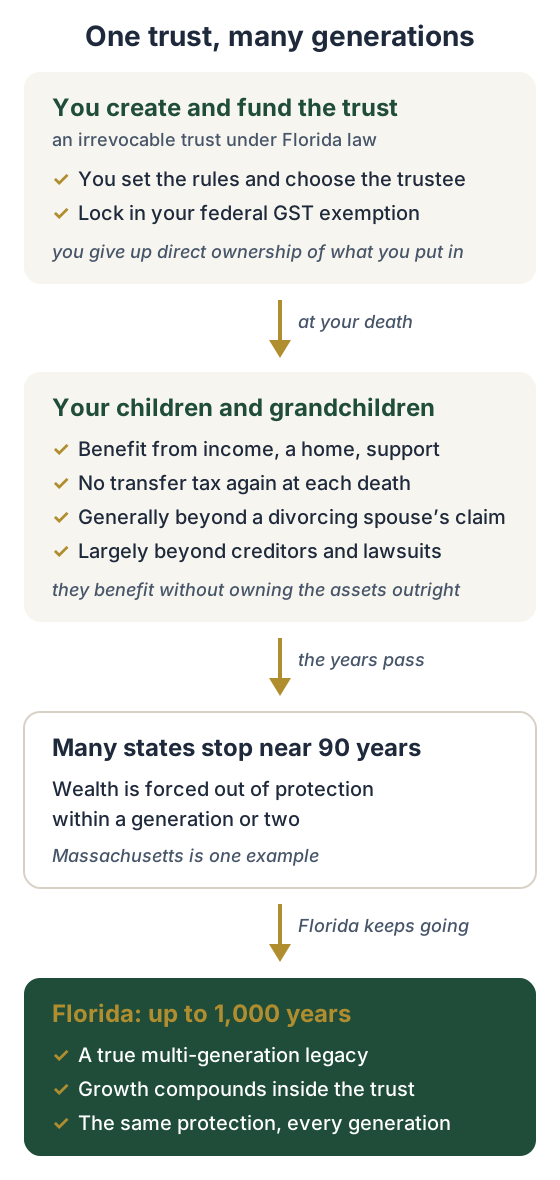
A dynasty trust is an irrevocable trust designed to hold family wealth for the long run, passing it down through children, grandchildren, and further still. Instead of handing each generation a lump sum that is exposed the moment it lands, the trust lets them benefit from the wealth while keeping it protected and intact. Florida is one of the few states where this works for centuries, because Florida law lets a trust last up to 1,000 years.
Why Florida, Even if You Live Somewhere Else
Many states still limit how long a trust can last, often to about 90 years, under an old legal rule called the rule against perpetuities. Massachusetts is one example. That limit forces the wealth out of protection within a generation or two. Florida took a different path and allows a trust to run for as long as 1,000 years, so a true multi-generation legacy is actually possible here. A family living in a high-tax or short-perpetuity state can use Florida law by setting up the trust with a Florida trustee, and we routinely work alongside the family’s home-state attorney to do exactly that.
| A trust in many states | A Florida dynasty trust |
|---|---|
| Must end after about 90 years, under the old rule against perpetuities | Can run up to 1,000 years |
| Wealth is forced out of protection within a generation or two | Protection can continue for children, grandchildren, and beyond |
| Massachusetts is one example | Open to out-of-state families through a Florida trustee |
What a Dynasty Trust Protects Against
- Transfer tax at every generation. Using your federal generation-skipping (GST) exemption, the assets and their growth pass down the family line without being taxed again at each death.
- Your children’s divorces. Because the wealth stays in the trust, it is generally not marital property a divorcing spouse can claim. Our guide to protecting your child’s inheritance walks through the case law.
- Creditors and lawsuits. Assets held in the trust are largely beyond the reach of a beneficiary’s creditors, generation after generation, thanks to the same spendthrift protection Florida law gives trust beneficiaries.
- Spending it all at once. You set the rules so the wealth supports each generation rather than being drained by one.
Thinking in generations, not just the next one?
Book a No-Cost Phone Consult with Attorney Kevin D. Klagge, Esq. We will tell you whether a Florida dynasty trust fits your family and how to use your exemptions, working with your home-state counsel where needed.
Book a no-cost consultThe Honest Trade-Offs
A dynasty trust is irrevocable, so you give up direct ownership of what you put in, which is what makes the protection and tax savings work. It is a sophisticated tool that earns its keep for families with meaningful wealth and a genuine multi-generation goal. For a simpler estate, a revocable trust or a lady bird deed is the better fit. Florida’s directed-trust and decanting laws keep even an irrevocable dynasty trust adaptable as the years pass. We quote the work at the consult.
Clients are often confused about the customary costs and fees, and ask me, “What does it cost to run one?” The drafting is a flat fee quoted at consult. The running cost is the trustee’s compensation, which Florida law limits to what is reasonable, plus a trust income tax return in most years, and our guide to Florida trustee fees explains how that compensation is set and challenged. A trust that runs for generations pays a trustee for generations, so the choice of trustee is a cost decision as much as a trust decision.
Can a Dynasty Trust Be Revocable in Florida?
A common question I hear is, “Can a dynasty trust be revocable?” Yes while you are alive, and then it has to lock. Most Florida dynasty trusts are written inside a revocable living trust and come into being at the death of the person who set them up. Until then you can amend or revoke the plan, the assets stay yours, and nothing is protected from anybody. At death the trust becomes irrevocable, your personal representative allocates your generation-skipping exemption to it on the estate tax return, and from that day the protections start. Florida measures the trust’s permitted term from the day the power to revoke ends, so the 1,000 years begin at your death rather than at the signing. The other design is a dynasty trust that is irrevocable from the day you sign it. That version uses your gift and generation-skipping exemptions now, moves all of the future growth out of your taxable estate, and protects the assets immediately, at the price of giving up the right to change it. Which design fits turns on whether the growth you are removing is worth the control you are giving up, and that is the arithmetic we run at the consult.
Frequently Asked Questions
What Is a Dynasty Trust?
A dynasty trust is an irrevocable trust built to last for many generations, holding and protecting family wealth for your children, grandchildren, and beyond instead of paying it out and exposing it. Each generation can benefit from the trust (income, a home to live in, support) without owning the assets outright, which keeps the wealth safe from their creditors, divorces, lawsuits, and estate tax as it passes down. It is the structure families use to build a lasting legacy rather than a one-generation inheritance.
How Long Can a Trust Last in Florida?
Up to 1,000 years for trusts created on or after July 1, 2022 (trusts created between 2001 and mid-2022 can run 360 years). That is one of the longest trust durations in the country. It matters because many states still limit trusts to roughly 90 years under the old rule against perpetuities, which cuts a dynasty short. Florida’s long horizon is a big reason families, including those who live in other states, choose Florida law for a multi-generation trust.
Why Would a Family in Another State Use a Florida Dynasty Trust?
Because their home state often will not allow a trust to last nearly as long. Massachusetts, for example, caps trusts at about 90 years; Florida allows up to 1,000. A family that wants wealth to pass to grandchildren and great-grandchildren needs a state whose law permits it, and with a Florida trustee they can use Florida’s. We frequently build the Florida trust and coordinate with the family’s home-state attorney.
How Does a Dynasty Trust Save Estate Tax Across Generations?
Normally, wealth can be taxed again each time it passes to the next generation. A properly structured dynasty trust uses your federal generation-skipping transfer (GST) tax exemption so the assets, and all their future growth, pass down through the generations without being hit by transfer tax at each death. Lock in the exemption now, and decades of growth can compound inside the trust free of those taxes.
Does a Dynasty Trust Protect Against My Children’s Divorces and Creditors?
Yes, that is one of its biggest draws. Because the assets stay in the trust rather than being handed to each beneficiary outright, they are generally beyond the reach of a beneficiary’s divorcing spouse, creditors, or a lawsuit. Your daughter can benefit from the trust without the assets becoming marital property she could lose in a divorce. The protection continues generation after generation.
Do I Lose Control of the Assets?
A dynasty trust is irrevocable, so you give up direct ownership, that is what makes the protection and tax benefits work. But it is far from rigid. You set the rules up front, choose the trustee, and Florida’s directed-trust and decanting laws allow real flexibility to adapt the trust as the family and the law change over time. You shape how the legacy works. You do not keep the assets in your own name.
How Much Does a Florida Dynasty Trust Cost?
It is custom planning, quoted at the consult, because the design depends on your assets, your family, and how the GST exemption is used. It is a sophisticated tool for families with meaningful wealth they want to protect for generations, so we only recommend it when it genuinely fits. The phone consult costs nothing, and we will tell you honestly whether a dynasty trust or a simpler plan is right.
What Is a Generation Skipping Trust?
A generation skipping trust is a trust built to pass wealth to grandchildren and later generations using the federal generation-skipping transfer tax exemption. The purpose is to keep the assets, and all their growth, from being taxed again each time the wealth passes to the next generation. A Florida dynasty trust is the long-running form of that plan, because Florida lets a trust created on or after July 1, 2022 last up to 1,000 years. Most Florida dynasty trusts are written inside a revocable living trust, and the personal representative allocates the exemption to the trust on the estate tax return.
Can a Generation Skipping Trust Be Broken?
A Florida generation skipping trust is irrevocable, but Florida law allows changes in limited ways. The trustee can move the property to a new trust with updated terms under the decanting statute. For trusts created on or after January 1, 2001, the trustee and all qualified beneficiaries can agree unanimously to modify the trust, and a court can order changes in some circumstances. A directed trust design also lets the family adapt how the trust is run as the family and the law change.
Common Situations
The grandparents building a legacy. A couple with substantial wealth wants it to protect their grandchildren and great-grandchildren, not just their children. Florida’s 1,000-year trust term makes that possible, where their home state’s 90-year limit would have ended the protection within two generations.
The out-of-state family. A New York family cannot get a multi-century trust under New York law. With a Florida trustee and a Florida dynasty trust, they can, and we coordinate with their New York attorney on the rest of the plan.
The business-owning family. Parents want a closely-held business to stay in the family for generations. A dynasty trust, often paired with a directed trust so the family keeps investment control, holds the business and protects it from each heir’s personal risks.
Sources of Law
- Fla. Stat. §689.225: Florida’s rule against perpetuities, permitting a trust term up to 1,000 years for trusts created on or after July 1, 2022 (360 years for trusts created 2001 to mid-2022). flsenate.gov (retrieved 2026-06-07)
- Federal generation-skipping transfer (GST) tax and exemption: IRC §§2601, 2631 (2026 exemption $15,000,000 per person, indexed).
- Florida Trust Code, Fla. Stat. ch. 736. Florida has no state income or estate tax.
- Case: Ludwig v. AmSouth Bank of Florida, 686 So. 2d 1373 (Fla. 2d DCA 1997) (trusts written to continue for the maximum period the rule against perpetuities permits; the period measured from the settlor’s death because the trusts were revocable until then; the estate of a grandson who died without descendants took nothing). Read in full from the official opinion text (retrieved 2026-09-03). Fla. Stat. §689.225(3)(b): the interest is created when the power to revoke ends.
What One Florida Family’s Trust Shows About Building a Dynasty
Nearly every fight I handle traces back to a sentence that seemed clear when it was written. In a trust built to last for generations, the sentence that matters most is the one that says when the trust ends, and the family in the case below spent four years in court over it.
Cases with this shape keep coming up, and it is usually a beneficiary who died before the trust did. In one case I have reviewed, a husband and wife approaching retirement in 1963 created a pair of trusts, and in 1970 they rewrote them so the money would continue after their deaths for their two grandsons, and for the grandsons’ descendants after that. They did not name a date for the trusts to end. Instead they wrote a savings clause, a paragraph saying that if a trust ever ran longer than the law allowed, the trustee should end it on the last day the law permitted and divide what was left between the two grandsons, or their descendants, or, if both lines had died out, among four other branches of the family and a charity in St. Petersburg. The grandfather died in 1976 and the grandmother in 1984. In 1993 one grandson died with no children, and his widow, as the representative of his estate, took the position that each trust should have ended when the grandparent who funded it died, which would have paid half of everything to her late husband’s estate and, through it, to her. The other grandson’s position was that the trusts continue for as long as the law allows. The bank serving as trustee did the careful thing and asked the court for instructions. The trial court, and in January 1997 the appellate court, read the grandparents’ words as a clear intent to keep the trusts running for the longest period the rule against perpetuities permitted, held that the deceased grandson’s share had never become his to leave, and gave his estate nothing from either trust. The trial court fixed the end of the trusts at 20 years and 364 days after the surviving grandson’s death, and other disputes in the family were still pending when the appeal was decided.
In reviewing that decision, I have a few take-home points.
The first is what a dynasty trust actually does when a line ends. The grandparents wanted the money to follow their descendants, and it did. The grandson who died childless never owned the trust property, so there was nothing for his estate to claim, and the whole fund stayed available for his brother and his brother’s two children. When I draft a share for a child or a grandchild, I keep it in trust for that beneficiary’s lifetime rather than paying it out at a set age, because that is the design that produced this result. Practice pointer. Decide, while the trust is being drafted, what happens to a share when a beneficiary dies without descendants, and write that rule into the distribution paragraph itself. The couple in that case put it only in a savings clause that applied if the trust broke the rule, and that placement is what gave the widow her argument.
Second, the clock did not start when the trust was signed. The trusts were revocable until the grandfather died in 1976, and the court measured the permitted period from that death rather than from the 1963 signing. Today’s statute says the same thing, that the period is measured from the day the power to revoke ends, and that rule is why a dynasty trust written inside a revocable living trust works. Practice pointer. The first question I ask about an existing trust is which date starts its period. A trust that became irrevocable between 2001 and June 30, 2022 runs 360 years, one that becomes irrevocable on or after July 1, 2022 runs 1,000, and the trust’s own words can shorten either period but never lengthen it.
Third, a trustee who is unsure asks the court, and the family pays for the answer. The bank in that case filed a petition for instructions, which is the mechanism Florida law still provides, and four law firms (one of them for the two minor great-grandchildren), a trial court ruling and an appeal followed, over a clause the grandparents had written 23 years earlier. What would have prevented the petition, in my reading, was one paragraph stating that each grandson’s share stays in trust for his life, then for his descendants, and passes to the other grandson’s line if he leaves none, without waiting for a perpetuities question to trigger it. That paragraph is in every dynasty trust I draft, and the trust itself is custom work with a flat fee quoted at consult, which is a small figure against four years of four law firms. Avoid a trust whose length is defined only by a formula borrowed from the perpetuities rule, because the formula changes with the statute and with the state, and in that case the formula itself became the lawsuit.
No Florida appellate court has yet construed a trust written under the 1,000-year period, because that period is four years old and the first trusts drafted under it will not raise the question for a very long time. What the older cases show is how a judge reads the words when the family cannot agree on them, and that reading is the one I draft for. Whether the generation-skipping exemption shelters a trust for its whole term depends on federal law, which Congress can change, and I will say so at the consult rather than promise otherwise.
Kevin D. Klagge, Esq., admitted in Florida since 2012. The case described above is a decision of a Florida court rather than a matter handled by this firm. Past results do not guarantee a similar outcome.
Updated on September 3, 2026. Reviewed by Kevin D. Klagge, Esq., Fla. Bar No. 99502. General information about Florida and federal law, not legal or tax advice, and no attorney-client relationship is created. Tax outcomes depend on your facts and on federal law that may change; nothing here is a guarantee. Do not send confidential information until we have agreed to represent you.
More Guides on Florida Irrevocable Trusts
- Florida Testamentary Trust
- Florida Special Needs Trust Attorney
- Florida Irrevocable Life Insurance Trust (ILIT)
- Florida QTIP Trust
- Florida QPRT (Qualified Personal Residence Trust)
- Florida Charitable Remainder Trust
- Charitable Remainder Trust Pitfalls
- What Is a GRAT?
Try the Florida Gift Tax Calculator.