The Short Answer
Decanting is how you fix an irrevocable trust that no longer works. The trustee "pours" the assets from the old trust into a new one with better terms, leaving the problems behind, much like pouring wine off its sediment. It is usually done by the trustee without a court, and it is the reason a trust labeled "irrevocable" is rarely as frozen as people assume. Florida has one of the more mature and reliable decanting laws in the country.
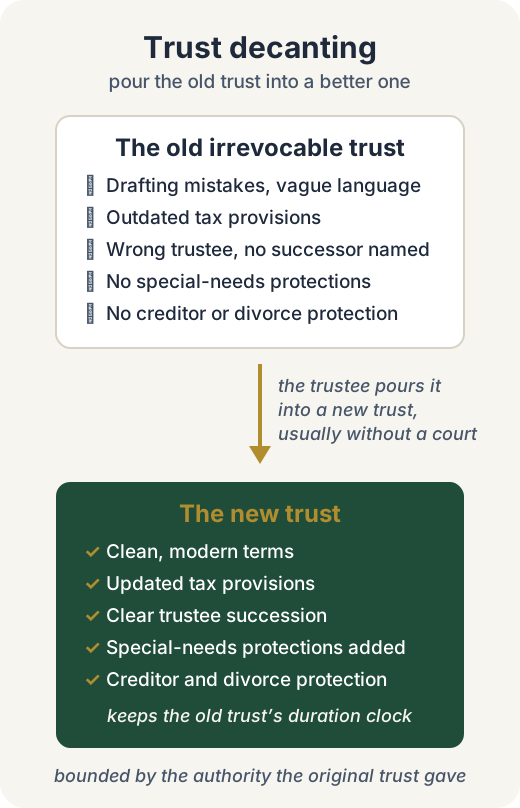
What Decanting Can Fix
Trusts are written for the law and the family of their time, and both change. Here is what decanting can address.
- Drafting mistakes or vague, contradictory language.
- Outdated tax provisions that no longer match current law.
- The wrong trustee, or missing trustee-succession provisions.
- A beneficiary who is now disabled and needs special-needs protections to keep their benefits.
- Adding creditor and divorce protection a beneficiary’s share never had.
What decanting cannot do is hand a beneficiary something the original trust never permitted. The trustee’s power to decant is bounded by the authority the original trust gave, which is one of the safeguards built into the law.
Who Can Decant a Trust in Florida, and How Long Does It Take?
People ask me who does the decanting, and the honest answer is that only the trustee can, and only a trustee who is neither the settlor nor a beneficiary and who holds a power to invade principal. The statute calls that person the authorized trustee. The beneficiaries do not sign, the settlor does not sign, and no judge signs. The trustee signs a written instrument, files it with the trust records, and the assets move.
Clients are often confused about how far the power reaches, and ask me, “Can the trustee change anything?” The answer depends on one phrase in the original trust. A trustee who may invade principal for purposes the statute lists as “best interests, welfare, comfort, or happiness” holds what it calls an absolute power, and can decant into a second trust with different terms, so long as the second trust names only beneficiaries of the first and reduces nobody’s vested interest. A trustee limited to health, education, maintenance and support can still decant, and the second trust must give every beneficiary interests substantially similar to the ones they had. Either kind of trustee can move the assets into a supplemental needs trust for a beneficiary with a disability.
The clock is 60 days. The trustee sends written notice of the planned decanting, with copies of the first trust, the second trust and the instrument doing it, to four groups at least 60 days before it takes effect, namely every qualified beneficiary, every trustee of the first trust, anyone with the power to remove or replace the trustee, and the settlor where a grantor-trust question is involved. If all four groups waive in writing, the trustee can act the same day. A trust’s own clause saying it can never be amended does not stop any of this, and neither does a spendthrift clause.
Why Florida, and Moving a Trust Here
Florida’s decanting statute was enacted in 2007, rewritten in 2018, and amended again in 2025, and its 12 subsections give trustees rules they can rely on. Some states have thin or untested decanting law, which makes trustees nervous; Florida’s is one of the more dependable. That is why families with an old trust in another state will move the trust’s legal home to Florida (its "situs"), put a Florida trustee in place, and decant it into a cleaner trust under Florida law to fix dated terms and modernize its machinery. (Decanting can push the trust’s own end date out, and it cannot restart the perpetuities period, which keeps running from the day the first trust was created under the law that governed it.) We do this in coordination with the family’s original or home-state attorney.
Stuck with a trust that no longer fits?
Book a No-Cost Phone Consult with Attorney Kevin D. Klagge, Esq. We will tell you whether decanting can fix it, usually without court, and what it would take.
Book a no-cost consultWhat Is the Difference Between Decanting and Modifying a Trust in Court?
A common question I hear is, “What is the difference between decanting and going to court?” Decanting is done by the trustee, and a court modification is done by a judge on a petition. An authorized trustee can usually decant without a judge, by following the statute and giving 60 days of written notice, which makes it faster, more private, and cheaper than a court fight. When a change is contested, or goes beyond the trustee’s authority, a court modification may still be the path. Because Kevin handles trust disputes in court as well as trust planning, we can tell you honestly which route your situation needs, and steer you to the lighter one when it will work. See trust litigation →
If court is where you end up, the statute that governs it is annotated in full on our page for Fla. Stat. 736.04113, along with §736.04115 and the five Florida appellate decisions applying them. Two things there are worth knowing before you choose a route. Only a trustee or a qualified beneficiary may apply, and a clause in the trust itself can bar judicial modification entirely. And when the problem is a drafting mistake rather than changed circumstances, the court route is reformation; our case story on the trust that said "male" shows what that fight looks like when it runs all the way up.
Frequently Asked Questions
What Is Trust Decanting?
Decanting is the legal way to fix or update an irrevocable trust by "pouring" its assets from the old trust into a new one with better terms, the way you would pour wine from one bottle to another and leave the sediment behind. The trustee, not a court, generally does it. It is how an "unchangeable" trust can actually be modernized when the original terms no longer make sense.
I Thought an Irrevocable Trust Could Never Be Changed?
That is the common belief, and it is mostly a myth in Florida. While you cannot casually revoke an irrevocable trust, Florida law gives a trustee real tools to adapt it, and decanting is the most powerful. If a trust was poorly drafted, has outdated tax provisions, names the wrong trustee, needs to last longer, or should protect a beneficiary who is now disabled, decanting can often fix it without going to court.
What Can Decanting Fix?
Quite a lot. Correcting drafting mistakes or ambiguous language, updating old tax planning to current law, changing or adding trustee-succession provisions, adding protective (spendthrift) or special-needs provisions for a beneficiary, consolidating or splitting trusts, and changing the trust’s governing state. What it cannot do is give a beneficiary something the original trust never allowed; the trustee’s power to decant is bounded by the authority the original trust granted.
Why Is Florida a Good State to Decant Into?
Florida’s decanting statute is mature and well-developed, with clear rules about what a trustee can and cannot do, and it has been refined over the years (including 2025 updates). That clarity gives families and trustees confidence. Some states have thin or untested decanting law; Florida’s is one of the more reliable, which is why families move an old out-of-state trust to Florida and decant it into a cleaner one.
Can I Move an Out-of-State Trust to Florida and Improve It?
Often, yes. Many trusts allow the situs (the trust’s legal home) to be moved, and once a trust is governed by Florida law with a Florida trustee, it can be decanted under Florida’s favorable statute to clean up dated terms, modernize tax provisions, or fix trustee-succession problems. (One limit holds. Decanting can push out the trust’s own end date, and it cannot restart the perpetuities period, which keeps running from the day the first trust was created under the law that governed it.) We frequently do this in coordination with the family’s original or home-state attorney.
Does Decanting Require Going to Court?
Usually not. One of decanting’s advantages over a court modification is that an authorized trustee can generally do it without a judge, following the statute’s requirements and notifying the beneficiaries. That makes it faster, more private, and less expensive than litigation. When the situation is contested or the desired change exceeds the trustee’s authority, a court modification may still be the route, and we will tell you which path fits.
How Much Does Decanting Cost?
It is quoted at the consult, because it depends on the trust, what needs fixing, and whether any party is likely to object. Decanting is typically far less expensive than living with a broken trust or fighting about it in court. If your irrevocable trust is not doing what the family needs, a short consult will tell you whether decanting is the fix.
Common Situations
The broken old trust. A trust drafted decades ago has dated tax language and names a trustee who has since died, with no clear successor. Rather than litigate, the trustee decants the assets into a clean new trust that fixes both, without a court.
The beneficiary who became disabled. A grandchild who is a trust beneficiary develops a disability and now receives means-tested benefits. Decanting adds special-needs provisions so an inheritance does not cost the grandchild those benefits.
The out-of-state trust brought home. A family moves an old trust’s situs to Florida and decants it into a longer-lasting, cleaner trust under Florida’s favorable law, coordinated with their prior attorney.
The pot trust the siblings outgrew. Two adult siblings share a single trust, one pot for both families, and disagree about nearly every investment and distribution. Rather than litigate, the trustee decants the assets into two separate trusts, one for each branch, on the same terms each side already had. The friction ends without a courtroom, and each branch deals only with its own share from then on.
Sources of Law
- Fla. Stat. §736.04117 (annotated): Florida’s trust decanting statute (a trustee’s power to invade principal and appoint to a second trust), refined by 2025 amendments (ch. 2025-159). flsenate.gov (retrieved 2026-06-07)
- Florida Trust Code, Fla. Stat. ch. 736 (trust modification and reformation generally); §689.225 (trust duration up to 1,000 years).
- The mechanics above: §736.04117(1)(a) and (b) (absolute power; authorized trustee), (2)(a) and (3)(a) (the two tiers), (4) (supplemental needs trusts), (2)(b)5. and (3)(d) (the second trust’s term may extend beyond the first trust’s term), (7)(b) (the perpetuities period stays that of the first trust), (8) (60-day notice to four groups, waivable in writing), (9) (a no-amendment clause or spendthrift clause does not bar the exercise); §736.04113(4) (the statute does not displace the common law). Statute text read at flsenate.gov (retrieved 2026-09-03).
- Cases: Peck v. Peck, 133 So. 3d 587 (Fla. 2d DCA 2014) (an irrevocable trust terminated on the consent of its settlor and all beneficiaries over a co-trustee’s objection); Horgan v. Cosden, 249 So. 3d 683 (Fla. 2d DCA 2018) (termination refused where every beneficiary agreed but the settlor had chosen otherwise). Both read in full from the official opinion text.
What a Florida Case Shows About Trusts That Say They Cannot Be Changed
Trial work teaches you which sentence a lawyer on the other side will pull out and read to the judge. In an irrevocable trust the sentence is the one that says the trust can never be amended or revoked, and Florida’s decanting statute says in so many words that the sentence does not stop a trustee from decanting. What the sentence stops, and what it does not, is the whole subject of this page, and I would rather show it with a family than with a subsection.
I walk clients through that sequence because of a Florida case I have reviewed, decided in 2014, in which the sentence did not hold. In December 1992 a lawyer prepared a trust for his adult daughter and funded it with the gifts he had made to her while she was a minor. The daughter signed as the settlor and served as co-trustee with her father, and her brother was named to take over as trustee. The trust paid her all of the income for life, let her draw $5,000 a year of principal until she turned 50, then $10,000 a year until 55, then $15,000 a year after that, and it said it was irrevocable and not subject to amendment. Her father, by the court’s account, had doubts about her ability to hold on to money, and the schedule was his way of slowing her down. In 2012 she petitioned to end the trust. Her three children, who would take whatever was left, agreed. Her brother, by then a co-trustee, objected that she might run through the assets, which was the very thing the trust had been built to prevent. The trial court ended the trust anyway, and the appeals court affirmed, because under Florida common law a trust can be modified or terminated when the settlor and every beneficiary consent, and the settlor of this trust was the daughter herself. The court added that if the father had signed as settlor, he probably could have written the trust so that it could not be undone this way after his death or over his objection while he lived. The trust he built to last her lifetime ended after 20 years, and the family litigated for 2 more.
In reading that decision against the current decanting statute, I have a few take-home points.
The first is the settlor line. The consent route that ended that trust needs a living settlor and every beneficiary in agreement, and it closes on the day the settlor dies. After that, an irrevocable trust changes only two ways, by a petition to a judge or by a trustee decanting it, and the decanting statute limits that trustee to someone who is neither the settlor nor a beneficiary. My practice pointer, and the first thing I settle when a parent wants to fund a trust for a child, is that the parent signs as settlor and the trust names an outside trustee, because that is the only arrangement I know of in which the parent’s plan survives the parent and a trustee still has a way to fix the document without a courtroom.
Second, decanting runs on a power to invade principal, and that power has to be written in. The trust in that case gave the daughter fixed withdrawal rights and gave the trustees no discretion over principal, so as I read it there was nothing for a trustee to decant with. A trustee who may invade principal for a beneficiary’s welfare or comfort holds an absolute power and can rewrite the terms broadly, and a trustee limited to health, education, maintenance and support can decant only into substantially similar interests. My practice pointer is that the breadth of the invasion clause a family signs this year decides what a trustee can do 30 years from now, so I draft it with the decanting statute open on my desk rather than copy it from the last trust I wrote.
Third, the sentence that says the trust cannot be amended is not the limit, and the spendthrift clause is not the limit either, because the statute says both are inapplicable to a decanting. The limits are the two rules that survive every rewrite, which are that the second trust may name only beneficiaries of the first and may not reduce a vested interest, and the 60-day written notice to four groups. I treat a decanting done without that notice as one the family can unwind, so I send the notice with all three documents attached even when everyone is on speaking terms, and I accept a written waiver from all four groups as the only shortcut. Avoid a trust that names the beneficiary as its own settlor and trustee and then calls itself irrevocable, because that arrangement can be undone by the beneficiary’s signature and her children’s consent, and it leaves a later trustee nothing to decant.
What the right document would have done for that family is plain to state. Had the father signed as settlor and given an outside trustee an absolute power to invade principal, which is how I would have drafted it, the daughter’s request in 2012 would have gone to that trustee under the decanting statute, and the trustee could have moved the assets into a second trust that paid her more while it held her children’s shares in trust, with 60 days of notice and no petition, hearing or appeal. I quote an irrevocable trust drafted that way as a flat fee at the consult, and I quote a decanting of an existing trust the same way, because the price follows the trust and the number of people I have to notify.
What decanting cannot do is give a beneficiary the money the settlor decided to hold back. In another Florida case I have reviewed, decided in 2018, a son with an income interest for life and the three schools that would take the remainder all agreed to end the trust and divide it, and the court refused, because the settlor had chosen to pay him income and not principal and had said so in the document. A decanting could not have done it either, because the second trust may not reduce a vested interest or move the money outside the beneficiaries of the first. Florida’s appellate courts have applied the decanting statute itself in one reported decision, under a version of the text that has since been rewritten twice, so most questions about the current statute have no controlling answer, and I will tell you when yours is one of them.
Kevin D. Klagge, Esq., admitted in Florida since 2012. Each case described above is a decision of a Florida court rather than a matter handled by this firm. Past results do not guarantee a similar outcome.
Updated on September 3, 2026. Reviewed by Kevin D. Klagge, Esq., Fla. Bar No. 99502. General information about Florida law, not legal advice, and no attorney-client relationship is created. Whether a trust can be decanted depends on its terms and your facts. Do not send confidential information until we have agreed to represent you.
More Guides on Florida Irrevocable Trusts
- What Is a GRAT?
- What Is a SLAT?
- What Is a Bypass Trust?
- What Is a GST Trust?
- Florida Dynasty Trust
- Florida Directed Trust
- Florida Spendthrift Trust
- Florida Testamentary Trust
Try the Florida Gift Tax Calculator.