What Is the Difference Between Guardianship and a POA in Florida?
A common question I hear is, “What is the difference between guardianship and a POA in Florida?” The two do the same job, control of your affairs when you cannot manage them, but they get there in opposite ways. A power of attorney is something you set up yourself, in advance, naming people you trust. Guardianship is imposed by a court after you have already lost capacity and did not plan, with a judge declaring you incapacitated and appointing someone to control your life under ongoing supervision. The power of attorney is the good outcome. Guardianship is the fallback nobody wants.
The planning side has a name. A durable POA for your finances plus a health care surrogate for your medical care is what incapacity planning means, and those two documents are what a Florida court is supposed to look for before it appoints anyone.
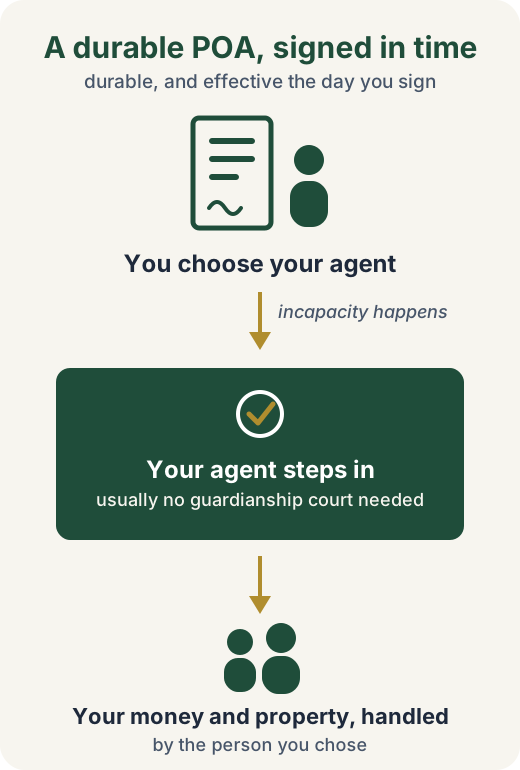
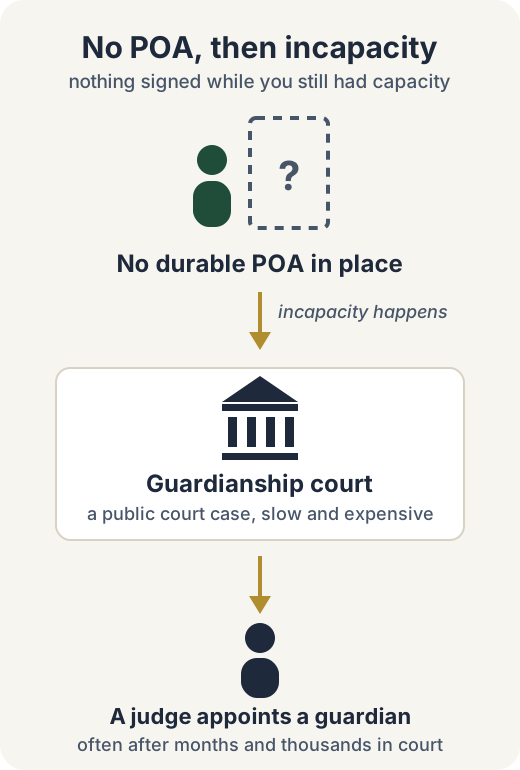
Side by Side
| How they compare | Power of attorney | Guardianship |
|---|---|---|
| Who chooses | You do, in advance | A judge |
| Cost | $350 for the durable POA and $350 for the health-care documents, once | Thousands, plus ongoing |
| Privacy | Private | Public court case |
| Court oversight | None | Ongoing hearings & reports |
| When you can set it up | While competent | After capacity is lost |
Florida Law Prefers the Power of Attorney
Florida law requires a court to consider less-restrictive alternatives, like a valid durable power of attorney and health care surrogate, before imposing a guardianship, and the statute goes further than “consider.” Once a court finds that a person cannot exercise some of their rights, it must decide whether an alternative to guardianship will sufficiently address the person’s problems, and if the answer is yes, a guardian may not be appointed. The documents you sign now are the alternative the court is required to look for, and a Florida appellate court has called skipping that step an error of fundamental proportions.
A durable power of attorney answers the financial half of that question and leaves the medical half open. The designation of health care surrogate is the document a court looks at when the question is who decides about treatment, which is why a complete set is a stronger answer to a guardianship petition than a power of attorney standing alone. Our page on the Florida health care surrogate covers what it authorizes and what the hospital actually asks for.
The process has a calendar. Within 5 days of a petition the court appoints an examining committee of 3 members, and the hearing is held between 10 and 30 days after the last committee report is filed, so a family can be in front of a judge about six weeks after a sibling files. The petitioner can also knock a power of attorney out as an alternative by filing a sworn statement of a good-faith belief, with a factual basis, that the document is invalid, which is why a document signed with two witnesses, a notary and a clear record of capacity matters more than the form it was written on.
People ask me whether a guardianship overrides a power of attorney, and the honest answer is that the petition alone suspends most agents. The moment anyone files to determine capacity, an agent’s authority is suspended until the petition is dismissed or the court authorizes the agent to act, and an order of incapacity ends the document unless the court preserves specific powers. The exception is an agent who is the principal’s parent, spouse, child or grandchild, whose authority continues unless the petitioner also files a separate verified motion. A child named as agent keeps paying the bills through the fight. A friend or a neighbor named as agent stops the day the petition is filed.
Keep your family out of guardianship court.
Book a No-Cost Phone Consult with Attorney Kevin D. Klagge, Esq. We will put a durable power of attorney and health care surrogate in place, so a judge never has to step in.
Book a no-cost consultThe One Window That Closes
Here is the catch that turns a simple plan into a courtroom. A power of attorney can only be signed while you still have capacity. Once a parent has dementia or has lost the ability to understand the document, it is too late, and guardianship becomes the only route to authority over their care and money. That is why the move is to sign a durable power of attorney and health care surrogate early, well before anyone thinks they are needed. If your parent is already incapacitated, we can still guide the family, and our Florida elder law and Medicaid planning overview covers the care and cost side. If they are not, do it now.
Frequently Asked Questions
What Is the Difference Between Guardianship and Power of Attorney?
A power of attorney is something you set up yourself, while you are competent, naming a person you trust to handle your finances (a durable power of attorney) and your medical decisions (a health care surrogate) if you ever cannot. Guardianship is the opposite. It is what happens when you did not plan and lose capacity, so a court has to step in, declare you incapacitated, and appoint someone, sometimes a stranger, to control your affairs under ongoing court supervision. You choose one in advance. A judge imposes the other.
Is a Power of Attorney Better Than Guardianship?
For almost everyone, yes, by a wide margin. A power of attorney is private, inexpensive, takes effect immediately when needed, and lets you choose who is in charge. Guardianship is public, expensive, slow, and ongoing, with court hearings, annual reports, and a judge overseeing decisions, and you do not get to pick the guardian. Florida law itself prefers the power of attorney, because a court must consider less-restrictive alternatives, like a valid POA, before imposing a guardianship.
Does a Power of Attorney Avoid Guardianship?
Usually, yes, and that is the whole point of signing one. If you have a valid durable power of attorney for finances and a health care surrogate for medical decisions, your chosen people already have the authority they need, so there is generally no reason for anyone to ask a court for a guardianship. The documents do the job a guardianship would, without the court. The catch is that they must be signed while you still have capacity, which is why waiting is the mistake.
What if My Parent Is Already Incapacitated and Has No Power of Attorney?
Then a power of attorney is no longer an option, because signing one requires capacity, and guardianship may be the only path to get someone legal authority over their care and finances. Good planning exists to avoid that situation. If you are facing it, we can guide the family through what is needed. If your parent still has capacity, the far better and cheaper move is to put a power of attorney and health care surrogate in place now, before it is too late.
Can a Power of Attorney and a Guardian Both Exist?
Sometimes, but they do not usually coexist smoothly. If a guardianship is established, the court can suspend or limit a power of attorney. The practical takeaway is to get the power of attorney in place early so a guardianship never becomes necessary. When a guardianship is truly unavoidable, the documents you signed earlier can still guide who serves and how, which is another reason to plan ahead.
When Does Each One End?
A power of attorney ends when you die (your will and estate plan take over then), and you can revoke it any time while you have capacity. A guardianship ends at your death too, or earlier if a court restores your capacity, but until then it continues under court supervision with regular reporting. The power of attorney gives you and your family control and flexibility. The guardianship gives the court control.
How Do I Set Up a Power of Attorney to Avoid Guardianship?
With two documents signed while you are competent, a durable power of attorney for your finances and a designation of health care surrogate (with a living will and HIPAA release) for your medical care. We prepare a complete incapacity plan, and the documents are flat-fee. The phone consult costs nothing, and the best time to do it is well before anyone thinks it is needed.
What Is a Legal Guardianship?
A legal guardianship is a court appointment that gives one person authority over another adult’s person, property or both, after a judge finds the adult incapacitated. A plenary guardian exercises every right the court can delegate, and a limited guardian holds only the powers the order lists. The guardian works under court supervision, filing an annual report and, for a guardian of property, an annual accounting. Florida treats guardianship as a last resort, so a court may not appoint a guardian when a less restrictive alternative such as a valid durable power of attorney meets the person’s needs.
How Do You Obtain Guardianship in Florida?
Guardianship starts with a petition to determine incapacity, usually filed together with a petition to appoint a guardian. Within 5 days the court appoints a three-member examining committee, at least one of them a psychiatrist or other physician, and the court also appoints a lawyer for the person said to be incapacitated. The hearing is held 10 to 30 days after the last committee report, the petitioner must prove incapacity by clear and convincing evidence, and if a majority of the committee finds no incapacity the court dismisses the petition. A preneed guardian declaration the person signed earlier creates a presumption in favor of the guardian named in it.
What Is a Plenary Guardian?
A plenary guardian is a guardian the court appoints to exercise all of the rights a person can delegate, after finding that the person cannot perform any of the tasks needed to care for his or her person or property. A limited guardian receives only the powers the court order names, for a person who can still handle some of those tasks. Florida courts must consider less restrictive alternatives first, so a plenary guardianship is reserved for someone who can manage none of the decisions in question.
What Is a Preneed Guardian?
A preneed guardian is the person an adult names, in a written declaration signed before two witnesses present at the same time, to serve as guardian if that adult later becomes incapacitated. The declaration can be filed with the clerk of court, and when an incapacity petition is filed the clerk produces it. The declaration creates a presumption that the named person is entitled to serve, though the court will not appoint someone found unqualified. A durable power of attorney and a health care surrogate signed in time usually keep the family out of guardianship altogether, and the preneed declaration covers the case where a court gets involved anyway.
Common Situations
The plan that worked. A daughter helps her still-sharp father sign a durable power of attorney and health care surrogate. Two years later his memory fails, and she steps in to manage everything immediately, no court, no guardianship.
The plan that was too late. A son waits until his mother’s dementia is advanced, then learns she can no longer sign a power of attorney. The family has to file for guardianship, a months-long, public, expensive process that an early document would have avoided.
The blended-family conflict. Without a chosen agent, relatives disagree about who should be in charge of an incapacitated parent, and a judge decides. A power of attorney naming one person up front would have settled it.
The stroke at fifty-eight. A husband collapsed with a stroke on an ordinary morning. There was no power of attorney, because at fifty-eight he was "too young to need one." His wife could not touch his retirement account or the business account to keep the household running, and the family had to ask a guardianship court for authority he could have granted with one signature. Incapacity does not wait for old age, and these documents belong in place at every age.
The doctor's letter that was not enough. After a car accident left a wife without capacity, her family arrived at the courthouse holding letters from two physicians and expected that to be the end of it. A probate court does not accept a doctor's letter in place of an adjudication of incapacity, so before her husband's estate could be administered at all the family had to run a separate proceeding with its own examining committee and its own months. A durable power of attorney signed while she was healthy would have removed the whole detour. That cascade, and the seven years it cost, is told in full in the estate plan that was perfect in 1989.
Sources of Law
- Fla. Stat. §744.331 and §744.2005: a court must consider less-restrictive alternatives (including a durable power of attorney and health care surrogate) before imposing guardianship. flsenate.gov (retrieved 2026-06-08)
- Durable power of attorney: Fla. Stat. ch. 709. Health care surrogate and advance directives: ch. 765. A power of attorney requires capacity to sign and ends at death. Suspension of an agent by a capacity petition, and the parent, spouse, child or grandchild exception: §709.2109(3). Preneed guardian declaration and the presumption in its favor: §§744.3045, 744.312(1). Examining committee of 3 within 5 days, hearing 10 to 30 days after the last report: §744.331(3), (5). Statute text retrieved 2026-09-03.
- Cases, each read in full from the official opinion text (retrieved 2026-09-03): Frank v. Guardianship of Frank, No. 4D2024-1073 (Fla. 4th DCA Aug. 19, 2026) (slip opinion, not final until any rehearing is decided; appointment of a professional guardian reversed where the court made no finding on the ward’s durable power of attorney and surrogate designation before appointing, and the later sale of the ward’s home and fee orders reversed with it); Adelman v. Elfenbein, 174 So. 3d 516 (Fla. 4th DCA 2015) (incapacity found, no guardian appointed because the advance directive documents were an alternative, and a later petition to reopen barred).
What a 2026 Florida Guardianship Case Shows About the Documents
I would rather spend twenty minutes on the language now than have your family spend two years on it later. The case below took six, and the documents in it were signed, valid and affirmed on video, which is the part that should worry anyone who believes the signing is the finish line.
I see cases where the power of attorney does its job the first time it is tested and fails the second, and the Fourth District decided one on August 19, 2026 that I have read in full. A mother in Weston had three grown children. One daughter moved in with her in August 2019, a son split his time between California and Marco Island, and the other daughter lived in Maryland. Before anyone went near a courthouse the mother signed a durable power of attorney naming the daughter who lived with her, a designation of health care surrogate naming the same daughter, and a trust and will that left that daughter the house and said, in the mother’s own words, that it should pass to her without interference from the other two. In June 2020 she recorded a video affirming the plan. In December 2020 the son filed to have her declared incapacitated. At the hearing in January 2021 she testified that she did not want him handling her money, and that when she could no longer do it herself, her daughter would. Her court-appointed lawyer argued against a guardianship because the power of attorney already covered it. The court declined to find her incapacitated, and the son dropped his petition.
In May 2022 the son and the other daughter filed again, and this time the petition was built from the caregiving daughter’s own deposition, in which she said she had put $72,000 of her mother’s money into precious metals inside a $94,000 annuity and had refused to have her mother tested for or vaccinated against COVID-19 on her own beliefs. A three-member examining committee found the mother incapacitated, and at the October 4, 2022 hearing her court-appointed lawyer recommended a professional guardian. The court appointed one from its registry, acknowledged the mother’s documents, made no finding on whether they were an alternative, and told the daughter she could ask for a separate hearing later. The first professional guardian resigned within months, citing the daughter’s lack of cooperation, and a second was appointed. In March 2023 the court adopted a care plan that moved the mother to an assisted living facility and removed the daughter as caregiver, ordered the daughter out of the house within ten days, and authorized the guardian to sell the house to the other two children for $700,000, which the court itself acknowledged was a non-arm’s-length price against a market range of $825,000 to $855,000. When the daughter’s motion for rehearing was finally heard in 2024, the court refused to look at anything that happened after October 4, 2022, and denied it in November 2024. The mother died. By 2026 the siblings and the guardian were in court over fees again. The appellate court reversed the 2022 appointment, the rehearing order, the sale of the house and every fee order that flowed from them, and sent the case back with instructions to put the parties, as far as reasonably possible, where they were before the guardian was appointed.
In reading that opinion against the statute, I have a few take-home points.
The first is that the documents hold only when a judge is made to rule on them. The statute says a court must decide whether an alternative to guardianship will address the person’s problems and may not appoint a guardian if it will, and the appellate court called the 2022 order a structural error because that decision was never made. An older case from the same court shows the rule working the other way. In 2015 a magistrate found a man incapacitated and appointed nobody, because his durable power of attorney, surrogate designation and trust already covered his affairs, and when a grandniece tried to reopen the case six months later the court threw it out. Practice pointer. The document is the alternative, and the family has to say so in writing before the hearing. I draft a power of attorney alongside a declaration naming a preneed guardian, because the declaration carries its own statutory presumption, and I tell the agent that the first filing after a petition is a notice asserting the less restrictive alternative, with the documents and the evidence of capacity at signing attached.
Second, the agent’s conduct is the evidence, and the second petition in that case was written from the agent’s own testimony. The appellate court said that unconventional investments and living in the house do not by themselves disqualify an agent, and the family still lost four years and the house before that sentence was written. Practice pointer. An agent keeps the principal’s money in ordinary accounts, keeps a ledger, and follows the doctors or writes down the principal’s own reason for not following them, because the court that reads the power of attorney will also read the deposition. Avoid the arrangement in which the agent lives in the parent’s house rent-free, stands to inherit it, and moves the parent’s money into products nobody else in the family understands, because that combination is what a sibling’s petition is built from, whether or not any of it was wrong.
Third, the record that saved the daughter was made before the fight. The mother’s June 2020 video and her sworn testimony in January 2021 were the evidence the appellate court relied on in 2026 to hold that her wishes were the polestar the trial court had to follow. Practice pointer. A short recorded statement at the signing, and a court appearance while the principal can still testify, are worth more than any clause I can write, and a child named as agent should know that under the current statute a petition does not suspend a child’s authority unless the petitioner files a separate verified motion, so the bills keep getting paid while the case is decided.
What the family paid is the measure of the two documents. The durable power of attorney is $350 here and the health-care documents are $350, and the mother had both. What she did not have was a family that put those documents in front of the judge with the video and the testimony attached and asked for the finding the statute requires, and the price of that gap was a guardianship that ran from October 2022 past her death, a house sold to two of her children for between $125,000 and $155,000 less than the court’s own market range, and a fee fight still running in 2026. Guardianship litigation is quoted per matter, and the two documents that make it unnecessary are the cheapest thing on this page.
The opinion is a slip decision, not final until any motion for rehearing is decided, and nothing on remand gives back the years or the mother’s last address. The court also affirmed that she was incapacitated by 2022. What it reversed was the decision to hand her affairs to a stranger without asking whether the person she chose could do the job, and that question is the whole difference between the two things this page compares.
Kevin D. Klagge, Esq., admitted in Florida since 2012. Each case described above is a decision of a Florida court rather than a matter handled by this firm. Past results do not guarantee a similar outcome.
Updated on October 1, 2026. Reviewed by Kevin D. Klagge, Esq., Fla. Bar No. 99502. General information about Florida law, not legal advice, and no attorney-client relationship is created. Whether guardianship can be avoided depends on capacity and timing. Do not send confidential information until we have agreed to represent you.
More Guides on Florida Power of Attorney
- Bank Won’t Accept Your Power of Attorney?
- Power of Attorney After Death in Florida: It Ends. Now What?
- Can a Power of Attorney Change a Will?
- How Long Does a Power of Attorney Last in Florida?
- How to Revoke a Power of Attorney in Florida
- Does a Power of Attorney Need to Be Notarized in Florida?
- How to Give Someone Power of Attorney in Florida
- Power of Attorney for an Elderly Parent
Try the Which Estate Plan Do I Need? (quiz).