The Short Answer
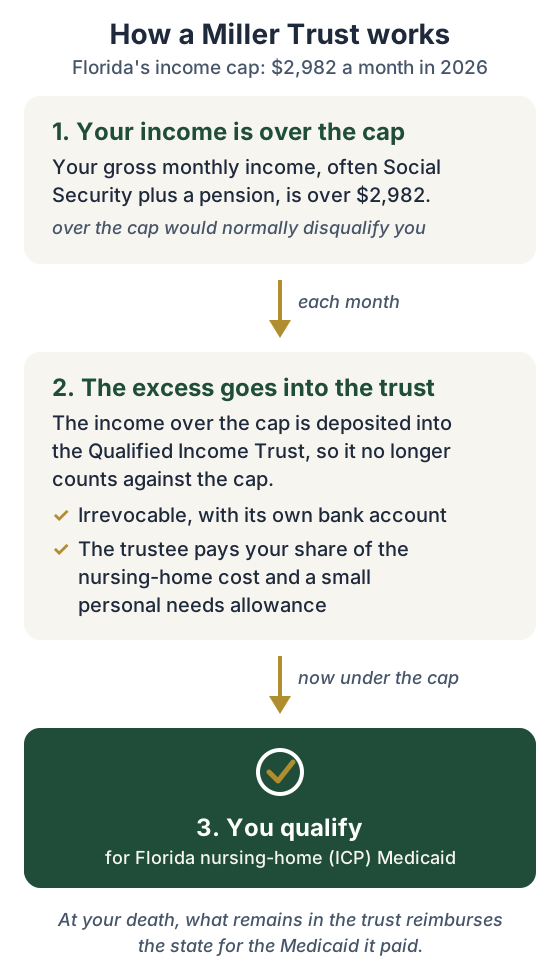
Florida is an income-cap state. To get nursing-home (ICP) Medicaid, your gross monthly income has to be at or under the cap, about $2,982 a month in 2026. If your Social Security and pension push you over, a Qualified Income Trust (also called a Miller Trust) is the fix. Each month the excess income flows through the trust, so it no longer counts against the cap, and you qualify. Being over income is rarely the real barrier. The trust is the standard, routine solution.
How It Works
- Each month, enough of your income is routed through the trust to bring your countable income under the cap.
- The trustee uses those funds under strict rules, generally for your share of the nursing-home cost and a small personal needs allowance.
- The trust must be irrevocable and set up correctly, with its own bank account.
- At your death, what remains reimburses the state for the Medicaid it paid.
Because it deals with income rather than transfers, it does not trigger the five-year look-back, so it can be set up quickly even in a crisis.
Told a parent is "over the income limit"?
Being over the limit is not a wall. Book a No-Cost Phone Consult with Attorney Kevin D. Klagge, Esq., and we will set up the Miller Trust and move the Medicaid application forward.
Book a no-cost consultIncome Trust vs. Asset Protection Trust
Do not confuse the two. A Qualified Income Trust handles your monthly income to get you under the income cap. A Medicaid asset protection trust handles your assets, the home and savings, to protect them from spend-down. The two solve different problems, and some families need both. We sort out which applies as part of Medicaid planning, and you can check your numbers first.
| Qualified Income Trust | Medicaid asset protection trust |
|---|---|
| Deals with income, the monthly money coming in | Deals with assets, the home and savings |
| Gets you under the income cap | Protects them from spend-down |
What It Costs
We prepare a Qualified Income Trust for a flat $750, including the document and getting the trust bank account set up correctly, since a small error can stall a Medicaid approval. The fee is modest next to coverage worth thousands of dollars a month. We can do it on its own or as part of a full Medicaid application. Check eligibility →
The Bank Account Is Where Applications Stall
The trust document is the easy half. In practice, most of the delay we see on these comes from the account rather than the paperwork.
The trust needs its own bank account, separate from every other account the applicant has. Money has to actually move into it each month, in the right amount, and that has to start in the month you want coverage to begin. A trust that exists on paper but was never funded does nothing at all, and a month with no deposit is a month you were over the cap.
Two practical problems come up constantly. Some banks do not know what a Qualified Income Trust is and will try to open the wrong kind of account, and the person who has to run this every month is often the same adult child who is already managing a nursing-home admission. Getting the account opened correctly and the rhythm established is most of what we are doing for the fee.
When Does a Miller Trust Have to Be Set Up and Funded?
The question I get most about this is, "Can we still do this after Mom is already in the nursing home?" Yes, and the trust works from the month it is funded forward, never backward. Florida counts a month as covered only if the income went into an executed trust account during that same month, and the state's own review checklist says a trust cannot be funded for a month that has already passed. A parent admitted on the 24th with a trust funded the following month has one month at the private rate, which for a Florida nursing home runs about $10,300 in 2026. The deposit can start before the state's legal counsel has approved the document, so the calendar sets the deadline and nothing else does.
What Expenses Can Be Paid From a Qualified Income Trust?
Money goes into the trust to clear the income cap, and then it comes back out in an order Florida sets by rule. Families ask me what the trustee is allowed to pay, and the honest answer is that the trustee has very little discretion. The order is prescribed.
Once someone is eligible for the nursing home program, hospice, PACE or the long-term care managed care program, the Department works out what I hear families call the bill and Florida calls patient responsibility, meaning the amount the state reduces its payment to the facility because the resident is contributing it. Patient responsibility is what is left after a fixed list of deductions.
| Deduction, in order | What it is |
|---|---|
| Personal needs allowance | $130 a month is protected for a resident of a medical institution or intermediate care facility. Someone electing hospice in the community has an amount equal to the federal poverty level protected instead |
| A spousal allowance | Where a spouse is still living in the community, an income allowance is computed for that spouse under the federal formula |
| Incurred medical and remedial expenses | Costs not covered by a third party, which must be medically necessary, recognized in state law, incurred no earlier than the three months before the month of application, and not already paid under the Medicaid State Plan |
| Everything left | Goes to the facility as patient responsibility |
I read the $130 out loud, because I have never had a family accept it the first time. That is the entire monthly amount a nursing home resident keeps for haircuts, clothing, a phone and anything else personal.
Avoid treating the trust account as a general checking account. I tell every trustee the same thing, which is that they pay the prescribed items and the facility and nothing else, because a distribution outside that list surfaces at a review with no way to put it back.
Who Gets What Is Left When You Die
The state does, up to the total Medicaid paid on the person's behalf. Federal law requires a trust of this kind to say so in the document itself, which is why you cannot draft around it and why a template that leaves the clause out will be rejected.
Families who assumed anything left over would pass to the children are surprised by that rule. In practice the balance is usually small, because the trust is designed to pass income through to the cost of care each month rather than accumulate. The rule is still worth knowing before you sign, because it is the one part of the arrangement people feel misled about later if nobody mentioned it.
Does a Qualified Income Trust File a Tax Return?
Usually the income is still reported on the individual's own return rather than on a return for the trust, because of the way these trusts are structured for tax purposes. The money is the applicant's income and it stays theirs for tax purposes even while it passes through the trust.
Separately from the tax question, the bank may ask for a taxpayer identification number to open the account. Needing a number for the bank is not the same as owing a separate filing, and the two get conflated constantly.
Tax filing depends on the specific facts and on what else the person has, so confirm the treatment with whoever prepares the return before assuming. We flag it at the consult and coordinate with your accountant rather than guess.
Is There an Official Florida Form?
No state form makes a Qualified Income Trust valid. What decides it is whether the document satisfies the federal requirements for this kind of trust, including that it is irrevocable, that it is composed only of the person's income, and that the state is repaid at death.
Downloaded templates cause trouble for that reason. A form drafted for another state's rules, or a generic income trust that omits the repayment language, can be rejected during the application, and the rejection usually arrives when the family is already weeks into a nursing-home bill. The document has to match Florida's program and the federal requirements at the same time.
A second reason to be careful about who prepares one comes from the Florida Supreme Court. In 2015 the Florida Supreme Court held that preparing a qualified income trust is the unlicensed practice of law when a non-lawyer does it, while filling out the Medicaid application itself is not.
Frequently Asked Questions
What Is a Qualified Income Trust (Miller Trust)?
A qualified income trust is a simple trust that lets someone qualify for Florida nursing-home Medicaid even though their income is over the limit. Florida is an "income-cap" state, so income above the cap (about $2,982 a month in 2026) would normally disqualify you. Each month, the excess income is deposited into the Qualified Income Trust, which means it no longer counts against the cap, and you qualify. The same trust is also called a Miller Trust, and it is one of the most common tools in Florida Medicaid planning.
Who Needs a Miller Trust in Florida?
Anyone applying for nursing-home (ICP) Medicaid whose gross monthly income exceeds the cap. That includes a lot of people whose Social Security and a pension together push them just over the line. Being "over income" feels like a wall, but it is not. The Miller Trust is the standard, well-established fix, and it does not require you to be wealthy or to give anything up. If your income is over the cap, you almost certainly need one.
How Does the Money Work?
Each month, enough of your income is routed through the trust to bring your countable income under the cap. The trustee then uses those funds under strict rules, generally to pay your share of the nursing-home cost and a small personal needs allowance. The trust must be irrevocable and set up correctly, and at your death, whatever remains is used to reimburse the state for the Medicaid it paid. We handle the setup and the bank account so it is done right.
Is a Miller Trust the Same as an Asset Protection Trust?
No, and people mix them up. A Qualified Income Trust deals with income, the monthly money coming in, to get you under the income cap. A Medicaid asset protection trust deals with assets, the home and savings, and protects them from spend-down. The two solve different problems, and some families need both. We tell you which one (or both) your situation calls for.
What Does It Cost to Set Up?
We set up a Qualified Income Trust for a flat $750, including the trust document and getting the trust bank account established correctly, because a small setup error can hold up a Medicaid approval. It is a modest cost for the tool that opens up Medicaid coverage worth thousands of dollars a month. We can prepare it as part of a Medicaid application or on its own.
Can You Set It Up Quickly if Care Is Already Needed?
Yes. Miller Trusts come up most often in crisis situations, when a parent is already entering or in a nursing home and the family needs Medicaid now. The trust can be put in place promptly, and unlike asset planning, it does not run into the five-year look-back, because it deals with income, not transfers. If you are racing a nursing-home bill, this is one of the fastest pieces to handle.
What Expenses Can Be Paid From a Qualified Income Trust in Florida?
The trustee has very little discretion, because Florida prescribes the order. After eligibility, the Department calculates patient responsibility by applying a fixed list of deductions to the income. A personal needs allowance of $130 a month is protected for a resident of a medical institution or intermediate care facility, and someone electing hospice in the community has an amount equal to the federal poverty level protected instead. Where a spouse remains in the community an income allowance is computed for that spouse. Incurred medical and remedial care expenses not payable by a third party are deducted, provided they are medically necessary, recognized in state law, incurred no earlier than the three months before the month of application, and not already paid under the Medicaid State Plan. Whatever remains goes to the facility.
Is a Miller Trust a Good Idea?
For someone over Florida’s income cap who needs nursing home Medicaid, it is less a choice than the mechanism. Florida is an income-cap state, so income above the cap disqualifies an applicant outright, and the qualified income trust is the route the federal statute provides for exactly that situation. It costs a modest fixed sum against coverage worth thousands of dollars a month, it does not require giving anything away, and because it handles income rather than transfers it does not trigger the five-year look-back. The honest caution is the remainder. Whatever is in the trust at death goes to the state up to what Medicaid paid, and families who expected a balance for the children should hear that before they sign.
Do I Need a Lawyer to Set Up a Miller Trust?
The document is rarely what fails. Our review of the Department’s published hearing decisions on income trusts found almost nothing lost on the terms of the trust itself, and the failures concentrated in two other places. The first is authority, where an agent under a power of attorney created the trust without the specific power to do it, which is a defect that cannot be cured afterward and cannot be cured at all once the person has died. The second is the money, where months of coverage were lost over shortfalls of a few dollars, a transfer initiated on the last day of the month that posted on the first of the next, and a trust that sat executed and unfunded. There is no de minimis tolerance. That is the work worth paying for, rather than the drafting.
Sources of Law
- 42 U.S.C. §1396p(d)(4)(B): Qualified Income Trust (Miller Trust) for income-cap states. Florida ICP income cap (about $2,982/month, 2026; figures change each January). (retrieved 2026-07-11)
- Florida DCF/ESS Policy Manual (income-cap and QIT treatment). Fla. Stat. ch. 736 (Florida Trust Code).
- The requirements described in the sections on the remainder and on the absence of a state form come from 42 U.S.C. §1396p(d)(4)(B), which conditions the treatment on a trust composed only of the individual's income and providing that the State receives all amounts remaining at death up to the total medical assistance paid. There is no Florida-issued form that makes such a trust valid; what controls is whether the document satisfies those requirements and Florida's program rules.
- Duty to advise and same-month funding: Forman v. Department of Children and Families, 956 So. 2d 477 (Fla. 4th DCA 2007) (denial of ICP benefits for the four months before the income trust was funded reversed, where the Department's specialist never advised the family of the requirement; DCF ESS Policy Manual §1840.0110). Funding in the month received and no retroactive funding: DCF ESS Appendix A-22.1. Trustee quarterly statements: Fla. Admin. Code r. 65A-1.702(13)(d). Read in full from the official opinion text (retrieved 2026-09-03).
- Post-eligibility treatment of income, which governs what comes back out of the trust: Fla. Admin. Code R. 65A-1.7141 (after eligibility for Hospice, ICP, PACE, iBudget or SMMC-LTC the Department determines patient responsibility, being the amount AHCA reduces its payments toward the cost of care, based on the income remaining after deductions applied pursuant to 42 C.F.R. §§435.725 and 435.726); (1)(a) (a personal needs allowance of $130 for individuals residing in medical institutions and intermediate care facilities); (1)(b) (individuals electing hospice services have an amount equal to the federal poverty level protected as their personal needs allowance); the community spouse income allowance computed under §1924 of the Social Security Act and Fla. Admin. Code R. 65A-1.716; and the deduction for incurred medical or remedial care expenses not subject to third-party payment, which must be medically necessary as specified in the Florida Medicaid Definitions Policy, recognized in state law, incurred no earlier than the three months preceding the month of application, and not paid under the Medicaid State Plan. Also Fla. Admin. Code R. 65A-1.701(57) (definition of Qualified Income Trust, requiring a trust consisting of only the individual's pension, Social Security and other income, irrevocable, with the State receiving amounts remaining at death up to the total medical assistance paid). Rule text from the verbatim chapter 65A-1 pull in the firm research repository, taken from the Cornell LII Florida regulations mirror on August 31, 2026, with flrules.org as the official source. ⚠ Administrative rules and dollar figures change; confirm the current rule before relying on a figure. (added 2026-09-15)
- Reading note on where these trusts fail: the statements about the concentration of failures come from the firm's own review of the Department's published administrative hearing decisions mentioning income trusts, held in the research repository. Those decisions are described rather than quoted, and they are administrative determinations on particular records rather than precedent. Nothing in that review predicts the outcome of any application. (added 2026-09-15)
- Reading note on tax treatment: whether a separate return is required turns on the individual's own facts, and a taxpayer identification number obtained so a bank will open the account is not the same thing as a filing obligation. Confirm the treatment with the return preparer rather than relying on a general statement. (added 2026-08-30)
What One Florida Case Shows About Funding a Miller Trust
I check the bank account and the monthly deposit, because that is where I have seen most of these actually fail. The trust itself runs a few pages and its terms are set by federal law, so the drafting is the smaller half of the work. The half that decides whether Medicaid pays is whether the income lands in the trust account in the right month, every month.
I walk clients through that sequence because of a case I have reviewed from the Fourth District, decided in 2007, about a 90-year-old woman with no savings and one pension check of $1,904 a month. In the spring of 2005 her doctors said she needed a skilled nursing facility, and her daughter started the Medicaid application, sending the state's case specialist every document the specialist asked for. On August 24, 2005 her mother moved into a Boca Raton nursing home as a Medicaid-pending resident. That same month the daughter opened a checking account whose only purpose was to receive the pension by direct deposit, and when the September check landed she sent every dollar of it to the nursing home (which is exactly what the trustee of a Miller trust would have done). Nobody at the state agency had mentioned an income trust. In December the specialist told her the application was denied for August through November, because the pension had never gone into an executed income trust account in the month it was received. The daughter set one up immediately, and her mother was approved from December forward. The four months before that stayed with the family, the family had no money, and the nursing home said it would discharge a 90-year-old woman unless the bills were paid. A hearing officer upheld the denial. The appeals court reversed it, because the state's own manual required its specialist to warn the family that no month counts unless the income goes into an executed trust that same month, and because the daughter had built the same arrangement in substance with her checking account. An executed trust and a bank account opened in August 2005 would have made every one of those four months a Medicaid month. We prepare that trust for a flat $750, document and account included, and the deposit schedule is the part I check before anything else.
In reading that opinion beside the state's own review checklist, I have a few take-home points.
The first is the month. Florida excludes the income only from the month it is placed in the trust, and the state's checklist says a trust cannot be funded for a month that has already passed. A trust signed and funded on the 3rd covers that month, and a trust signed on the 3rd and funded the following month leaves the first month on the family at the private rate. The practice pointer is that the account is opened and the first deposit lands in the same month the application is meant to start, and the manual allows that deposit before the state's legal counsel has approved the document, so nobody waits for the approval letter to start funding.
Second, the caseworker's duty to advise is real, and it is what saved that family on appeal, a year and a half and a hearing after the denial. Nobody should plan on it, and I treat that duty as a backstop rather than a plan. The practice pointer is that the family owns the calendar. The trust, the account and the first deposit come before the application goes in, so the approval never depends on what a specialist remembered to say.
Third, the account has one depositor. A trust that holds anything other than the applicant's own income fails entirely, so a joint account with a child, a deposit of a spouse's Social Security, or a lump sum moved in to tidy things up disqualifies it, and the state's rule makes the trustee's quarterly statements a duty rather than a courtesy. The practice pointer is one account in the trust's name, funded only by the applicant's own checks, with a statement kept every quarter. Avoid the arrangement in that case, a plain checking account that forwards the pension to the nursing home, because it does everything a Miller trust does except count, and that family learned the difference four months and a discharge notice later.
What the opinion does not say is what those four months cost in dollars, because the nursing home's rate is not in it, and it promises nothing to the next family, since the reversal turned on a manual provision and a specialist who never mentioned the trust. A family that was told about the trust and still missed the month has no such argument. I will tell you at the consult whether a missed month can be recovered, and most of the time the honest answer is that it cannot.
Kevin D. Klagge, Esq., admitted in Florida since 2012. Each case described above is a decision of a Florida court rather than a matter handled by this firm. Past results do not guarantee a similar outcome.
Updated on September 15, 2026. Reviewed by Kevin D. Klagge, Esq., Fla. Bar No. 99502. General information about federal and Florida law, not legal advice; 2026 Medicaid figures change annually and eligibility turns on your facts. No attorney-client relationship is created. Do not send confidential information until we have agreed to represent you.
More Guides on Florida Medicaid Planning
- Florida Medicaid Share of Cost and Medically Needy
- Does Florida Medicaid Check Your Bank Account?
- Florida Medicaid Community Spouse
- Can a Postnup Help With Medicaid Planning in Florida?
- Florida Gift Tax Calculator
- How Much Does Assisted Living Cost in Florida?
- Does Medicaid Pay for Assisted Living in Florida?
- Can You Have Medicare and Medicaid at the Same Time?