The Short Answer
A Florida Community Property Trust lets a married couple agree to treat what they put inside it as community property, the shared form of ownership used in states like Texas and California. Florida is not naturally a community-property state, so this is a choice you opt into, and couples make that choice for one reason. They want the potential double step-up in basis when the first spouse dies, which can erase the capital-gains tax on assets that have grown enormously in value. The trust is a sophisticated move, and it is not for everyone, so let us walk through who it actually helps.
The Problem It Solves
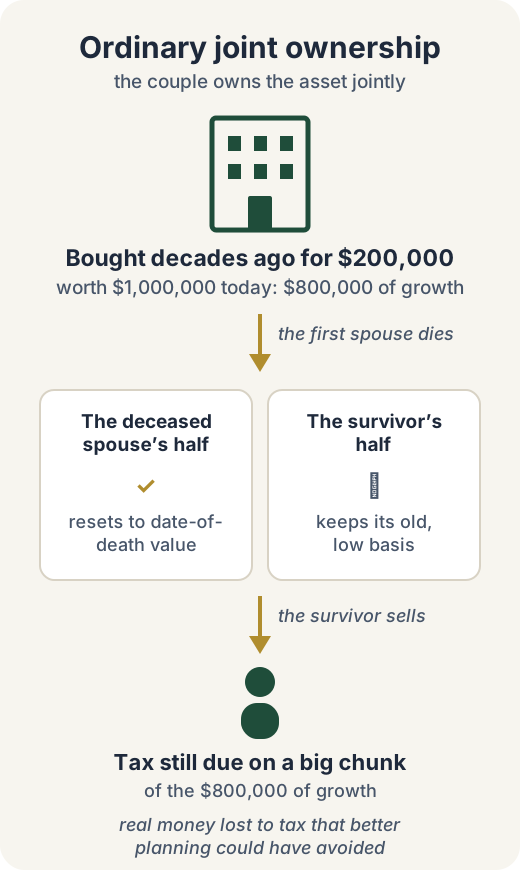
Imagine a couple bought stock, or a rental property, decades ago for $200,000, and today it is worth $1,000,000. The $800,000 of growth is a built-in capital gain, and selling it triggers tax on the gain. Here is where it stings. When one spouse dies, the normal rule resets the basis on only that spouse’s half. The survivor’s half keeps its old, low basis, so selling still owes tax on a big chunk of the growth. For couples who plan to sell appreciated assets after one of them is gone, that is real money lost to tax that better planning could have avoided.
How the Double Step-Up Works
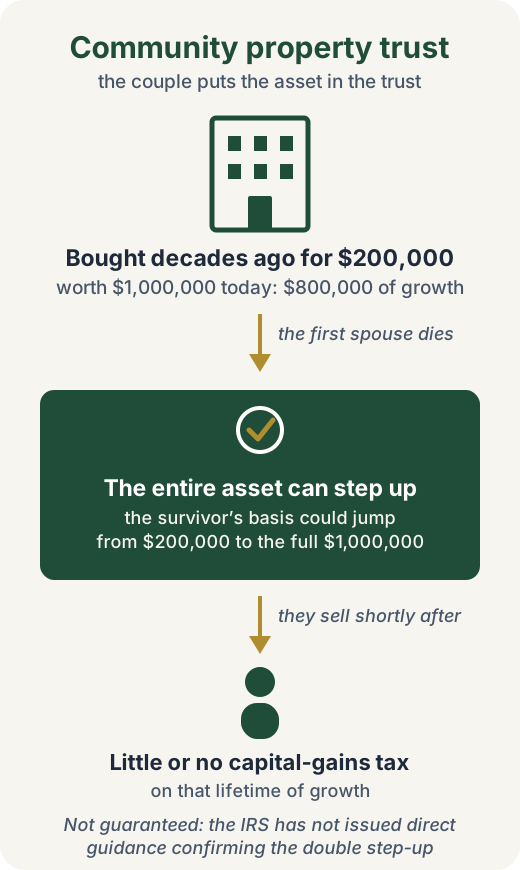
A community property trust changes the math. Because the assets inside it are treated as community property, the law can reset the basis on the entire asset, both halves, at the first spouse’s death, not just the deceased spouse’s share. In the example above, the survivor’s basis could jump from $200,000 to the full $1,000,000, so selling shortly after would owe little or no capital-gains tax on that lifetime of growth. On a large, low-basis asset, the savings can run well into six figures. The reset is the whole appeal.
Does All Real Estate in a Florida Community Property Trust Get a Stepped-Up Basis Upon Death?
A common question I hear is, “Does all the real estate in the trust get a stepped-up basis when one of us dies?” The potential reset reaches every asset the trust holds as community property on the date of the first death, both halves of it, so a rental bought for $200,000 and worth $1,000,000 is exactly the kind of property the trust exists for. Two limits apply. Property that is worth less than you paid for it gets the same reset in the other direction, so the loss disappears and the survivor inherits a lower basis, which is why a building that has dropped in value stays out. And the trust only reaches what has been retitled into the trustee’s name, so a deed that was never recorded leaves that parcel outside the trust on the day it matters. The homestead can go in. Since a 2025 amendment, moving a Florida homestead into one of these trusts keeps the homestead exemption and does not trigger a reassessment, which answers the property-tax objection, though whether the homestead belongs there is a separate conversation about creditors and a future sale of the home.
Do Both Spouses Have to Live in Florida for a Community Property Trust?
People ask me whether both spouses have to live in Florida, and the honest answer is that neither of them does. The statute says a couple may classify property as community property whether both, one, or neither of them is domiciled in Florida. What the trust needs is at least one qualified Florida trustee (a Florida resident or a company authorized to act as trustee here), and either spouse or both may serve alongside that trustee. A couple in a high-tax state can reach for Florida’s basis benefit while keeping their home and lives where they are, and because Florida has no state income or estate tax, using the tool does not add a Florida tax bill (curious what your own state’s estate tax costs? compare it with Florida). We always coordinate this with your advisors back home so the pieces fit your whole picture.
The Honest Caveat
We will not oversell this. Florida’s statute is clear about allowing these trusts, but the IRS has not issued direct guidance confirming that an opt-in community property trust delivers a double step-up in every situation. The silence leaves some risk the benefit could be questioned. For a couple with a large built-in gain, the potential savings are usually big enough to justify the strategy with that risk understood, but you should never enter it believing it is guaranteed. Anyone who promises you a certain result here is not being straight with you.
The Trade-Offs
Converting assets to community property genuinely changes who owns what. Each spouse comes to own half, which matters if a marriage ever ends in divorce, and it can change how creditors reach the property compared with other ways Florida couples hold assets. The conversion is a deliberate trade. You give up some ownership and protection features in exchange for a potentially large tax benefit. Whether that trade makes sense depends on your assets, your marriage, and your goals, which is exactly the conversation we have before anyone signs anything. The drafting matters just as much as the decision. Any trust written around a couple has to say plainly what the survivor may do once the first spouse is gone, and we wrote up a published case where a couple described everything in terms of their joint lives and never answered that question, in the two words that froze a trust.
Sitting on a big unrealized gain?
In a No-Cost Phone Consult we will run the numbers and tell you honestly whether a community property trust is worth it for your family, or whether a simpler plan wins.
Book a no-cost consultIs It Right for You?
Lean toward it when you are a married couple holding highly appreciated assets you may sell, like long-held stock, a business, or real estate bought long ago. Lean away when most of your wealth is in retirement accounts (which get no step-up at all) or in assets without much built-in gain. If you are unsure which describes you, that is normal, and it is what the consult sorts out. A community property trust often works alongside a revocable living trust and, for those who can move, a change of domicile to Florida.
What It Costs
The community property trust is custom planning, not a flat-fee form, so we quote it at the consult once we understand your assets and goals. And if the likely tax savings do not justify the cost and complexity for your situation, we will tell you, because for many couples a simpler plan is the right answer. The phone consult costs nothing. See our flat-fee planning prices →
Frequently Asked Questions
What Is a Florida Community Property Trust?
A Florida Community Property Trust is a special trust, available since 2021, that lets a married couple agree to treat the assets they put into it as community property, the way property is owned in states like Texas or California. Florida is not naturally a community-property state, so this is an opt-in choice. The reason couples do it is a single, powerful tax benefit, a potential double step-up in basis at the first spouse’s death, which can erase the capital-gains tax on assets that have grown a lot in value.
What Is the Double Step-Up in Basis?
When you die, the things you own get their tax basis reset to the value on that date, which is what spares your heirs capital-gains tax on all the growth during your lifetime. The catch for a married couple owning something jointly is that normally only the deceased spouse’s half gets that reset; the survivor’s half keeps its old, low basis. A community property trust can step up the entire asset, both halves, when the first spouse dies. On something that has appreciated a lot, that difference can be worth a great deal in saved tax.
Do I Have to Live in Florida to Use One?
No, and this is what makes it powerful for out-of-state couples. The trust needs at least one qualified Florida trustee (a Florida resident or a Florida trust company), but the couple themselves do not have to live here. That lets a couple in a high-tax state use Florida’s tool for the basis benefit while keeping their home and life where they are. The plan should always be coordinated with advice in your own state.
Is the Double Step-Up Guaranteed?
No, and we will not pretend otherwise. Florida’s statute is clear, but the IRS has not issued direct guidance confirming that these opt-in community property trusts produce a double step-up in every situation, so there is some risk the benefit could be challenged. For the right couple with significant appreciated assets, the potential savings are large enough to be worth the strategy, but it has to be entered with eyes open. We walk through that honestly before you decide.
What Are the Trade-Offs I Should Understand?
Converting assets to community property genuinely changes ownership. Each spouse comes to own half, which has real consequences if the marriage ends in divorce, and it can change how creditors reach the property compared to other ways Florida married couples hold assets. The trust is a deliberate trade of some ownership and protection features for a potentially large tax benefit. Whether that trade is worth it depends entirely on your assets and your marriage, which is exactly what the planning conversation is for.
Who Is This Really For?
Married couples who own highly appreciated assets they may eventually sell, like long-held stock, a closely held business, real estate bought decades ago, or other property worth far more than they paid. If most of your wealth is in assets with little built-in gain, or in retirement accounts (which do not get a step-up at all), a community property trust may do little for you. The trust shines when there is a big, unrealized capital gain sitting in a jointly owned asset.
Does Florida Tax Any of This?
No. Florida has no state income tax and no state estate tax, so this is purely a federal capital-gains strategy. That is part of why Florida is a useful jurisdiction to reach for, even for couples who live elsewhere. You get the tool without adding a Florida tax bill on top.
What Does It Cost to Set Up?
A community property trust is custom work, not a flat-fee form, so we quote it at the consult after we understand your assets and goals. We will also tell you honestly if the likely tax savings do not justify the cost and complexity for your situation, because for many couples a simpler plan is the better answer.
Common Situations
The long-held stock. A retired couple holds tech stock bought in the 1990s for $150,000, now worth $1.2 million. Putting it in a community property trust positions the whole position for a basis step-up at the first death, so the survivor could sell with little capital-gains tax instead of owing on a million dollars of gain.
The out-of-state couple. A married couple in Massachusetts owns a highly appreciated rental. The couple does not want to move, but with a qualified Florida trustee they can use a Florida community property trust for the basis benefit, coordinated with their Massachusetts advisors.
The family business. A couple spent thirty years building a company now worth many times what they put into it, and the survivor will likely sell after the first death. Placing the ownership interest in a community property trust positions the entire interest, not just half, for a basis step-up at the first death, so a later sale could owe far less capital-gains tax. Because the IRS has not confirmed the double step-up for these trusts, they go in with that risk spelled out in writing.
The couple we talked out of it. A pair whose wealth is mostly in IRAs comes in asking for one. Because retirement accounts get no step-up, the trust would do little for them, and we say so. The honest answer is sometimes no.
Sources of Law
- Fla. Stat. ch. 736, Part XV, §§736.1501 (annotated) to 736.1512 (annotated): Florida Community Property Trust Act (effective July 1, 2021). flsenate.gov (retrieved 2026-06-07)
- IRC §1014(b)(6): basis of community property at the death of a spouse. There is no direct IRS ruling confirming a double step-up for elective community property trusts; the benefit is well-supported but not guaranteed.
- Florida imposes no state income tax and no state estate tax.
- Johnson v. Townsend, 259 So. 3d 851 (Fla. 4th DCA 2018): a surviving spouse’s community property interest in an investment acquired in Texas was a claim against the Florida estate, barred after the 3-month claim period and the 2-year repose period. The legislature then rewrote the procedure in ch. 2024-238, now Fla. Stat. §732.2211: the dispute is a declaratory action rather than a claim, but it must be filed within 2 years after the death, and the personal representative has no duty to search unless a written demand is made within 6 months after service of the notice of administration. Community property brought from another state keeps its character inside a community property trust under §736.1511 (annotated). Homestead in the trust: §736.151 (annotated), subsection (3) added by ch. 2025-159 and expressly remedial. (opinion and statutes read in full 2026-09-03)
Has Any Court Ruled on a Florida Community Property Trust Yet?
When I say Florida courts have not decided something, it is because I have looked for the case and it is not there. I searched every reported Florida opinion for the Community Property Trust Act, and as of the date at the bottom of this page no court has construed a single section of it. The statute took effect on July 1, 2021, and the IRS has not issued a ruling on Florida’s version either. Reading the statute itself and the one Florida case that comes closest to it, I have three take-home points.
The first is the deadline that community property carries when nobody puts it in a trust. In one case I have reviewed, decided by the Fourth District in 2018, a couple had lived in Texas, where what either spouse earns during the marriage belongs to both of them, and the husband bought an investment there in his own name. He died in January 2015, his estate was opened in Palm Beach County, his will named his wife personal representative, and she published the notice to creditors herself. In September 2017, two years and eight and a half months after his death, she asked the probate court to confirm that half of that investment had been hers all along. His daughters moved to strike the petition and the court agreed with them, because her half was a claim against his estate, the three-month claim window had closed in June 2015, and the two-year bar after death had closed behind it. Under Texas law the money was hers, and under Florida procedure it went to his daughters, because nobody filed a piece of paper in time. The legislature rewrote that procedure in 2024, so a surviving spouse’s community property demand is no longer a creditor claim, but it still has to be filed as its own lawsuit within two years of the death or it is forfeited, and the personal representative has no duty to look for community property unless the spouse makes a written demand within six months of being served with the notice of administration. A Florida community property trust would have changed her position from the day it was funded. The Act says community property brought from another state keeps that character once it goes into the trust, and the trustee holds her half in the trust’s name, so there is no petition to file, no notice to publish against herself, and no deadline to miss. I quote that trust at the consult, and for a couple it usually sits on top of a trust plan that starts at $4,500. Practice pointer. A couple who moved to Florida from a community property state should decide, while both are alive, whether the property they brought goes into a community property trust or gets claimed within two years of a death, because deciding after a death means litigating it.
Second, the statute is strict about form, and the defect I look for first is the trustee. The document must say in so many words that it is a community property trust, at least one trustee must be a Florida resident or a company authorized to act as trustee in Florida, both spouses must sign it, and a warning in capital letters must sit at the top of the agreement. A couple in Massachusetts who name their Boston lawyer as the only trustee have signed a trust that fails the second requirement, and a trust that is not a community property trust under Florida law gives the federal basis rule nothing to attach to. Practice pointer. Name the Florida trustee before the trust is drafted and keep one in office for as long as the trust exists, because the requirement is written in the present tense, and a trust whose only Florida trustee has moved to Georgia raises a question no court has answered.
Third, a divorce filing starts a clock most couples never hear about. If the divorce action stays pending for 180 days, the trust terminates on its own and the trustee must hand half of the assets to each spouse, unless one spouse objects within those 180 days, the court orders otherwise, the couple agrees otherwise in writing, or the trust agreement itself says something else. The trustee also may not split a rental property or a business interest in a way that leaves the former spouses as co-owners unless they agree to that in a separate writing during the case. Practice pointer. Write the divorce paragraph while the marriage is good, with the couple deciding which spouse takes which asset, because the default is an even split with equitable distribution switched off.
Avoid funding a community property trust with property the two of you hold as tenants by the entirety, because the protection that form of ownership gives against one spouse’s creditors ends when the transfer is recorded, and a basis step-up at some future death does not pay a judgment today. What I have not seen a trust do is give a couple both benefits on the same asset, so each parcel and each account gets its own decision.
The honest limit is the one I started with. No Florida court has construed the Act, the IRS has not ruled on Florida’s version, and four other states with the same design have gone years without a challenge, which is comfort rather than an answer. I put that uncertainty in writing before a couple signs, and I will tell you at the consult whether your gain is large enough to be worth carrying it.
Kevin D. Klagge, Esq., admitted in Florida since 2012. The case described above is a decision of a Florida court rather than a matter handled by this firm. Past results do not guarantee a similar outcome.
Updated on September 3, 2026. Reviewed by Kevin D. Klagge, Esq., Fla. Bar No. 99502. General information about Florida law and federal tax, not legal or tax advice, and no attorney-client relationship is created. Tax outcomes depend on your specific facts and on federal law that may change; nothing here is a guarantee of any tax result. Do not send confidential information until we have agreed to represent you.
More Guides on Florida Revocable Living Trust
- Trust Account Requirements (Dataset)
- How to Open a Trust Account at a Bank
- Chase Trust Account: What Chase Requires
- Bank of America Trust Account
- Wells Fargo Trust Account
- Ally Bank Trust Account: How to Open One
- Dying without funding your trust
- What Assets Should Not Be in a Revocable Trust?
Try the Which Estate Plan Do I Need? (quiz).