The Short Answer
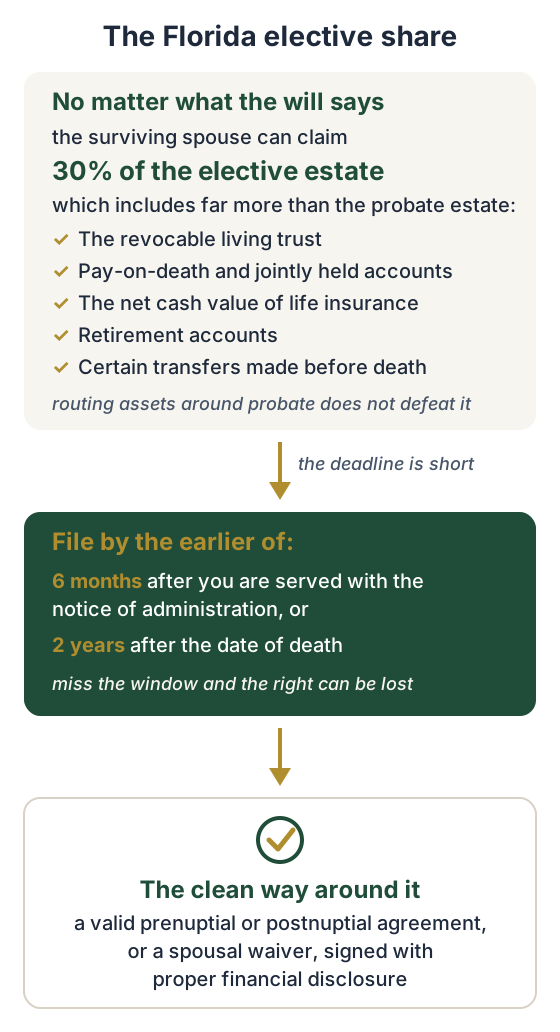
Florida law says you cannot disinherit your spouse. Even if your will or trust leaves a surviving husband or wife nothing, they can claim the elective share, 30% of the elective estate. And the "elective estate" is defined broadly, so a spouse cannot be cut out by simply moving assets into a trust or naming other beneficiaries. The elective share is one of the strongest protections in Florida estate law, and it is what families fight about most.
One threshold condition decides whether any of it applies. The right belongs to the surviving spouse of a person who dies domiciled in Florida. A snowbird who kept a New York domicile, or a parent who died domiciled abroad, leaves no Florida elective share behind no matter how much Florida property sits in the estate. Where the decedent was domiciled is the first question, and it is the one families answer wrongly most often. See how Florida domicile is established and proved.
A common question I hear is, "My husband left me nothing, is that allowed?" The will is allowed to say it, and Florida is not obliged to honor it. What the surviving spouse has to do is file an election, on a deadline, and the deadline is shorter than almost anybody expects.
Is the Florida Elective Share 30% or a Third, and Does Marriage Length Change It?
The Florida elective share is 30% of the elective estate. Not a third, and not a sliding scale. The figure does not move with the length of the marriage, so a spouse of six weeks and a spouse of forty years claim the same 30%. Several states do run a scale that starts small and climbs with the years married, which is the Uniform Probate Code approach, and Florida has never adopted it.
The vocabulary differs too, which matters when you are reading advice written for another state. Florida measures the 30% against the elective estate. New York and New Jersey measure their share against the augmented estate. The two are assembled differently, so an article about an augmented estate is not describing your Florida rights.
Practice pointer. Check which state an answer was written for before you rely on the number in it. The most common wrong figure repeated about Florida is one third, and the second is a percentage scaled to the length of the marriage, which describes a different state’s statute entirely.
What Counts: It’s Not Just Probate Assets
The breadth of the definition is what gives the elective share its teeth. The 30% is measured against an elective estate that includes far more than the probate estate.
- The deceased spouse’s revocable living trust.
- Pay-on-death and jointly held accounts.
- The net cash value of life insurance.
- Retirement accounts.
- Certain transfers the deceased spouse made before death.
In other words, you cannot defeat the elective share by routing assets around probate. The law follows them.
Are Jointly Owned Accounts Included in the Florida Elective Share?
Yes. A joint account with right of survivorship, a pay-on-death account, a transfer-on-death registration and an in-trust-for account all go into the elective estate, and the statute says how much of each. An account the two spouses held as tenants by the entirety goes in at one half of its value. Any other survivorship or pay-on-death account goes in at the portion the deceased spouse could have withdrawn without owing anyone an accounting, and for a parent who funded the whole account and added an adult child for convenience that is usually the whole balance.
Other jointly held property follows a simpler rule. Real estate or securities held in joint tenancy with right of survivorship, or as tenants by the entirety, go in at the value of the property divided by the number of owners, so a condo titled to the deceased spouse and one child counts at half.
Two things soften this for the surviving spouse. Whatever passed to the spouse from those same accounts is applied first toward the 30 percent, and a joint account the couple held together often satisfies much of the share by itself, as the section on who pays explains below.
Does the Elective Share Apply to Annuities and Retirement Accounts?
Yes to both, with a different measure for each. Amounts payable to anyone by reason of surviving the deceased spouse under any pension, retirement or deferred compensation plan, or any similar arrangement, go into the elective estate, so a 401(k) or an IRA left to a child counts in full. Social Security and Railroad Retirement benefits are the two exceptions the statute names.
Annuities appear in the statute by name. Where the deceased spouse transferred property and kept the right to annuity payments from it, Florida treats that right as a right to the share of the income needed to produce the payment, and the property goes into the elective estate to that extent. Whether a commercial annuity with a death benefit payable to someone else counts as a similar arrangement to a retirement plan turns on the contract, and that is one to bring to the consult rather than assume either way. Life insurance works differently again, because only the net cash surrender value immediately before death counts and the death benefit above it is excluded.
How Does the Elective Share Reach an Irrevocable Trust?
An irrevocable trust is inside the elective estate when the deceased spouse kept something from it, and outside when the gift was complete and made before the marriage. Three rules decide it. A transfer made irrevocable before the marriage to the surviving spouse is excluded, and so is a transfer the surviving spouse consented to in writing. A trust funded during the marriage goes in to the extent the deceased spouse kept the right to the income or the use of the property, or a trustee other than the spouse could distribute principal back to the deceased spouse. And a transfer made in the year before death goes in whatever the trust says, beyond the gift tax annual exclusion of $19,000 per recipient for 2026 and payments made directly for medical or educational expenses.
A Medicaid asset protection trust and a spousal lifetime access trust are both irrevocable, and both are usually funded during the marriage, so the one-year rule and the retained-interest rule decide whether the surviving spouse can reach them. What a Florida irrevocable trust does covers the planning side.
Is the Florida Elective Share Ever 50 Percent?
No. The Florida elective share is 30 percent of the elective estate in every case, whatever the length of the marriage and whatever the will says. The 50 percent figure people search for comes from three other places. Several states give a surviving spouse one half under an augmented estate statute. Community property states treat half of the marital property as the survivor's own, and Florida applies that rule only to community property a couple brought in from one of those states. And Florida's own statute uses one half in two places, neither of which is the share. A tenants by the entirety account counts at half its value, and the homestead counts at half its value when the spouse takes a life estate in it or elects a half interest instead.
The homestead election is the one most often mistaken for a 50 percent elective share. Instead of a life estate, a surviving spouse may elect to take an undivided one-half interest in the home as a tenant in common, with the other half vesting in the deceased spouse's descendants. The election has to be made within six months after the death, and it is a homestead right that exists whether or not the spouse elects against the will.
The Deadline Is Short
A surviving spouse generally has to file the election by the earlier of six months after being served with the notice of administration, or two years after the date of death. Miss it and the right can be lost. If you are a surviving spouse who was left out or shortchanged, this is time-sensitive, so get advice promptly rather than waiting to see how the estate plays out.
Practice pointer. Write down the date you were served with the notice of administration, not the date of death, because the six-month clock runs from service and it is the one that usually expires first. In the cases where the right is lost outright, nobody was arguing about the merits. Everybody was arguing about a calendar.
And There’s More Than the 30%
A surviving spouse’s protections stack. On top of the elective share, a spouse may be entitled to exempt personal property and a family allowance during administration, and those come in addition to the 30%. The spouse’s homestead rights (a life estate or a half interest in the home) are separate and cannot be defeated by the will, but since 2017 the home’s value is counted inside the elective-share math. The home goes into the estate the 30% is measured against, and what the spouse receives in the home counts toward satisfying the 30%. Together they give a surviving spouse substantial rights, which is precisely why spousal-rights disputes are so common in Florida estates. The homestead side has rules of its own, so see whether you can leave your Florida home to anyone.
A surviving spouse left out, or an estate facing a claim?
Book a No-Cost Phone Consult with Attorney Kevin D. Klagge, Esq. We will tell you what the elective share is worth here and the deadline you are working against, before the window closes.
Book a no-cost consultWill a Prenup Cancel Florida’s Elective Share?
A prenuptial agreement can cancel the elective share, and Florida law names the exact wording that does it. A waiver of "all rights," or equivalent language, in the property or estate of a present or prospective spouse waives the elective share. The same phrase also sweeps in the intestate share, the pretermitted share, homestead, exempt property, the family allowance, a claim under Florida’s community-property-at-death act, and preference to serve as personal representative. One phrase carries all of them.
Two requirements decide whether the waiver holds. The document must be signed in the presence of two subscribing witnesses, which is the step people skip because an ordinary contract does not need them. Then the timing changes what else is required. A waiver signed after the wedding obliges each spouse to make fair disclosure of their estate to the other. A waiver signed before the wedding requires no disclosure at all under the spousal-rights statute.
The difference matters most when somebody is deciding whether to attack an old prenup. Under the separate statute governing premarital agreements, a missing disclosure defeats the agreement only where the agreement was also unconscionable when it was signed, and the spouse attacking it did not waive disclosure in writing, and could not reasonably have known what the other spouse owned. All three have to be true together, which is a far harder case to make than "he never showed me what he had."
Sometimes a spouse genuinely wants to leave the other less than 30%, most often in a second marriage where each has their own children. A valid prenuptial or postnuptial agreement, or a separate spousal waiver, is the clean and enforceable route. Retitling assets or moving them into a trust does not work, because the elective estate already reaches non-probate transfers. For the blended-family picture, see our guide to second-marriage prenups, and for the house specifically, whether a stepparent can keep you from inheriting the family home.
Practice pointer. Read your own prenup for the words "all rights" before you rely on it. An agreement that recites only what each spouse’s separate property is, and who each of them intends to leave it to, has not used the language the statute rewards, and what follows is a hearing decided by testimony about what the two of you meant years ago.
Who Actually Pays It
The share is a percentage of the elective estate, and the question everybody asks next is which assets get raided to fund it. Florida answers that in a fixed order, and the order matters enormously to anyone on the receiving end of a claim.
Whatever the spouse is already getting comes first. Property in the elective estate that passes to or for the benefit of the surviving spouse is applied first, along with amounts actually paid to or for the spouse from retirement plans and similar arrangements, the decedent's half of certain jointly held property, the proceeds of a life insurance policy on the decedent that somebody other than the spouse owned, property held for the spouse in a qualifying special needs trust, and interests that would have counted under one of those headings but were disclaimed.
Only if a balance remains does the law reach other people's inheritances, and it does so one class at a time.
- Class 1. The decedent's probate estate and revocable trusts.
- Class 2. Recipients of certain non-probate interests brought into the elective estate, including those the decedent could still redirect at death.
- Class 3. Recipients of all other property interests in the elective estate.
Each class is exhausted before the next is touched, and within a class the burden is apportioned among the recipients. Interests for which a charitable deduction was allowed or allowable to the decedent or the spouse under the federal gift or income tax laws are protected and sit outside this. The practical consequence is that a child who received a lifetime transfer sits behind the probate estate, and may be asked to contribute only after the estate and the revocable trust have been used up.
Practice pointer. Total what the surviving spouse already received before anybody files anything. Joint accounts, life insurance and survivor benefits are applied to the 30% first, and a family that runs the arithmetic early often finds the election is worth nothing, which ends the dispute before it has cost either side a retainer.
Electing for a Spouse Who Cannot Elect
Electing on behalf of a spouse who cannot elect comes up constantly, and it is one of the least known parts of the statute.
The right of election may be exercised by the surviving spouse, or, with the approval of the court having jurisdiction of the probate proceeding, by an attorney in fact or a guardian of the property of the surviving spouse. Before approving it, the court has to determine that the election is in the best interests of the surviving spouse during the spouse's probable lifetime.
So a spouse with dementia, or one who has had a stroke, has not lost the share by being unable to claim it. Somebody has to go to court and show the election serves that spouse rather than the people who will inherit from them, and the statutory test is deliberately framed around the living spouse rather than around the family's eventual inheritance. Where an agent under a power of attorney is considering this, the six-month clock is running against them the same way it runs against a spouse acting alone.
Getting More Time
The deadline is unforgiving but it is not the only date in the statute. Within the election period, or forty days after the termination of any proceeding that affects the amount the spouse is entitled to receive from the first-applied sources, whichever is later, the spouse or an attorney in fact or guardian of the property may petition the court for an extension. The outer wall stays in place regardless, at two years after the decedent's death.
The extension exists because the size of the share sometimes cannot be known until something else finishes, such as a will contest (its own objection is due 3 months after the notice of administration is served) or a dispute about what belongs in the estate. If a related proceeding is pending, the extension petition belongs on the calendar early rather than at the end.
When It Becomes a Fight
Elective-share disputes are common, especially in blended families. A surviving spouse asserts the claim, and children from a prior marriage, or the estate, contest the amount or the validity of a waiver. Because Kevin litigates probate and trust disputes in court as well as drafting the plans, we can represent a surviving spouse claiming the right, or an estate defending an overreaching claim, and give you a straight read on your position.
Frequently Asked Questions
What Is the Florida Elective Share?
It is a surviving spouse’s legal right to claim a share of the deceased spouse’s estate regardless of what the will or trust says. In Florida the elective share is 30 percent of the "elective estate." The point of the law is that you cannot disinherit your spouse; even if your will leaves them nothing, they can elect to take their 30 percent. It exists to protect a surviving husband or wife from being cut out.
How Much Is the Elective Share in Florida?
Thirty percent of the elective estate. What makes it powerful is how broadly the "elective estate" is defined. It is not just the probate assets. It also reaches into the deceased spouse’s revocable living trust, pay-on-death and jointly held accounts, the net cash value of life insurance, retirement accounts, and certain transfers made before death. So a spouse cannot dodge the elective share simply by moving assets into a trust or naming other beneficiaries; the law counts those too.
Can a Spouse Really Not Be Disinherited in Florida?
Correct, not without their agreement. Unlike a child, who can be disinherited, a spouse has the elective-share right by law. The only ways to limit it are with the spouse’s consent, through a valid prenuptial or postnuptial agreement or a separate written waiver, or by the spouse simply choosing not to elect. Absent a waiver, a surviving spouse who was left little or nothing can claim their 30 percent.
What Is the Deadline to Claim the Elective Share?
Short, which is why people call quickly. A surviving spouse generally must file the election by the earlier of six months after being served with the notice of administration, or two years after the date of death. Miss the window and the right can be lost. If you are a surviving spouse who was left out or shortchanged, treat it as time-sensitive and get advice before the clock runs.
Is the Elective Share All a Surviving Spouse Gets?
No, there is more. A surviving spouse may also be entitled to exempt personal property and a family allowance during administration, and those come in addition to the elective share. The spouse’s homestead rights (often a life estate or a half interest in the home) cannot be defeated by the will, though under current law the home’s value is counted inside the elective-share calculation. Between them, Florida law gives a surviving spouse substantial protection, which is exactly why spousal rights are a frequent source of estate disputes.
How Do I Plan Around the Elective Share?
If you want to leave your spouse less than 30 percent, perhaps in a second marriage where each spouse has their own children, the clean way is a valid prenuptial or postnuptial agreement, or a properly drafted spousal waiver, signed in front of two subscribing witnesses. A waiver of ‘all rights’ is the language the statute treats as covering the elective share, and fair financial disclosure is required only where the document is signed after the wedding rather than before it. Trying to defeat the elective share by hiding assets does not work, because the law reaches non-probate transfers. We draft enforceable waivers and structure plans that respect the rules.
What if There’s a Fight Over the Elective Share?
These disputes are common, especially in blended families. A surviving spouse claims the share, and the children from a prior marriage, or the estate, contest the amount or the validity of a waiver. Because Kevin litigates probate and trust disputes in court as well as drafting the plans, we can represent a surviving spouse asserting the right, or an estate defending against an overreaching claim, and tell you honestly where you stand.
Common Situations
The second marriage. A husband’s will leaves nearly everything to his children from his first marriage and little to his second wife. She elects against the estate and claims her 30% of the elective estate, including assets he had moved into a trust. A prenuptial agreement would have set different terms by agreement.
The trust that did not dodge it. A spouse moved most assets into a revocable trust believing it kept them away from the surviving spouse. Because the trust is part of the elective estate, the surviving spouse’s 30% reached those assets anyway.
The enforceable waiver. A remarrying couple, each with grown children, sign a postnuptial agreement with full disclosure, each waiving the elective share. When one dies, the plan holds, and the estate passes as they intended without a fight.
The share already satisfied. Adult children panic when their father’s widow files for the elective share, fearing she will take 30% on top of everything else. But what passed to her outside the will counts first. Under Florida law, the joint accounts, life insurance, and other assets that already flowed to a surviving spouse are applied toward the 30% before anything is taken from anyone else. Because she had already received more than the share was worth, the election added nothing. Running the numbers early spared the family a fight.
Waiving the Elective Share, and the Clause That Decides It
A spouse can give this up. Florida lets the elective share be waived wholly or partly, before or after the marriage, in a written agreement signed by the waiving spouse in front of two subscribing witnesses, and the same agreement can waive the intestate share, the pretermitted share, homestead, exempt property, the family allowance, a community-property claim and even preference to serve as personal representative. No extra consideration is required beyond signing.
Two details decide almost every fight about one of these agreements.
The first is disclosure, and it runs against instinct. Fair disclosure of each spouse's estate is required where the agreement is signed after the marriage, and no disclosure is required where it is signed before. So a postnuptial waiver is held to more than a premarital one. The comparison is worked through here.
The second is the catch-all, and it is the one that surprises lawyers as well as clients. Unless the waiver says otherwise, a waiver of "all rights," or equivalent language, in the other spouse's property or estate is a waiver of all rights to the elective share. An agreement that never uses the phrase can still have waived it.
A Florida appellate court applied exactly that in 2006. A widow filed her election, her husband's children objected on a prenuptial agreement that waived her rights in his separate property without ever naming the elective share, and the court held the agreement operated as a waiver. The clause was found ambiguous, which let the trial judge hear her testify about what she had intended when she signed years earlier, and she lost the election anyway.
The practical reading is that the absence of the words proves nothing in either direction. A broadly worded clause is doing more than a client expects, and a clause that carefully lists equitable distribution and alimony and stops may be doing less.
Waiving Homestead Is a Different Question Again
Homestead appears twice in Florida law and the two do not behave the same way, which is where advice about waivers most often goes wrong.
The restriction on who you may leave the home to, and the surviving spouse's rights in it, sit alongside the elective share and can be waived in the same agreement. Where a spouse has waived homestead rights in an antenuptial agreement, the Florida Supreme Court has treated the owner as free to devise the homestead even when survived by that spouse and adult children.
The protection of the home from forced sale by creditors is the other homestead, and it is not waivable the same way. The Florida Supreme Court declined in 2007 to let a debtor waive that exemption in an ordinary contract, describing the argument for changing course as a slim reed on which to recede from a hundred and twenty three years of precedent. A mortgage can reach the home. A retainer agreement cannot.
So a spousal waiver and a creditor waiver are separate instruments doing separate work, and an agreement that waives one has not touched the other. Florida homestead creditor protection covers the second.
How the 30 Percent Is Actually Calculated
The percentage is the easy part and the pool is where the work is. The elective share is 30 percent of the elective estate, and the elective estate is defined far more broadly than the assets that pass under the will.
That single design choice is why the ordinary planning moves do not defeat it. Retitling assets into a revocable trust, adding a beneficiary designation, and holding accounts jointly are all sensible steps and none of them removes an asset from the calculation by itself. Anyone estimating the number from the probate estate alone is estimating the wrong number, usually by a lot.
The 30 percent runs on net value. Claims paid or payable from the elective estate are deducted, and mortgages, liens and security interests come off the property they encumber to the extent they were not already deducted as claims. The homestead is valued the same way, net of any mortgage the deceased spouse was liable for. So a $600,000 house carrying a $400,000 mortgage contributes $200,000 to the elective estate, and the share is figured on that.
If You Moved to Florida With a Plan From Another State
The elective share catches movers hardest, because it is Florida law applying to a plan that was never written for Florida. A will drafted in New Jersey or Illinois is still a valid will here, and the 30 percent claim attaches anyway once you are domiciled in Florida. The couples most exposed are the careful ones, where each spouse wrote a will protecting their own children from a first marriage and both believed the matter was settled. Two wills say the same reasonable thing and neither one stops the election. What changes when you move to Florida, and the fix, works through the whole review, including why an out-of-state prenuptial agreement is usually not defeated by Florida's witness rule and is often defeated by its own silence.
What Decides These Cases Is Usually the Wording, Not the Money
In 14 years of law practice, the elective-share call that worries me is not the one from a spouse who was left out. A spouse who was left out has a statute on their side and a number attached to it. The call that worries me comes from the adult children, holding a prenuptial agreement they were told solved this, asking me to confirm it did.
I read the Florida cases on spousal waivers rather than relying on a summary of them, and the pattern is consistent enough to plan around. The agreements that fail are almost never the unfair ones. The agreements that fail are the ones that described the property carefully and never used the words the statute actually names.
One case I have reviewed shows how thin the margin is. A couple lived together for eleven years and then married in 2002. Before the wedding they signed a prenuptial agreement, and her own attorney drafted it. The agreement said his property stayed his, and it named his two children as the people he intended to receive it. A matching paragraph said her property stayed hers and named her son. The agreement never used the phrase "elective share" and it never used the phrase "all rights," which is the wording the Florida statute singles out.
After he died she filed to take the elective share. His children objected. Because the agreement could honestly be read two ways, the judge let her testify about what she had understood when she signed it, and she answered the way a truthful person answers. She had understood that her son would receive her property and that his children would receive his. Her own answer decided the case. The court held she had waived the elective share, the appellate court affirmed, and she kept the house they had lived in and a joint account holding $15,000.
I have come across a case that runs the same question the other way, and the pair is the reason I draft these the way I do. A second wife and the adult children of a first marriage, again, with an agreement signed before the wedding. This one contained a release clause saying that each party releases all claims or demands in the property or estate of the other, however and whenever acquired, including future acquisitions. The widow challenged the will anyway. She lost on summary judgment in 2025, and the appellate court affirmed, holding she had no standing to contest it at all.
Set the two side by side and the lesson is not about who deserved to win. Both surviving spouses ended up without the share. One of them got there after an evidentiary hearing in which she had to testify about conversations from years earlier, and an appeal on top. The other was decided on the documents. The release clause did not change the outcome. It changed whether anybody had to hold a trial to reach it, and a trial is the part the family pays for.
Reading that outcome from the drafting side is what changed how I write these. Nobody in that case behaved badly. Her lawyer wrote the agreement, both of them understood the bargain, and the document still cost a hearing, an appeal and four years to interpret because it recited intentions instead of using seven words the legislature had already blessed.
Avoid assuming that a signed prenup has settled this. In my practice the question I ask first is not whether an agreement exists but whether it uses the statutory language, was signed in front of two subscribing witnesses, and was signed before or after the wedding, because the answer to the last one changes what a challenger has to prove.
Kevin D. Klagge, Esq., admitted in Florida since 2012. Any case described above is a decision of a Florida court rather than a matter handled by this firm. Past results do not guarantee a similar outcome.
Sources of Law
- Fla. Stat. §732.2065: the elective share is 30% of the elective estate. §§732.2035 and 732.2045: what is included in (and excluded from) the elective estate. flsenate.gov (retrieved 2026-06-08)
- Fla. Stat. §732.2135: time to file the election (the earlier of 6 months after service of the notice of administration or 2 years after death). §732.702: waiver of spousal rights.
- Fla. Stat. §732.702: waiver of spousal rights. Subsection (1) requires two subscribing witnesses and treats a waiver of “all rights” or equivalent language as waiving the elective share. Subsection (2) requires fair disclosure only where the waiver is executed after marriage. Fla. Stat. §61.079(7): enforcement of premarital agreements, where absent disclosure defeats the agreement only in combination with unconscionability at execution. Verified against the 2025 statute text 2026-09-01.
- Fla. Stat. §732.201: the right belongs to the surviving spouse of a person who dies domiciled in Florida. Verified against the 2025 statute text 2026-09-01.
- De Holguin v. Holguin Lourido, No. 3D24-0014 (Fla. 3d DCA Sept. 17, 2025) (slip op.): an antenuptial agreement releasing “all claims or demands in the property or estate of the other, however and whenever acquired,” left the surviving spouse without standing to contest the will, decided on summary judgment. Grounds for invalidating a marital agreement are set out in Casto v. Casto, 508 So. 2d 330 (Fla. 1987). Not final until disposition of any timely rehearing motion. Read in full 2026-09-01.
- Weisfeld-Ladd v. Estate of Ladd, 920 So. 2d 1148 (Fla. 3d DCA 2006): a prenuptial agreement that recited each spouse’s intent for their separate property, without using “elective share” or “all rights,” was ambiguous, so parol evidence was admitted and the surviving spouse’s own testimony supported a finding that she had waived the elective share. Read in full 2026-09-01.
- Fla. Stat. §732.2035(3) (pay-on-death, transfer-on-death, in-trust-for and survivorship accounts, with entireties accounts at one half), (4) (other joint property at the value divided by the number of tenants), (6) (retained income, use or discretionary principal, with the annuity rule), (7) (net cash surrender value of life insurance), (8) (pension, retirement and deferred compensation plans, excluding Social Security and Railroad Retirement), (9) (transfers in the year before death, with the medical, educational and annual exclusion carve-outs); §732.2045(1)(a), (c), (d), (f) (transfers irrevocable before the marriage, transfers made with the spouse's written consent, insurance proceeds above cash value, the decedent's half of community property); §732.2055(1)(b) and (6) (mortgages, liens and claims deducted); §732.401(2) (the surviving spouse's election of an undivided one-half interest in the homestead, within 6 months after death). Read from the 2026 Florida Statutes in elder/will/ch-732-2026.md (2026-10-19).
- Separate spousal protections: homestead (Fla. Const. Art. X, §4; §732.401), exempt property (§732.402), family allowance (§732.403).
Updated on October 19, 2026. Reviewed by Kevin D. Klagge, Esq., Fla. Bar No. 99502. General information about Florida law, not legal advice, and no attorney-client relationship is created. Elective-share outcomes depend on the specific facts and on strict deadlines. Do not send confidential information until we have agreed to represent you.
More Guides on Florida Probate
This guide is part of Florida Probate.
- Disclaiming an Inheritance
- Estranged Parent Died in Florida: Do You Inherit Their Debt?
- Inherited House With a Mortgage or Liens in Florida
- What Happens to Debt When Someone Dies in Florida?
- Inheriting a House in Florida
- Selling a House in Probate in Florida
- Petition to Determine Homestead Status
- What Property Is Exempt From Probate
Try the Florida Probate Cost Calculator.