What Is a Prenup?
A prenup, short for prenuptial agreement, is a written contract two people sign before they marry that sets the rules for their money if the marriage ends in divorce or at a death. Florida law calls it a premarital agreement, meaning an agreement between people about to marry, made with the marriage in mind and effective on the wedding day. In simple terms, signing a prenup means the two of you decide in advance who owns what, who owes what and what each of you can claim from the other, instead of accepting the rules Florida would otherwise apply.
A prenup works by replacing those defaults. Without one, a Florida divorce court divides marital property starting from an equal split, and a surviving spouse can claim 30 percent of the estate and rights in the home whatever the will says. With one, the agreement controls the subjects it covers and the defaults fill in only what it leaves out. The agreement binds both spouses until both sign a written change, and no agreement can set child support. What happens if you don’t sign a prenup lays out the defaults, and whether a prenup is worth it weighs them against the cost.
What a Prenup Decides
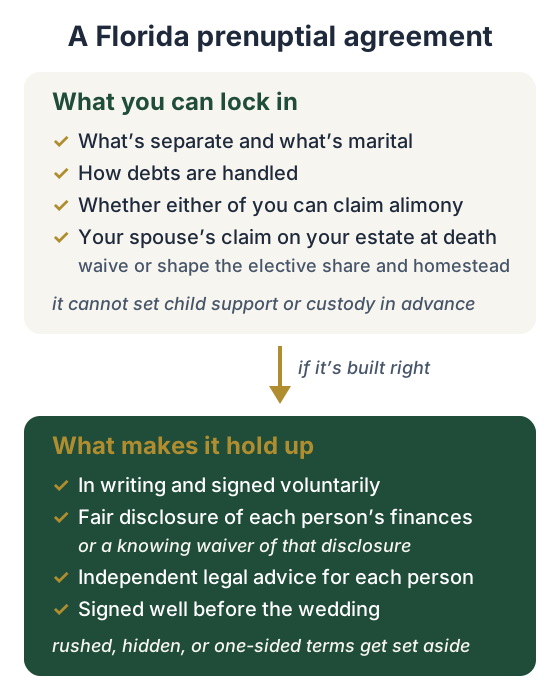
A Florida prenuptial agreement lets the two of you set the rules in advance, instead of inheriting the default ones. Under Florida law (the Uniform Premarital Agreement Act), you can decide the following.
- What’s separate and what’s marital. Keep a business, a property, or premarital savings clearly yours.
- How debts are handled, so you are not answerable for your spouse’s.
- Whether either of you can claim alimony, and how much.
- What happens at death, including waiving or shaping your spouse’s claim on your estate (see below).
What a prenup cannot do is predetermine child support or custody. Florida decides those later, by the child’s best interests, no matter what the agreement says.
The Estate-Planning Side Most Couples Miss
The estate side is the piece a divorce-only mindset overlooks. In Florida, a surviving spouse can claim roughly 30% of your estate (the elective share), plus homestead and other rights, regardless of what your will says, unless those rights were waived in a valid agreement. A prenup (or postnup) is how you waive or shape them. The waiver matters most in a second marriage, where you want to provide for your spouse and still leave the bulk to your children from a prior relationship. We coordinate the agreement with your will or trust and beneficiary designations so they do not contradict each other.
Two formalities decide whether that waiver actually works, and both come from the probate code rather than from the premarital statute. Florida lets a spouse give up the elective share, the intestate and pretermitted shares, homestead, exempt property, the family allowance and even preference to serve as personal representative, either before or after the marriage, by a written agreement signed by the waiving party in the presence of two subscribing witnesses. The premarital act asks only for writing and two signatures, and it says in terms that it does not alter the formalities required for a spousal agreement under the probate code. One qualifier matters and it is easy to miss, because the witness requirement reaches instruments signed by Florida residents, so a couple who signed in another state before moving here is not caught by it. For anyone signing in Florida, an agreement that is flawless for divorce purposes can still be two witnesses short of delivering the estate result the couple wanted.
The disclosure rule splits the same way, and it runs opposite to what most couples assume. Florida requires each spouse to make a fair disclosure of their estate when the waiver is signed after the marriage, and requires no disclosure at all for one signed before it. Full disclosure is still how we draft either one, because the divorce side of the same agreement can be attacked as unconscionable where disclosure was missing, and because a waiver nobody understood is a waiver somebody will fight about.
Side by side, here is what changes, and what does not.
| Without a prenup | With a Florida prenup |
|---|---|
| A statute or a judge decides the rules | The two of you set them in advance |
| Florida’s default rules decide what is separate and what is marital | A business, a property, or premarital savings stays clearly yours |
| Alimony is left to the default rules | You decide whether either of you can claim it, and how much |
| Your spouse can claim roughly 30% of your estate (the elective share), plus homestead and other rights, regardless of what your will says | The agreement waives or shapes the elective share and homestead rights |
| Child support and custody are decided later, by the child’s best interests | The same, since a prenup cannot set them in advance |
Protect what you built, and your peace of mind.
A No-Cost Phone Consult covers what to include, what it costs, and how to keep it enforceable.
Book a no-cost consultWho Really Needs One
- Second marriages and blended families, to protect children from a prior relationship.
- Business owners, so a divorce or death does not drag the company into a marital fight (this pairs with business succession planning).
- Anyone with an inheritance, separate property, or a big gap in assets or debts between the two of you.
Will It Hold Up?
A Florida prenup holds up when it is built right. The premarital act asks for a written agreement signed by both people, and then puts the burden on whoever attacks it later. A challenger has to prove one of three things. Either the agreement was not signed voluntarily, or it was the product of fraud, duress, coercion or overreaching, or it was unconscionable when signed and that person got no fair and reasonable disclosure, never waived disclosure in writing, and could not reasonably have known what the other person owned. The third route needs all four parts, which is why the agreements that fall are almost always the ones signed under pressure rather than the ones with hard terms. What makes a prenup invalid in Florida walks through each ground and the separate rules after a death.
Agreements get set aside when somebody was rushed into signing on the eve of the wedding, when assets were hidden, or when the terms are unconscionable. The cure is straightforward, with full disclosure, independent legal advice for each person, and signing well before the date. Every prenup we draft follows that cure.
Do We Each Need Our Own Lawyer?
Florida does not require it. Neither the premarital act nor the probate code makes independent counsel a condition of a valid agreement, and I still recommend it in every agreement that touches estate rights.
A common question I hear is, “Can one lawyer just write it for both of us?” One lawyer drafts the agreement, and that lawyer represents one of you. The other person should have their own review, and the reason sits in the list above. A challenger who wants the agreement gone has to prove it was not signed voluntarily, or that it came out of fraud, duress, coercion or overreaching. A separate lawyer on the other side of the table is the cheapest evidence available that neither of those happened.
Signing early does the same work for less money. An agreement signed months before the wedding is hard to describe as coerced, and one signed the night before the rehearsal dinner invites the argument.
How a Prenup Is Made at This Firm
A prenup drafted here goes through six steps, in this order. Each step has its own way of failing, and the steps are built around those failures.
- The consult. A No-Cost Phone Consult covers your wedding date, what each of you owns and what you want the agreement to do. The date the prenup was first raised between the two of you goes into the file that day, because the time between that date and the signing is the first thing a challenger looks at. What goes wrong. Timing sinks more agreements than terms do. In Flaherty v. Flaherty (2013), the final draft was handed over at 11:30 p.m. the night before a Las Vegas wedding, after the wife’s own lawyer had told her not to sign, and a Florida appeals court set the agreement aside for duress and coercion.
- The engagement and the fee in writing. A conflict check runs on both names before any drafting, and an engagement letter names one of you as the client and fixes the flat fee. The other person receives written notice that the firm does not represent them, with the suggestion to hire their own lawyer. What goes wrong. One lawyer ends up explaining the agreement to both people, or the side that drafted it picks the other person’s lawyer, and the other person later has an argument that nobody independent ever explained it.
- The disclosure schedules. Each of you lists every asset, debt and source of income, with a value, the date of the value and how it was reached. The schedules are dated, attached to the agreement and signed, and a written waiver of any further disclosure goes in alongside them, never in place of them. What goes wrong. An entry that says the value is unknown, or a schedule marked “to follow,” gives the other side the disclosure argument the waiver was meant to close.
- Drafting and negotiation. The draft says what stays separate, including growth on separate property, how alimony works under Florida’s 2023 alimony law (which ended permanent alimony for divorces filed on or after July 1, 2023), and what each of you gives up at death, the elective share and homestead above all. Up to two rounds of revisions with the other lawyer are included. What goes wrong. General words about growth get litigated. In Hahamovitch v. Hahamovitch, a couple with lawyers on both sides signed a broad release in 1986, and after twenty-two years of marriage the meaning of those words went to the Florida Supreme Court, which held in 2015 that they reached the growth in property titled to the husband, including growth from marital work and money.
- The signing. Each spouse signs before two witnesses who sign as witnesses and are not the other spouse, plus a notary. Every page is initialed, the schedules are attached before anyone signs, and two originals are signed so each of you leaves with one. What goes wrong. In Williams-Paris v. Joseph (2021), a couple filled in an online form on the morning of the wedding and signed before a notary alone, hours before the 4 p.m. ceremony. The Fourth District Court of Appeal noted that a notary is not a subscribing witness and that it found no law letting one spouse serve as the other’s witness.
- Afterward. Each of you keeps an original somewhere the other can find it, and the firm keeps a copy in its file. After the wedding the will, the trust and the beneficiary designations are updated to match the agreement, and retirement plan consents are signed on the plan’s own forms, because federal law counts only a consent signed by a spouse. What goes wrong. The agreement promises something at death and nobody signs the will or buys the insurance that delivers it.
Does It Travel to Other States?
Usually it does. Florida follows the Uniform Premarital Agreement Act, which most states (around 28) have adopted, and we include a Florida choice-of-law clause, so a well-drafted agreement generally travels with you. The notable exception is Louisiana, a civil-law state with its own community-property rules. If your life or assets touch more than one state, we draft for portability and flag anything that needs local review.
How Much Does a Prenup Cost at This Firm?
The firm posts three flat fees for marital agreements, so you know the number before you book anything.
| Service | Flat fee |
|---|---|
| Prenuptial agreement, drafted for one spouse | from $2,450 |
| Review of a prenup the other side drafted | from $750 |
| Postnuptial agreement, drafted for one spouse | from $2,950 |
The drafting fee covers one spouse only, because one lawyer cannot represent both sides of the same agreement and each spouse needs separate counsel. The fee includes the first draft, up to two rounds of revisions with the other spouse’s lawyer, the financial disclosure schedules, and a signing with two witnesses and a notary. Negotiation beyond those two rounds is quoted in writing before it starts.
The review fee covers a full review of the agreement and its disclosures, a written analysis in plain English that measures the agreement against Florida’s default rules, and a call with the attorney. If you have already been handed a prenup to sign, the prenup review page explains what the review checks and what it does not.
The postnup fee is higher because Florida requires fair financial disclosure before a waiver of rights at death signed after the wedding is valid, so the disclosure work is heavier than for a prenup.
Each fee is honored for 90 days from the posted date of October 6, 2026. Government costs, such as recording if any, are additional and passed through at cost. A challenge to an existing agreement, and any divorce litigation, is quoted per matter and never carries a flat fee.
Frequently Asked Questions
What Does a Florida Prenuptial Agreement Actually Do?
A Florida prenup lets you and your future spouse decide in advance what is separate property and what is marital, how debts are handled, whether either of you can claim alimony, and what happens to your property at death. Under Florida law (the Uniform Premarital Agreement Act), those choices are enforceable if the agreement is done right. With a prenup the two of you set those rules yourselves instead of leaving them to a statute or a judge. What a prenup cannot do is set child support or custody in advance, since those are always decided later by the child’s best interests.
How Much Does a Prenup Cost in Florida?
Drafting a prenup for one spouse is a flat fee from $2,450 at this firm, and reviewing an agreement the other side drafted is a flat fee from $750. A postnup is a flat fee from $2,950, because Florida requires fair financial disclosure for a waiver of rights at death signed after the wedding. Across the Florida market, prenups commonly run from a couple of thousand dollars to the mid five figures for complex estates. Recording costs, if any, pass through at cost, and a challenge to an existing agreement is quoted per matter.
Will a Florida Prenup Hold Up in Court?
A Florida prenup holds up when it is built correctly. Florida requires the agreement to be in writing and signed voluntarily, with fair and reasonable disclosure of each person’s finances (or a knowing waiver of that disclosure). Agreements get thrown out when someone was pressured into signing days before the wedding, when assets were hidden, or when the terms are so one-sided they are unconscionable. The fix is simple, with full disclosure, independent legal advice for each person, and signing well before the wedding. Every prenup we draft is built that way.
Does a Florida Prenup Work if We Move to Another State?
Usually it does. Florida follows the Uniform Premarital Agreement Act, which most states (around 28) have adopted, and a well-drafted agreement includes a Florida choice-of-law clause. So a prenup we draft generally travels with you. The main exception is Louisiana, a civil-law state with its own community-property rules. If you have ties to more than one state, we draft for portability and flag anything that needs local review.
What’s the Estate-Planning Side of a Prenup?
The estate side is the part most couples miss. In Florida, a surviving spouse can claim about 30% of your estate (the elective share) and has homestead and other rights, no matter what your will says, unless those rights were waived in a valid agreement. A prenup or postnup is how you waive or shape them, which is essential for a second marriage where you want to provide for your spouse but leave the bulk to children from a prior relationship. We coordinate the prenup with your will, trust, and beneficiary designations so they all say the same thing.
Can We Get a Prenup After We’re Already Married?
Yes, and the document is called a postnuptial agreement. A postnup covers the same ground but is signed after the wedding. A postnup is not governed by the premarital statute, so Florida courts apply contract law with extra scrutiny, because spouses owe each other a duty of fairness. Done with full disclosure and independent advice, a postnup is enforceable and is often the right tool after a business takes off, an inheritance arrives, or a second marriage begins.
Can We Change or Cancel a Prenup After the Wedding?
Yes, you can. Under Florida law, once you are married the prenup can be changed or canceled entirely, but only by a written agreement signed by both of you. A conversation, an email, or simply ignoring the agreement for years does not undo it. Couples update a prenup when life moves, when a business takes off, children arrive, or the deal you struck before the wedding no longer fits the marriage you have. We draft the amendment with the same disclosure and care as the original, so the updated version holds up too.
If the wedding has already happened, the instrument is a postnuptial agreement rather than a prenuptial one, and it reaches the same rights. The difference is that Florida requires fair disclosure of each estate for an agreement signed after the marriage and requires none for one signed before. Prenup versus postnup, side by side.
Sources of Law
- Fla. Stat. §61.079 (Florida Uniform Premarital Agreement Act). §61.079(3) (a premarital agreement must be in writing and signed by both parties, and is enforceable without consideration other than the marriage itself). §61.079(7)(a) (a premarital agreement is not enforceable in a family-law proceeding if the party resisting it proves the agreement was not executed voluntarily, or was the product of fraud, duress, coercion, or overreaching, or was unconscionable when executed and that party was not provided a fair and reasonable disclosure, did not voluntarily and expressly waive disclosure in writing, and did not have and could not reasonably have had adequate knowledge of the other party’s property or financial obligations); §61.079(7)(c) (unconscionability is decided by the court as a matter of law); §61.079(6) (after marriage, amendment or revocation only by a written agreement signed by the parties). §61.079(10) (the section “does not alter the construction, interpretation, or required formalities of, or the rights or obligations under, agreements between spouses under s. 732.701 or s. 732.702”).
- Spousal-rights waiver: Fla. Stat. §732.702(1) (the elective share, intestate share, pretermitted share, homestead, exempt property, family allowance, a community-property claim under §§732.216 to 732.228, and preference in appointment as personal representative of an intestate estate may be waived wholly or partly, before or after marriage, by a written contract, agreement, or waiver signed by the waiving party in the presence of two subscribing witnesses, the witness requirement applying to instruments signed by Florida residents after the effective date of the law); §732.702(2) (fair disclosure of each spouse’s estate required where the instrument is executed after marriage, and “[n]o disclosure shall be required for an agreement, contract, or waiver executed before marriage”); §732.702(3) (no consideration beyond execution required). History includes s. 10, ch. 2024-238. Fla. Stat. §732.7025. Elective share: §§732.201 to 732.2155. Postnuptial agreements are governed by Florida contract law. (§61.079 and §732.702 text retrieved 2026-09-08; balance retrieved 2026-06-09.)
- Process section. Flaherty v. Flaherty, 128 So. 3d 920 (Fla. 2d DCA 2013) (2002 agreement handed over in final form at 11:30 p.m. the night before the wedding, after the wife’s lawyer advised against signing; set aside for duress and coercion where the husband offered no evidence of voluntariness; a pre-Act agreement). Hahamovitch v. Hahamovitch, 174 So. 3d 983 (Fla. 2015) (a 1986 broad release of claims to the other spouse’s property, owned then or acquired later in that spouse’s name, reaches assets titled in the other spouse’s name and their enhancement from marital labor or funds), approving 133 So. 3d 1008 (Fla. 4th DCA 2014). Williams-Paris v. Joseph, No. 4D20-1760 (Fla. 4th DCA Nov. 17, 2021), n.1 (agreement signed before a notary only; the court disagreed that the two-subscribing-witness requirement of §732.702(1) was met and found no case law letting one party’s signature serve as a subscribing witness to the other’s, but did not apply the point because it was not raised below). Fla. Stat. §61.08 as amended by ch. 2023-315, Laws of Fla. (permanent alimony eliminated for petitions filed on or after July 1, 2023). 29 U.S.C. §1055(c) and Treas. Reg. §1.401(a)-20, Q&A-28 (retirement plan spousal consent must come from a spouse; an agreement signed before marriage does not satisfy it). Opinions read in full.
Related Guides
What a prenup costs in Florida · what a prenup covers · do I need a prenup? · second-marriage prenups · prenups for business owners · how to get a prenup · postnuptial agreements · what makes a prenup invalid · prenup review before you sign · does a prenup apply at death? · what happens without a prenup · is a prenup worth it? · does a prenup replace a will? · prenups, 401(k)s and IRAs · prenups for trust beneficiaries · a parents’ guide to a child’s prenup · prenups for K-1 fiancé visa couples · prenups for foreign nationals and E-2 investors · prenups for Canadian couples · a prenup signed in another state or country
What I Have Learned About Agreements That Hold
In 14 years of law practice, the prenuptial agreements that fail are almost never the ones somebody read carefully and signed anyway.
I have a few take-home points about the ones that hold.
The first is that a fight after a death is about the circumstances of signing rather than the words on the page. I have come across a case where a Florida man’s estate plan was rewritten twice during his marriage, and the detail that mattered to me was buried in the procedural history. The man had gone to court for a restraining order against his wife, alleging she had made death threats. The wills she obtained left his fortune to her, and if she did not survive him, $150,000 to her daughter from an earlier marriage and the residue in trust for that daughter’s two sons. The wife was convicted of his murder, which meant Florida treated her as having died before him, and I would not have guessed the result that followed. Her daughter and grandsons became the sole beneficiaries of his estate, because the statute that disinherits a killer reaches only the killer. His cousins, named in an earlier will, spent six years in court to get the undue influence question back in front of a judge at all.
The second point I take from that case is about timing. An estate plan signed in the middle of a marriage carries no proof at all about the state of mind of the person who signed it. When I look at a prenuptial agreement instead, I can see that both people were represented, both had disclosed, and neither was yet living with the consequences. I would rather fix the estate terms at the one moment in the whole sequence when nobody can plausibly claim pressure.
Practice pointer. Count the witnesses on any agreement signed in Florida that waives estate rights. Florida’s premarital act asks only that a prenup be in writing and signed by both people, while the probate code separately requires the waiving spouse to sign in front of two subscribing witnesses, and the probate code is what governs the waiver. The requirement reaches Florida residents, so the agreement a couple signed in another state is judged differently from the one they sign after the move. The asymmetry is worked through for people who relocated here in what changes when you move to Florida with an existing estate plan, where the out-of-state prenup is usually defeated by its own silence rather than by a missing witness. I have read agreements that would have survived a divorce and would not have delivered the estate result the couple paid for.
Avoid signing in the last week before the wedding. A challenger who can show the agreement was not signed voluntarily, or that it came out of duress or overreaching, never has to say a word about whether the terms were fair, and a signature obtained days before a booked reception is the fact that argument gets built on.
An honest limit belongs here. A prenuptial agreement binds the person who signed it and does nothing to stop a later will or deed from being attacked on its own facts, so an agreement is one part of a plan rather than the whole of it. A postnuptial agreement is measured differently again, under contract law rather than the premarital statute, and Florida does require a fair disclosure of each estate for a waiver signed after the marriage. What I tell people is that nothing on paper stops someone determined to do harm, and the case above is the proof of it.
Kevin D. Klagge, Esq., admitted in Florida since 2012. General information rather than advice on your situation.
Updated on October 6, 2026. Reviewed by Kevin D. Klagge, Esq., Fla. Bar No. 99502. General information about Florida law, not legal advice, and no attorney-client relationship is created. Each spouse should have independent counsel. Do not send confidential information until we have agreed to represent you.
More Guides on Florida Prenuptial Agreements
This guide is part of Florida Estate Planning.
Prenups and postnups
- Your Will and Beneficiaries After a Divorce in Florida
- Is an Inheritance Marital Property in Florida?
- How to Protect Your Assets in a Divorce in Florida
- What Is a Prenup?
- Can You Get a Prenup After Marriage?
- How Long Does a Prenup Last?
- Florida Prenup Template: What a DIY Prenup Leaves Out
- HelloPrenup vs a Florida Attorney
- Prenup Agreement for a House in Florida
- Can a Prenup Waive Alimony in Florida?
- Does a Prenup Protect Future Assets?
- Prenup Infidelity Clause in Florida
- My Spouse Wants a Postnup: What to Know Before You Sign
- Prenup for Women in Florida: What to Ask For
- Prenup Lawyer in Miami
Try the Which Estate Plan Do I Need? (quiz).