How Long Before You Qualify for Homestead Exemption in Florida?
Florida sets no minimum residency period for the homestead exemption. There is no 30 day rule, no 90 day rule, and no 183 day rule. Those numbers do not appear anywhere in the exemption statutes. The law asks one thing, whether you owned the home and were actually living in it as your permanent residence on one particular day.
The only duration figure anywhere in Florida’s homestead tax law is 25 years, and it belongs to a different benefit. Counties may offer an additional exemption to owners who are 65 or older, have kept the same home as their permanent residence for at least 25 years, and fall under a value limit and an income limit. That is a local senior benefit, not the exemption people mean when they say homestead.
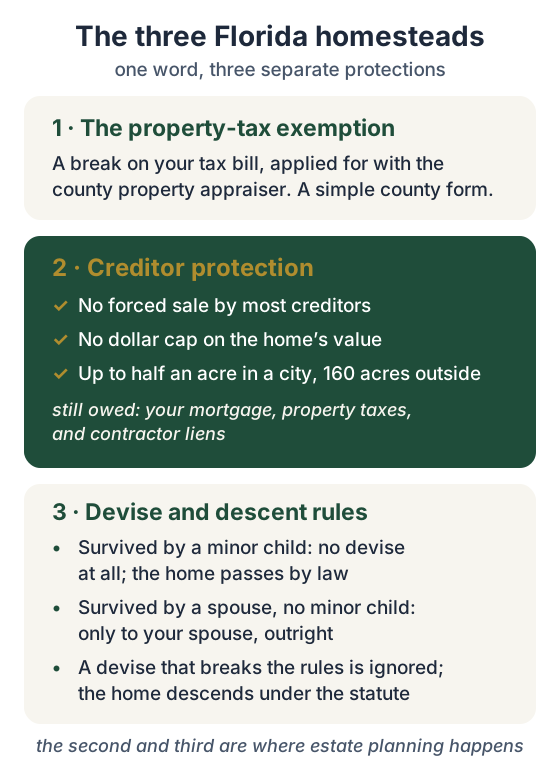
It also helps to know which homestead you are asking about, because Florida gives one word to three different protections.
The January 1 Rule, and Why It Is a Date and Not a Duration
Three things must be true on January 1. You hold legal or equitable title to the property. You actually make it your permanent residence. And you do so in good faith, meaning you intend it as your real home rather than a mailing address.
A fourth requirement catches people who buy in December. Your deed has to be recorded in the county’s official records before the exemption can be granted. A closing that funds on December 30 and records on January 3 can cost you the year.
The January 1 date is not in the Florida Constitution. The constitution says only that a person who holds title and maintains a permanent residence on the property is exempt. January 1 comes from the separate statute that fixes the assessment date for all real property in the state. That is worth knowing, because it explains why the rule is so unforgiving. Florida photographs the tax roll on one morning and taxes what it sees.
So one well timed day in December is worth more than eleven months of living here. Move from New York on December 15, 2026, record the deed, move in, and still be living there on January 1, 2027, and you can claim the exemption for the whole 2027 tax year. Move on January 2, 2027 and you generally wait for 2028.
Moving to Florida and not sure what the timing costs you?
Book a No-Cost Phone Consult with Attorney Kevin D. Klagge, Esq. We will look at your closing date, your old state, and what has to happen before January 1.
Book a no-cost consultHow to File, and What Happens If You Miss March 1
Qualifying on January 1 does not give you the exemption. You still have to apply for it, and the deadline is March 1.
You apply on Form DR-501, the Original Application for Homestead and Related Tax Exemptions. The Department of Revenue prescribes it, so the substance is the same in every county even though counties put their own branding on it and most now accept it online.
You file it with the county property appraiser. That office and no other. This is where new arrivals lose the most ground, because the declaration of domicile goes somewhere else entirely, to the clerk of the circuit court. Recording a declaration of domicile is useful evidence and it is not an application for anything. People record one, feel finished, and never apply at all.
Clients mix up those two offices constantly and often ask me, "Where do I file this?" The homestead application goes to the county property appraiser and the declaration of domicile goes to the clerk of the circuit court. Sending either one to the wrong desk costs a filing season, because nobody at the receiving office is going to forward it for you.
Three things are genuinely required. Your deed has to be recorded before the exemption can be granted. The application has to be signed and on time. And it has to carry the Social Security number of the applicant and of the applicant’s spouse.
That spouse requirement is the quiet one. The number is required even when your spouse is not on the deed and is not applying. Leave it blank and a timely application counts as incomplete. The appraiser then contacts you, and you have until April 1 to refile a complete one. Miss that and you have waived the exemption for the year after qualifying for it in every other respect. It is the most common way a properly qualified applicant loses twelve months.
Everything else the county asks for is evidence rather than a precondition. The form’s proof of residence table tracks the same factors the appraiser weighs, so it asks about your Florida driver license, your vehicle tag, your voter registration, your recorded declaration of domicile, your employer, the address on your last federal return, where your children go to school, and who pays the utilities. Counties hand that over as a checklist and it reads like a list of requirements. No single factor is required and none of them decides the question by itself, so someone who does not drive, or who cannot register to vote, is not disqualified on that ground alone.
Take the receipt when you file. Florida law makes that receipt conclusive proof that you filed on time, which is the entire argument if an application later goes missing.
Two narrow paths survive a missed deadline. The first covers postal error, where you can clearly document that your application failed to arrive because the mail failed. The second is broader and almost nobody uses it. If you missed March 1 but can show you were unable to apply on time, or can otherwise demonstrate extenuating circumstances, you may still file with the property appraiser within 25 days after the appraiser mails the annual notice of proposed property taxes. Those notices go out in August, so that window generally closes near the end of August. If the appraiser refuses, you can petition the value adjustment board within the same 25 days for a $15 fee.
The appraiser works through applications after March 1 and decides by July 1. If you are approved, you will see the exemption on the notice of proposed property taxes that arrives in August. If you are denied, the appraiser has to send a notice stating the specific statutory requirement you failed and the specific facts behind it, and has to tell you how to appeal. A notice that fails to do that is invalid, and so is the denial resting on it. You then have 30 days from the mailing of that notice to petition the value adjustment board. If the board also refuses, a further route to circuit court exists on a short clock, and the statutes are not consistent about how short, so treat that as something to confirm the day the ruling lands rather than a deadline to assume.
After the first year you do not file again, as the next section explains.
One calendar note. March 1, 2026 fell on a Sunday, so counties took filings through March 2. March 1, 2027 is a Monday, so there is no extra day next year.
Do You Have to File Homestead Exemption Every Year?
No. You file the original application once, by March 1 of the first year you qualify, and after it is granted the property appraiser mails you a renewal each year by February 1 that is accepted as proof of the exemption unless the appraiser denies it.
The confusion comes from the statute itself, whose heading reads annual application required. The body of the same statute then tells the property appraiser to send the renewal and to accept it, and it lets a county commission waive the annual renewal altogether at the property appraiser’s request. In a county that has done that, no renewal arrives at all and the exemption simply stays on the roll.
Four events do require a fresh filing. You file again when the home is sold, when the ownership changes in any way, when you stop using it as your permanent residence, and when your status changes in a way that affects the exemption. Moving to a new Florida home means a new application for the new home by the next March 1, together with the separate portability form if you want to carry your Save Our Homes savings across.
The duty that runs every year is the duty to tell the property appraiser when something changes. An owner who keeps an exemption after renting the home out or moving away faces up to ten years of back taxes, a 50 percent penalty for each year and 15 percent interest a year.
Practice pointer. A death or a deed into a trust is a change of ownership on the property appraiser’s records. The surviving spouse, heir or trustee should confirm with the property appraiser the same year, rather than assume the renewal card covers it.
If I Buy a House in Florida in 2026, When Does the Homestead Exemption Start?
A home bought in 2026 gets its first homestead exemption on the 2027 tax bill, provided you hold title and live there as your permanent residence on January 1, 2027 and file Form DR-501 with the county property appraiser by March 1, 2027. The 2026 bill, which arrives in November, reflects the roll as it stood on January 1, 2026, before you owned the home, so the exemption you apply for cannot touch it. Closing in March 2026 and closing in December 2026 land in the same place, which is the 2027 roll.
The calendar after that runs on fixed dates. The property appraiser decides applications by July 1, 2027. The notice of proposed property taxes mailed in August 2027 shows the exemption, and the November 2027 bill is the first one it reduces. That same January 1, 2027 is the date the home is assessed at just value, and the 3 percent Save Our Homes cap first limits an increase on January 1, 2028. A buyer who held a Florida homestead exemption on another home in any of the three years before can carry the accumulated savings across on Form DR-501T, filed by the same March 1.
Avoid waiting for the property appraiser to send something. Nothing arrives until you file, and a filing on March 2, 2027 is a filing for 2028 unless one of the two late paths described above applies.
How Do I Know if I Have a Homestead Exemption?
Look up your parcel on your county property appraiser’s website, where the exemptions on the current tax roll are listed with the owner and the assessed value, or read the notice of proposed property taxes the property appraiser mails every August. A granted homestead exemption appears on both, and one that was removed shows up as missing.
The property appraiser’s site searches by owner name, street address or parcel number, and it is free. The parcel page lists the exemptions applied to the current year along with the just value and the assessed value. On a home that has held the exemption for a few years, an assessed value well below the just value is the Save Our Homes cap at work, and the cap applies only to a homestead.
The August notice is often called the TRIM notice, and most new owners mistake it for junk mail. The TRIM notice shows the new assessed value, the exemptions still on the roll, each taxing authority’s proposed rate and the dates of the public hearings. The TRIM notice also starts a 25-day clock. An owner who qualified but missed the March 1 deadline because of extenuating circumstances can still file within 25 days after the notice is mailed, and can petition the value adjustment board for a $15 fee if the property appraiser refuses.
A first-time applicant also hears directly. The property appraiser decides applications by July 1 and must mail a written notice of any denial that states the reason and explains the appeal, which gives you 30 days to petition the value adjustment board. Keep the receipt from your original filing, because Florida law makes that receipt conclusive proof that you filed on time.
Avoid relying on the November tax bill to tell you. By then the 25-day window that follows the August notice has closed, and a missing exemption can wait a full year to be fixed.
What the Exemption Is Worth in 2026
There are two homestead exemptions, and they apply to different slices of your assessed value. That structure is why the savings never come out as round as people expect.
- The first $25,000 of assessed value is exempt from every levy, including school taxes.
- The next $25,000 of value is fully taxable.
- The slice above $50,000 carries the second exemption, $26,411 for the 2026 tax year, and it applies to every levy except school taxes.
Together that removes $51,411 of assessed value for 2026, up from $50,722 for 2025. The second exemption grows because Florida voters indexed it to inflation in 2024, effective with the 2025 tax roll. It adjusts each January 1 by the change in the Consumer Price Index, and only when that change is positive. The first $25,000 is fixed in the constitution and is the only part that reaches a school bill, which is why the exemption shelters less of your total tax than the headline number suggests. Figures change annually, so confirm the current amount with your county property appraiser before relying on it.
What Percentage of Florida Homes Have a Homestead Exemption?
About 53 percent. On the 2026 Florida Department of Revenue property roll, 5,251,737 parcels carry a homestead exemption out of 9,830,053 residential parcels, which is 53.4 percent. The rest are rental homes, second homes, homes owned by a company or a trust that does not qualify, and vacant residential lots, none of which can hold the exemption. The county figures, with what the Save Our Homes cap is worth to the average homestead in each, are in Florida Save Our Homes savings by county, and the 270,615 homesteads held in a qualifying trust are counted in Florida homes held in trust by county.
How Does Florida Define Permanent Residence for the Homestead Exemption?
Permanent residence has a specific legal meaning here. It is the place you treat as your true, fixed, and permanent home, the one you intend to return to whenever you are away. You can have only one at a time. And once you have established a permanent residence in another state or country, Florida law presumes it continues until you show that it changed. The burden starts against you, which is the part that surprises people arriving from a high tax state.
Whether you intended to make Florida your permanent home is a question of fact, decided first by the property appraiser. Florida law lists ten things the appraiser may weigh and says no single one settles it.
- A formal declaration of domicile recorded in the county where you are claiming the exemption
- Where your dependent children are registered for school
- Your place of employment
- Your previous permanent residency in another state or country, and the date that residency ended
- Florida voter registration, with the card address matching the property
- A valid Florida driver license or identification card, and evidence that you gave up licenses from other states
- A Florida license tag on any motor vehicle you own
- The address on your federal income tax returns
- Where your bank statements and checking accounts are registered
- Proof that you pay the utilities at the property you are claiming
Two of these deserve attention. The fourth asks when your residency in the other state ended, not how long you have been in Florida, which is the statute quietly confirming that duration is not the test. The sixth asks for a Florida driver license and, separately, for evidence that you surrendered the licenses from your other states. That surrender is the step people skip most often, and the full residency checklist covers the rest of it.
If You Are Not a US Citizen
The ten factors above are where most non-citizen owners are told the answer lies, and a Swiss couple in Charlotte County proves that they do not settle it. They lived and worked in the county for at least five years, they held Social Security numbers and Florida drivers’ licenses, they paid federal income tax, and they had recorded a Declaration of Domicile. In 2006 they lost, because they held only temporary visas. Two decades before that, a man lost the same argument after twenty years in the United States, ten of them in Florida, and six working for a local government.
So start where the law starts rather than with the checklist. The Florida Constitution asks the owner to maintain on the property the permanent residence of the owner, or the permanent residence of another person legally or naturally dependent on the owner. Citizenship appears nowhere in that sentence, and the Florida Supreme Court has held that those are two separate and independent ways to qualify.
The second one is the door most non-citizen families should be looking at. In 2012 the Supreme Court applied it for two citizens of Honduras who held temporary visas and whose three minor children had been born in Florida, and it struck the words in the statute that had required the owner to live on the property. Their own visas did not matter, because their dependent children lived there.
Where the claim rests on the owner’s own residence instead, immigration status carries real weight and the older cases still bite. What has moved that question is not a longer list of Florida connections but evidence that the status itself has no fixed end date. A Miami owner with a pending political asylum application won his exemption in 1998, and the court relied on expert testimony about the current state of immigration law to get there.
One thing worth being clear about before you read a county website. A property appraiser’s checklist is that office’s administrative position rather than the rule, and the Supreme Court has held that the constitution reaches owners the statute those offices were reading did not cover. An application that does not fit the boxes on a form is a filing to get right and a record to build, which is a different thing from being ineligible. The full analysis for non-citizen owners is here, including which ground fits which family and what the cases actually credited.
Where the 183-Day Idea Comes From
The 183 day number is real. It just belongs to a different question. It comes from your old state’s income tax law. New York, for example, treats you as a resident for income tax purposes if you keep a permanent place of abode in the state and spend more than 183 days there during the year, and other high tax states use the same kind of backstop.
Florida has no equivalent because Florida cannot tax personal income. The state constitution forbids it. With no income tax to protect, Florida never needed a day counting residency test, and the declaration of domicile statute contains no day count either.
So the two rules answer different questions. The 183 day count is your former state deciding whether it can still tax your income. January 1 is Florida deciding whether you get the exemption. Counting days still matters, and matters a great deal if your old state might audit you, but it has nothing to do with your homestead application.
The Trap of Keeping a Benefit in Your Old State
If you are receiving or claiming a tax exemption or tax credit in another state that requires permanent residency there, you are not entitled to the Florida homestead exemption. A New York STAR credit left in place is the version we see most. The Florida application asks you directly whether you claim residency or homestead in another county or state.
Getting this wrong is expensive. If the property appraiser determines that you received the exemption in any year within the prior ten years without being entitled to it, the property becomes subject to the taxes that were exempted, plus a penalty of 50 percent of the unpaid taxes for each year, plus 15 percent interest a year. You get 30 days notice to pay before a lien can be filed.
There is relief when the mistake was the appraiser’s clerical error rather than yours. In that situation there is no penalty and no interest, and if you come forward and disclose it voluntarily before anyone catches it, there are no back taxes at all.
The same rule reaches your estate. If you die and your estate is administered in another state on the claim that you lived there, and Florida homestead was allowed in any of the ten years before your death, the appraiser can record a lien within three years after death carrying that same 50 percent penalty and 15 percent interest, unless a circuit court determines you really were a Florida permanent resident. That is one of the quieter reasons a clean domicile record matters to the estate plan and not only to the tax bill.
Save Our Homes Does Nothing in Year One
Florida’s 3 percent assessment cap, the one people call Save Our Homes, protects nothing in your first year. When a property first receives the homestead exemption it is assessed at just value as of that January 1. The cap then limits how far the assessment can rise, and it first does that the following January. Your first Florida tax bill has no cap protection at all.
Portability is the companion benefit, and it moves only between Florida homes. If you held a Florida homestead exemption as of January 1 in any of the three immediately preceding years, you can carry your accumulated assessment savings to the new Florida home, up to $500,000. You file it on a separate form alongside your homestead application, by that same March 1 deadline. Someone arriving from New York has nothing to port, because there was never a Florida assessment differential to build up. How large that differential grows for long-time owners, county by county, is in Florida Save Our Homes savings by county.
Amendment 3 Would Add a Five-Year Wait for New Arrivals
Everything above is current law, and current law has no waiting period. Florida voters will decide in November 2026 whether to change that.
Amendment 3, placed on the ballot by the Legislature, would raise the homestead exemption to $150,000 for 2027 and $250,000 for 2028, and would lower the assessment cap on non homestead property from 10 percent to 5 percent. It also draws a line at December 31, 2026. A person who establishes Florida residency after that date would have to maintain Florida residency for five years before receiving the full enlarged exemption.
If it passes, the timing question changes shape entirely. Becoming a Florida resident on or before December 31, 2026 would put you on the established side of that line. Waiting until January 2027 would mean missing the 2027 tax year under the January 1 rule and then waiting five years for the larger exemption on top of it.
Our Amendment 3 guide has the ballot text word for word and a calculator showing what the larger exemption would save a homestead in each of the 67 counties.
There is history behind that five year figure, and it is the part almost nobody mentions. Florida has attached a residency waiting period to this exemption before and lost in court both times. The Florida Supreme Court struck down a one year residence requirement in 1952. In 1983 it held unconstitutional a five year Florida residence requirement attached to the $25,000 exemption, saying the exemption belongs to all bona fide permanent residents.
That 1983 decision rested solely on the equal protection clause of the Florida Constitution, and that detail explains the shape of what is happening now. A constitutional amendment can supersede a state constitutional ground, which is why this is being done by amendment rather than by statute. What an amendment to the Florida Constitution cannot reach is the federal question, and the federal question was never decided in those cases. The United States Supreme Court has struck down a state property tax exemption limited to people who were residents before a fixed date, and it looks harder at classifications burdening the right to travel than at ordinary tax line drawing. The counterexample is California’s Proposition 13, which the Court upheld, though that scheme turned on when an owner bought rather than on how long a person had lived in the state.
So the federal question is live and genuinely open. We are not predicting an outcome and nobody should plan around one. What we can say is that the date written into the measure is December 31, 2026, and if you were moving anyway, moving sooner costs you nothing.
A trust does not cost a Florida homeowner the exemption. On the 2026 property roll, 270,615 homestead parcels are held in a trust, 46 percent of all the homes in a family trust, and the exemption survived in each of them because the owner kept a beneficial interest for life. The county figures are in Florida homes held in trust by county.
Frequently Asked Questions
How Long Do You Have to Live in Florida to Get the Homestead Exemption?
There is no minimum. No 30 day, 90 day, or 183 day rule appears anywhere in Florida’s homestead exemption statutes. The law asks whether you held title to the home and were actually living in it as your permanent residence on January 1, and whether you applied by March 1. Someone who moved in on December 20 and someone who has lived in the same house for 40 years stand in exactly the same position on January 1. The only duration figure anywhere in Florida homestead tax law is 25 years, and it belongs to a separate local option benefit for owners who are 65 or older.
What Happens If I Move to Florida in January?
You generally wait a full year. The exemption is decided by your status on January 1, so arriving on January 2 means you miss that entire tax year and your first exemption applies to the following year. This is why the timing of a move matters so much more than most people expect. One recorded deed and one occupied home in late December can be worth more than eleven months of living here. If a closing is running close to the end of the year, the recording date is the thing to watch.
Can I File After March 1?
Sometimes, through two narrow paths. If your application failed to arrive because of a postal error and you can clearly document it, the value adjustment board can still grant the exemption. Separately, if you missed the deadline but can show you were unable to apply on time or can otherwise demonstrate extenuating circumstances, you may file with the property appraiser within 25 days after the appraiser mails the annual notice of proposed property taxes. Those notices go out in August, so that window generally closes near the end of August. If the appraiser refuses, you can petition the value adjustment board within the same 25 days for a $15 fee.
How Much Is the Florida Homestead Exemption in 2026?
For the 2026 tax year the two exemptions remove $51,411 of assessed value in total. The first $25,000 is exempt from every levy, including school taxes. The next $25,000 of value is fully taxable. The slice above $50,000 carries the second exemption, $26,411 for 2026, which applies to every levy except school taxes. That second amount grows with inflation because Florida voters indexed it in 2024, effective with the 2025 tax roll, and it rises only when the Consumer Price Index change is positive. The first $25,000 is fixed in the constitution and is the only part that touches a school bill, which is why the exemption shelters less of the total tax than people expect. Confirm the current figure with your county property appraiser before relying on it.
Can I Keep My New York STAR Credit and Claim Florida Homestead?
No. If you are receiving or claiming a tax exemption or tax credit in another state that requires permanent residency there, you are not entitled to the Florida homestead exemption. A retained STAR credit is the most common version of this problem for people moving from New York. The Florida application asks you directly whether you claim residency or homestead in another county or state. Answering it wrong is expensive, because the property appraiser can look back ten years and add a penalty of 50 percent of the unpaid taxes for each year plus 15 percent interest a year.
Does Save Our Homes Protect Me the First Year?
No. When a property first receives the homestead exemption it is assessed at just value as of that January 1, and the 3 percent cap first limits an increase the following January. Your first Florida tax bill carries no cap protection. Portability is the related benefit and it moves only between Florida homes. If you held a Florida homestead exemption as of January 1 in any of the three immediately preceding years, you can carry your accumulated assessment savings to a new Florida home, up to $500,000, on a separate form filed by the same March 1 deadline. Someone arriving from another state has no Florida assessment history to carry.
Can I Get the Exemption If My Home Is in a Trust?
Usually yes. Florida law treats a possessory right based on an instrument that gives you a beneficial interest for life as equitable title to the real estate, which is what the constitution requires. That covers the ordinary case where you put your own home into your revocable living trust and remain the lifetime beneficiary. The application asks whether the property is in a trust and for the name of the trust on the deed, and the property appraiser may ask for documents establishing title, usually the trust instrument or a certificate of trust. There is no statewide trust form, so the county sets the format. Life estates, certain long term leases, and co-op stock are treated as equitable title on the same principle.
What If My Home Is Owned by an LLC?
Generally there is no exemption. The exemption goes to a person who in good faith makes the property his or her permanent residence, and the constitution requires the titleholder to maintain the owner’s permanent residence on the property. A limited liability company is not a natural person and has no permanent residence, so there is nothing for the exemption to attach to. The lost tax break is not the worst of it. A Florida home held in an LLC also falls outside the Save Our Homes assessment cap and outside the constitutional creditor protection, which by its own terms protects property owned by a natural person. Moving a Florida home into an LLC is one of the more expensive mistakes people make on their own.
Can a Non-Citizen Claim the Florida Homestead Exemption?
Often yes. Nothing in the exemption conditions it on citizenship, so a lawful permanent resident who makes the home their permanent residence can qualify on the ordinary path. Florida also allows the exemption to an owner who maintains the property as the permanent residence of someone legally or naturally dependent on them, and in 2012 the Florida Supreme Court applied that to parents holding temporary visas whose minor United States citizen children lived in the home, striking the added statutory requirement that the owner personally reside there. One practical wrinkle is the Social Security number the application requires, which not every applicant has, and the statute provides no substitute. Call the property appraiser before filing in that situation.
My Spouse and I Own Homes in Two States. Can We Both Claim One?
Usually not. The Florida Constitution allows not more than one exemption to any individual or family unit. The test is the family unit rather than the marriage certificate, so a couple living as one household cannot hold a Florida exemption in two counties, and cannot hold a Florida exemption while claiming a residency based benefit in another state. Florida courts have allowed two separate exemptions where spouses are genuinely separated, have no financial connection, and provide no income or support to each other, and in that situation one of the two homes can be out of state. Commingled finances and a normal marriage sink the claim, and the penalty for getting it wrong reaches back ten years.
How Do I Homestead My House in Florida?
To homestead a house in Florida, own it and live in it as your permanent residence on January 1, then file Form DR-501 with the county property appraiser by March 1. The application goes to the property appraiser and no other office, and recording a declaration of domicile with the clerk is not an application. The deed has to be recorded, and the form needs the Social Security number of the applicant and of the applicant’s spouse, even a spouse who is not on the deed. After the first year the appraiser mails a renewal, so there is no need to reapply.
What Is the Florida Homestead Exemption?
The Florida homestead exemption is a property tax break that removes up to $51,411 of assessed value from the home you own and live in as your permanent residence, for the 2026 tax year. The first $25,000 comes off every levy, school taxes included, and a second exemption of $26,411 applies to value above $50,000 for every levy except school taxes. A home that holds the exemption also gets the Save Our Homes cap, which limits how far the assessment can rise each year starting the January after the exemption first applies. The county property appraiser grants it on an application filed by March 1.
Does the Homestead Exemption Expire?
No. The Florida homestead exemption has no expiration date, and after the first year the property appraiser mails a renewal each year instead of asking for a new application. The exemption ends when the home stops being your permanent residence, for example when you rent it out or move your permanent home elsewhere, and a change in ownership can end it too. Tell the property appraiser when that happens. Keeping the exemption after it should have stopped exposes the home to ten years of back taxes, a 50 percent penalty and 15 percent interest a year.
When Does the Homestead Exemption Take Effect?
The exemption takes effect for the tax year that begins on the first January 1 when you hold title to the home and live in it as your permanent residence, provided you apply by March 1 of that year. A buyer who records the deed and moves in on December 20, 2026, then files by March 1, 2027, gets the exemption on the 2027 tax bill. The property appraiser rules on applications by July 1, an approved exemption appears on the notice of proposed property taxes in August, and the tax bill that reflects it arrives in November. A move on January 2 generally pushes the first exemption to the following year.
What Is the Additional Homestead Exemption in Florida?
The additional homestead exemption is the second exemption, which applies to assessed value above $50,000 and is worth $26,411 for the 2026 tax year. The second exemption reduces every levy except school taxes, and the amount rises with inflation because Florida voters indexed it in 2024, starting with the 2025 tax roll. Some owners mean a different benefit, the local exemption for owners who are 65 or older. Counties may offer that extra exemption to seniors who have kept the same home as their permanent residence for at least 25 years and fall under a value limit and an income limit.
Can You Get a Homestead Exemption on a Second Home?
No. Florida grants the homestead exemption only on a permanent residence, a person can have only one permanent residence at a time, and the constitution allows not more than one exemption to any individual or family unit. A vacation home or second condo pays tax without the homestead exemption and falls under the 10 percent assessment cap for non homestead property instead of Save Our Homes. Claiming a residency based tax benefit in another state also disqualifies the Florida home.
Common Situations
The December closing. A couple sells in New Jersey and closes on a Naples house on December 29. They move in the same week, but the deed does not reach the county records until January 4. They meet every other requirement and still lose the year, because the recording had not happened when the tax roll was photographed on January 1.
The forgotten STAR credit. A retiree moves to Florida, files for homestead, and keeps his New York home for the grandchildren without cancelling the STAR credit on it. Four years later the property appraiser matches the records. He was never entitled to the Florida exemption in those years, and the back taxes arrive with a 50 percent penalty on each year plus 15 percent interest.
Sources of Law
- Fla. Stat. §196.031(1)(a) (January 1 title, permanent residence, good faith; recording of the deed required before the exemption may be granted); §196.031(1)(b) (inflation adjustment to the second exemption, added by ch. 2024-261, first applied to the 2025 tax roll); §196.031(6) (no exemption where a residency-based exemption or credit is claimed in another state).
- Fla. Stat. §192.042(1) (real property assessed as of January 1, the source of the January 1 test). Fla. Const. Art. VII §6(a)(1)-(2) (the two exemptions and the CPI indexing; note the constitutional provision itself states no date). Fla. Const. Art. VII §5(a) (no state tax on the income of natural persons).
- Fla. Stat. §196.011(1)(a) (March 1 application filed with the county property appraiser; the Department of Revenue prescribes the form; failure waives the exemption for that year); §196.011(8) (postal error); §196.011(9) (extenuating circumstances; filing within 25 days after the notice of proposed property taxes; petition to the value adjustment board; $15 fee); §196.011(7)(a) (renewal application mailed by the appraiser on or before February 1, accepted as evidence of exemption unless denied); §196.011(10)(a) (a county may waive the annual application; refiling required on sale, any change in ownership, cessation of homestead use or a change in status; duty to notify the appraiser promptly; ten-year lookback, 50 percent penalty and 15 percent interest). Read from the 2026 Florida Statutes in elder/deeds/ch-193-196-homestead-tax-2026.md (retrieved 2026-10-01).
- Form DR-501, Original Application for Homestead and Related Tax Exemptions (R. 01/26), prescribed by the Department of Revenue and incorporated by reference in Rule 12D-16.002, F.A.C.; Form DR-501T, Transfer of Homestead Assessment Difference. Fla. Stat. §196.011(1)(b) (Social Security number of the applicant and the applicant’s spouse; omission renders a timely application incomplete; refiling deadline of April 1; waiver thereafter). §193.114(5) (confidentiality) and §196.121 (information may be furnished to any state where the applicant has resided).
- Fla. Stat. §196.131(1) (receipt on filing is conclusive proof of timely filing). §196.151 (applications considered on or before July 1; notice of disapproval stating reasons). §196.193(5)(b)-(c) (denial notice must state the specific statutory requirements relied on and the specific facts, and must state the right to appeal; a notice that does not comply renders the denial invalid). §194.011(3)(d) (petition to the value adjustment board on or before the 30th day following the mailing of the notice). Reading note: §196.151 states a 15-day window for a circuit court proceeding after a board refusal, which sits uneasily beside the 60-day periods in §194.171 and §193.155(8)(l); confirm the controlling deadline before relying on any of them.
- Fla. Stat. §196.041(2) (a beneficial interest for life is equitable title for purposes of the exemption); §196.041(1) (vendees under recorded contracts, life estates, certain long-term leases, and cooperative stockholders), as amended by ch. 2026-162 (approved June 25, 2026, remedial and clarifying, preserving equitable title where a lease terminates on the death of the lessees).
- Non-citizen owners and dependents: Fla. Const. art. VII, §6(a) (the owner must maintain on the property the permanent residence of the owner, or of another legally or naturally dependent upon the owner); Fla. Stat. §196.031(1)(a) ("or the permanent residence of another or others legally or naturally dependent upon him or her"); §196.031(6) (a residency-based exemption or credit claimed in another state disqualifies the owner, except where the owner maintains on the Florida property the permanent residence of a dependent). Garcia v. Andonie, 101 So. 3d 339, 351-52 (Fla. 2012) (art. VII, §6(a) "permits every owner of Florida real property to apply for and receive ad valorem tax relief" where the owner maintains the permanent residence of a dependent with no impediment to residing permanently; the "and who resides thereon" element of §196.031(1) held invalid and unenforceable; the owners were themselves temporary-visa holders), affirming De La Mora v. Andonie, 51 So. 3d 517 (Fla. 3d DCA 2010). Reporter citation confirmed 2026-09-08. The current text of §196.031(1)(a) no longer contains the struck phrase. How this works for a non-citizen owner.
- One exemption per family unit: Fla. Const. Art. VII §6(b). Endsley v. Broward County, 189 So. 3d 938 (Fla. 4th DCA 2016); Brklacic v. Parrish, 149 So. 3d 85 (Fla. 4th DCA 2014); Wells v. Haldeos, 48 So. 3d 85 (Fla. 2d DCA 2010) (separate family units where spouses have no financial connection and provide no support to each other).
- Prior Florida residency waiting periods held invalid: Sparkman v. State, 58 So. 2d 431 (Fla. 1952) (one-year residence requirement); Osterndorf v. Turner, 426 So. 2d 539 (Fla. 1983) (five-year Florida residence requirement in §196.031(3)(e) held unconstitutional; the decision rests solely on the equal protection clause of the Florida Constitution).
- Fla. Stat. §196.012(17) (definition of permanent residence; only one at a time; a residence established in a foreign state or country is presumed to continue until a change is shown). §196.015 (intention is a factual determination by the property appraiser; the ten factors; no single factor conclusive). §196.075(2)(b) (local option senior exemption, age 65 and 25 years of permanent residence, the only duration requirement in this area).
- Fla. Stat. §193.155 (new homestead assessed at just value as of January 1 of the year it receives the exemption; the 3 percent or CPI cap applies beginning the following year); §193.155(8) (portability; homestead exemption as of January 1 in any of the 3 immediately preceding years; $500,000 transfer cap; form filed with the homestead application). Fla. Const. Art. VII §4(d)(4).
- Fla. Stat. §196.161(1)(a)-(b) (improper homestead; 10-year lookback; 50 percent penalty per year and 15 percent interest per annum; 30 days notice before a lien; clerical-error relief and voluntary disclosure; lien within 3 years after death where an estate is administered in another state).
- 2026 exemption amounts ($25,000 plus $26,411, total $51,411; 2025 was $25,000 plus $25,722) per Florida county property appraiser publications. Amounts change annually; verify with your county property appraiser.
- Homestead parcel count (5,251,737 parcels with a homestead just value on the 2026 Department of Revenue NAL roll) and residential parcel count (9,830,053) from the firm's Save Our Homes and homes-in-trust datasets, both read from the 2026 NAL roll (66 counties preliminary, Citrus final), built September 2026.
- Amendment 3, November 2026 general election: "INCREASED HOMESTEAD EXEMPTION; LOWER CAP ON INCREASES IN NON-HOMESTEAD PROPERTY ASSESSMENTS," HJR 1-F, made ballot 06/16/2026 (Florida Department of State, Division of Elections, Initiatives/Amendments/Revisions database). A proposed amendment is not law unless approved by at least 60 percent of voters.
- Right-to-travel and property tax classification: Hooper v. Bernalillo County Assessor, 472 U.S. 612 (1985); Zobel v. Williams, 457 U.S. 55 (1982); Att'y Gen. of New York v. Soto-Lopez, 476 U.S. 898 (1986); compare Nordlinger v. Hahn, 505 U.S. 1 (1992) (acquisition-value assessment upheld).
- Comparison point on the 183-day rule: N.Y. Tax Law §605(b)(1)(B) (statutory residence, permanent place of abode plus more than 183 days). Fla. Stat. §222.17 (declaration of domicile; no day count). (all retrieved 2026-08-28)
What I Have Learned About the Waiting Period
In 14 years of law practice, I have never once had to tell a client they were too new to Florida to claim this exemption, because the waiting period they are worried about does not exist.
I went through the Florida case law on this myself rather than relying on a summary of it, and what struck me was how hard the state has tried. Florida attached a waiting period to this exemption twice, once at one year and once at five, and lost both times in its own Supreme Court. I have not found a Florida decision upholding a waiting period on this exemption, and when I say that it is because I went looking for the case and it is not there.
I have a few take-home points.
The first is the arithmetic that made the second fight worth having. The Legislature had granted a $25,000 exemption to homeowners who had been Florida residents for five consecutive years and $5,000 to everyone else. The lead petitioner had been in Florida under five years, so his exemption came to one fifth of what a longer-settled owner received. Nothing about the houses accounted for the gap and nothing about how the families lived in them accounted for it either. The whole difference was a count of years.
The second is how long the argument took to win. The lead petitioner appears in that opinion as his own counsel of record, working out of Daytona Beach. He lost in the trial court, which found a rational basis for treating the two groups differently. He lost again in the district court, which called the rule a valid durational residency requirement. Only the Florida Supreme Court agreed with him, and by the time it did the year was 1983.
The third is the part I most want an owner to hear. When the Court struck the five year rule, it made the relief prospective from the 1983 tax year forward and carved out only those taxpayers who had challenged the statute in a timely manner. Every owner who had quietly accepted the smaller exemption in the earlier years went on accepting it. Winning the constitutional argument returned nothing to the people who had never made it.
Practice pointer. Where an exemption is denied or cut and the stated reason is your arrival date, file the application anyway, get the denial in writing, and calendar the value adjustment board deadline that runs from the mailing of that notice. I push clients toward the written denial because a denial that states the specific requirement and the specific facts is what preserves the argument, and the 1983 case is why I bother.
Avoid treating a favorable court decision as self-executing. A ruling that a residency requirement is unconstitutional is worth money to an owner who filed something and nothing at all to an owner who filed late or not at all.
An honest limit belongs here. The 1983 decision rested on the equal protection clause of the Florida Constitution rather than the federal one, so an amendment to the Florida Constitution can move the ground it stood on, which is exactly why Amendment 3 is an amendment rather than a statute. Whether a federal court would strike a five year wait has never been decided, and I am not going to tell you how that would come out.
Kevin D. Klagge, Esq., admitted in Florida since 2012. General information rather than advice on your situation.
Updated on October 19, 2026. Reviewed by Kevin D. Klagge, Esq., Fla. Bar No. 99502. General information about Florida law, not legal advice, and no attorney-client relationship is created. Exemption amounts and deadlines change, eligibility depends on your facts, and no result is guaranteed. Do not send confidential information until we have agreed to represent you.
More Guides on Florida Homestead Law
- Florida Homestead & the Surviving Spouse (After Death)
- Can You Leave Your Florida Home to Anyone in a Will?
- Florida Spousal Waiver of Homestead Rights
- Florida Save Our Homes Cap, and What Resets It
- What Is Homestead Property in Florida?
- How Much Does Homestead Exemption Save in Florida?
- How to File for Homestead Exemption in Florida
Try the Which Estate Plan Do I Need? (quiz).