The Short Version
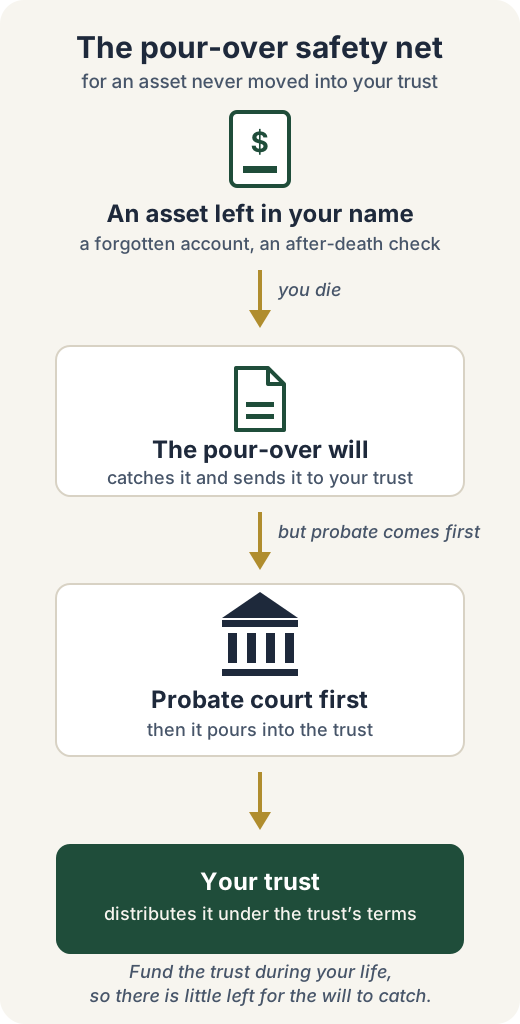
A pour-over will is a short will that pairs with a revocable living trust. Its job is to be a safety net. If you die owning something in your own name that you never moved into your trust, the pour-over will "pours" that asset into the trust, so it is distributed under your trust’s terms instead of falling outside your plan. Every well-built trust plan includes one, because no one funds a trust perfectly.
Why You Need One With a Trust
A trust only controls what you actually retitle into it, and there is almost always a straggler, an account you forgot, an asset you bought last month, or a check that arrives after death. The pour-over will catches those leftovers and sends them into your trust so they still follow your wishes. It also does one thing a trust cannot, name a guardian for your minor children. See how to set up the trust it backs up →
Setting up a trust? You need the pour-over will too.
Book a No-Cost Phone Consult with Attorney Kevin D. Klagge, Esq. Our trust plan includes the pour-over will, all coordinated, one flat fee.
Book a no-cost consultIt Does NOT Avoid Probate by Itself
Here is the part people get wrong. Anything that actually passes through the pour-over will goes through probate first, then pours into the trust. The probate-avoidance comes from funding the trust during your life, so there is little or nothing left for the will to catch. The pour-over will is insurance for the gaps, not the main event, the better you fund the trust, the less the will ever has to do.
Pour-Over Will vs. Regular Will
A regular will distributes your assets directly to the people you name. A pour-over will sends them to your trust, which then distributes them privately and (for funded assets) outside probate. So the "who gets what" details live in the trust; the pour-over will is just the catch-all. If you have a trust, you want a pour-over will; if you do not, a regular will is the right tool.
| A regular will… | A pour-over will… |
|---|---|
| Distributes your assets directly to the people you name | Sends your assets to your trust, which then distributes them |
| Spells out who gets what in the will itself | Leaves the who-gets-what details in the trust; the will is the catch-all |
| The right tool if you do not have a trust | What you want if you have a trust |
Frequently Asked Questions
What Is a Pour-Over Will in Florida?
A pour-over will is a short will that works alongside a revocable living trust. Its only real job is to act as a safety net. If you die owning something in your own name that you never moved into your trust, the pour-over will "pours" that asset into the trust so it is distributed under the trust’s terms. Without it, a forgotten asset could pass under the state’s default rules instead of your plan. Every well-built trust plan includes one.
Do I Need a Pour-Over Will if I Have a Trust?
Yes. A trust only controls the assets you actually retitle into it, and almost no one funds a trust perfectly, there is usually a stray account, a recently bought asset, or a check that arrives after death. The pour-over will catches those leftovers and routes them into your trust so they still follow your plan. It is the backstop that keeps a small oversight from becoming a separate, unplanned inheritance. It also lets you name a guardian for minor children, which a trust cannot do.
Does a Pour-Over Will Avoid Probate?
Not by itself, and this surprises people. Anything that has to pass through the pour-over will still goes through probate first, then pours into the trust. The probate-avoidance comes from properly funding the trust during your life, so there is little or nothing left for the pour-over will to catch. Think of the pour-over will as insurance for the gaps, not the main event. The goal is to fund the trust well enough that the will rarely has to do any heavy lifting.
What Is the Difference Between a Pour-Over Will and a Regular Will?
A regular (or "simple") will distributes your assets directly to the people you name. A pour-over will sends your assets to your trust instead, and the trust then distributes them. So with a pour-over will, the details of who gets what live in the trust (which is private and avoids probate for funded assets), while the will is just the catch-all that sends stray assets into it. If you have a trust, you want a pour-over will; if you do not, a regular will is the right tool.
How Is a Pour-Over Will Signed in Florida?
Exactly like any Florida will, meaning in writing, signed by you at the end, and witnessed by two people who sign in your presence and each other’s, with a self-proving affidavit before a notary. The pour-over will is part of the trust plan we prepare, executed at the same signing as your trust and other documents, so everything is coordinated and valid.
Is a Pour-Over Will Included When You Set Up a Trust?
Yes. Our trust-based plan includes the pour-over will along with the revocable trust, durable power of attorney, health-care documents, and a deed to fund your home, all in one flat fee of $3,200 for an individual or $4,500 for a couple. You do not buy the pour-over will separately; it comes standard, because a trust plan is not complete without it.
Common Situations
The forgotten account. A man set up a trust but never retitled an old brokerage account. At his death, his pour-over will caught it and poured it into the trust, so it still passed to his children as he intended, instead of by default.
The after-death check. A final paycheck and a tax refund arrived after a woman died. Her pour-over will swept them into her trust, keeping her plan intact.
The young parents. A couple with two small children funded their trust carefully, but the trust could not do the one thing they cared about most, naming who would raise the kids. Their pour-over wills did, nominating the children’s aunt as guardian if both parents died. The trust manages the money; the will names the person. That pairing is why the two documents come as a set.
Sources of Law
- Fla. Stat. §732.513 (devises to a trust, the basis for a pour-over will); §732.502/.503 (will execution and self-proving). Probate avoidance requires funding the trust (ch. 736). (retrieved 2026-06-08)
What the Pour-Over Will Actually Catches
In 14 years of law practice, the pour-over will is the document clients understand least and need most, because its whole job is to catch what the plan missed.
A common question I hear is, "If everything is in the trust, why do I need a will at all?" Because everything is never in the trust. There is always an account somebody opened later, a car, a refund cheque. The pour-over will sweeps those into the trust so one set of instructions governs.
I have come across a case where the interaction mattered more than either document. A husband had a pour-over will and a revocable trust that was only partly funded. After he died, his widow claimed her elective share of the estate, and the successor trustee argued that by taking it she had given up her interest in the trust income. The Fourth District disagreed, and held she kept the trust interest even though it would be paid out of assets pouring over from the estate.
What that tells me is that these two documents are read together rather than in sequence, and a spouse who takes one right does not automatically surrender another.
Practice pointer. Fund the trust while you are alive and treat the pour-over will as the net rather than the plan. Everything the will has to catch goes through probate to get there, which is the cost the trust existed to avoid.
Avoid writing a pour-over will and never funding the trust. A trust with nothing in it and a will that points at it produces a full probate and a bill for two documents.
Kevin D. Klagge, Esq., admitted in Florida since 2012. Any case described is a decision of a court rather than a matter handled by this firm. General information rather than advice on your situation.
Updated on September 1, 2026. Reviewed by Kevin D. Klagge, Esq., Fla. Bar No. 99502. General information about Florida law, not legal advice, and no attorney-client relationship is created. A pour-over will is part of a coordinated trust plan. Do not send confidential information until we have agreed to represent you.