
What a Florida Estate Plan Actually Is
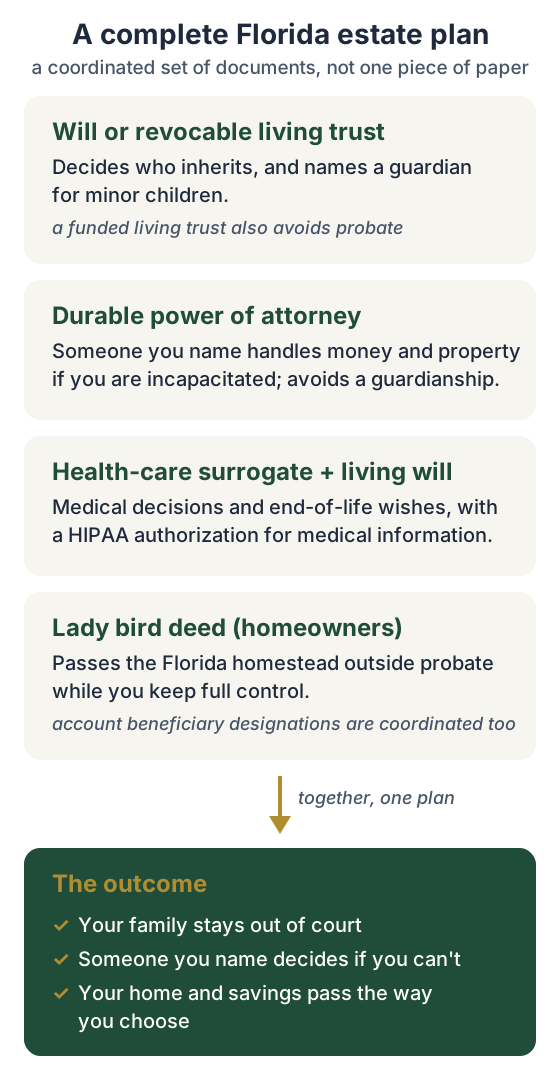
An estate plan is a coordinated set of documents, not one piece of paper. Together they control who gets what and when, who acts for you if you can’t, and how to keep your family out of probate and guardianship court. See the full estate planning checklist →
Without a will, Florida law decides your heirs and their shares for you, and your estate goes through probate anyway. Planning is how you take that pen back.
The Core Documents Every Florida Adult Needs
- A will (or, for many, a revocable living trust plus a pour-over will) to direct your property and name a guardian for minor children.
- A durable power of attorney so someone can handle money and property if you’re incapacitated. This is the document that avoids a guardianship.
- A designation of health-care surrogate for medical decisions, a living will for end-of-life wishes, and a HIPAA authorization so the people you name can actually get medical information.
- For homeowners, a lady bird deed to pass the Florida homestead outside probate while you keep full control.
Will vs. Revocable Living Trust: Who Needs Which
A will alone still goes through probate and controls only the probate estate. A revocable living trust avoids probate on funded assets, manages them if you lose capacity, and keeps your plan private, but only for assets actually re-titled into it.
Choose a trust when you have multiple or out-of-state property, minor children, blended families, special-needs beneficiaries, or strong incapacity-management needs. A will-based plan is often enough for simpler estates, paired with a lady bird deed and beneficiary designations. Not sure? Try the deed selector →
Marrying or remarrying? A prenuptial or postnuptial agreement is how you protect separate property, a business, and children from a prior relationship, and how a spouse waives the elective share. We draft them as part of the plan.
Observant Jewish family? We coordinate your secular plan with a halachic will so your estate honors both Florida law and Jewish law. Living in Israel with US assets?
Have a financial advisor? We work alongside your advisor and CPA, see how the two roles fit together.
Incapacity Planning: The Half People Forget
Estate planning is not only about death. The durable power of attorney, the health-care surrogate and living will, and a successor trustee keep your life running if you’re hospitalized or develop dementia. They also keep your family out of a public, slow, expensive guardianship.
Three Florida traps to know. First, a durable POA is effective immediately under Florida law; a “springing” POA that only activates on incapacity is not recognized here. Second, certain high-risk powers (gifts, creating or amending trusts, changing beneficiaries) must be separately initialed to work at all. Third, a HIPAA release is what lets your agent prove the incapacity that starts their authority.
Avoiding Probate in Florida
Probate means months of delay, a public record, and attorney’s fees calculated as a percentage of your estate’s value. Those fees are presumed reasonable under Florida law, not a cap you can easily argue down. The avoidance toolkit is a funded revocable trust, a lady bird deed on the homestead, and proper beneficiary, pay-on-death, and transfer-on-death designations on accounts (they override your will, so they must be coordinated).
The right mix depends on what you own and how it’s titled. See what probate actually costs → or read the probate guide.
Own a business? It belongs in the plan too: a trust can own your LLC so the company avoids probate, and co-owners need a buy-sell agreement so a death or divorce does not hand your business to the wrong people. See full business succession planning →
Florida Homestead: The Rule That Breaks DIY Plans
Your homestead cannot be left in a will to whoever you choose if you are survived by a spouse or a minor child, with a narrow exception that it may go to the spouse when there is no minor child. A will that ignores this rule is ineffective, and the home passes by statute instead: the surviving spouse typically takes a life estate with remainder to descendants, or may elect a one-half ownership share. See how Florida homestead law works →
This is exactly why the home, the will, the trust, and any deed have to be reconciled together. It is also why online estate planning often fails in Florida.
Protecting a Spouse: What a Will Can’t Override
A surviving spouse has rights you cannot cut out by will alone. The 30% your spouse can claim regardless of your will (the elective share) is calculated across a broad estate that pulls in revocable-trust assets too, so moving things into a trust doesn’t defeat it. On top of that, a surviving spouse has rights to the homestead, certain exempt personal property, and a family allowance.
These rights can be waived only by a valid written marital agreement. This matters for every married client, and especially for blended families.
One plan, every document, one flat fee.
A free 30-minute consult maps your family and goals. You don’t need it all figured out first.
Book your free consultBlended Families, Minor Children, and Special Needs
Minor children cannot inherit outright, so we use a trust plus a guardian nominated in the will. Blended families balance a current spouse against children from a prior relationship, usually with a trust (a marital or QTIP structure plus defined children’s shares) and a written marital waiver.
For a special-needs beneficiary, a supplemental-needs trust preserves SSI and Medicaid eligibility. Never leave assets to a disabled beneficiary outright. Special-needs provisions add $750 to the plan; a standalone special-needs trust is a flat fee quoted at the consult.
Florida-Specific Advantages (and Limits)
Florida has no estate or inheritance tax (see does Florida have an estate tax, and how moving here escapes a high-tax state’s), and federal estate tax reaches only very large estates (about $15 million and up in 2026). If you or your spouse is not a US citizen, or you own assets or live across a border, the rules change sharply and need their own plan (see international and cross-border estate planning). For nearly all families the goals are probate avoidance, incapacity protection, and a full basis step-up at death (the "step-up" means your heirs inherit at today's market value, erasing capital gains). When a spouse dies, there is also one tax move worth knowing: estate tax portability, which preserves the late spouse's unused exemption if you file in time.
Two honest limits: a revocable trust does not protect assets from your creditors during life and does not help Medicaid eligibility. For those goals see asset protection, our Medicaid planning, and irrevocable trust pages. If you just moved to Florida, your out-of-state plan should be re-checked under Florida law. See domicile →
What It Costs, and How We Work
Flat fees, no surprises. Trust-based plan: $3,200 individual / $4,500 couple (trust, pour-over will, durable POA, health-care directives, and one funding deed). Will-based plan: $1,200 individual / $1,950 couple (will, POA, surrogate, living will, and HIPAA). Add-on provisions are $750. Single documents start at $299. Government recording and filing costs are additional, at cost.
We work in three steps: a free 30-minute consult, a plain-English draft you review, then a guided signing with Florida formalities. We handle funding so the plan actually works. See full pricing →
Estate Planning Across Florida
We serve clients throughout Florida remotely. Local pages for some of the areas we work in:
Get the Florida Estate Plan Checklist (free PDF)
The one-page checklist for Florida households: every document you need, the Florida homestead and spousal rules that surprise people, and the two steps most plans forget.
We'll email the PDF and nothing else unless you ask. Downloading it does not create an attorney-client relationship; please don't send confidential details yet.
Frequently Asked Questions
Do I Need a Will or a Living Trust in Florida?
It depends on what you own and your goals. A will directs your property but still goes through probate; a funded revocable living trust keeps your family out of probate and manages things if you lose capacity. We talk through both at the free consult and recommend what fits.
What Documents Are in a Complete Florida Estate Plan?
At minimum: a will (or a revocable living trust with a pour-over will), a durable power of attorney, a designation of health-care surrogate, a living will, and a HIPAA authorization. Homeowners often add a lady bird deed to pass the home outside probate.
How Much Does an Estate Plan Cost in Florida?
Our flat-fee trust-based plan is $3,200 for an individual and $4,500 for a couple; the will-based plan is $1,200 individual and $1,950 couple. Single documents start at $299. Government recording and filing costs are additional, at cost.
What Happens in Florida if I Die Without a Will?
Florida’s intestacy law (Chapter 732) decides your heirs and their shares, and your estate still goes through probate. A spouse and children split the estate under fixed formulas you don’t control, and the court appoints who administers it.
Does a Living Trust Avoid Probate in Florida?
Yes, for assets actually re-titled into the trust. Funding is everything: an unfunded trust still goes through probate. We handle the deeds and retitling so the plan works.
Can I Leave My House to My Kids in My Florida Will?
Not if you’re survived by a spouse or a minor child. Florida homestead law (Art. X §4) restricts how you can devise the home; ignoring it makes the gift ineffective and the home descends by statute. We coordinate the home with a lady bird deed or trust.
Can I Disinherit My Spouse in Florida?
Not with a will alone. A surviving spouse can elect 30% of the elective estate (which includes revocable-trust assets) plus homestead, exempt property, and a family allowance. These are waivable only by a valid written marital agreement.
What Is a Durable Power of Attorney and Why Do I Need One?
It names someone to manage your money and property if you become incapacitated, and it’s what keeps your family out of a guardianship proceeding. In Florida a POA must be effective immediately (springing POAs don’t work here), and certain powers must be separately initialed.
Who Makes My Medical Decisions if I Can’t?
The person you name in a Florida designation of health-care surrogate. Pair it with a living will (your end-of-life wishes) and a HIPAA authorization so your agent can access medical information when it matters.
Is There a Florida Estate Tax?
No. Florida has no state estate or inheritance tax. Federal estate tax applies only to very large estates (about $15 million and up in 2026), so for most families the goal is avoiding probate, planning for incapacity, and preserving a full step-up in basis.
Do You Handle Estate Planning for People Who Just Moved to Florida?
Yes. We work remotely by video and phone with clients throughout Florida, and we review out-of-state plans under Florida law for new residents, where homestead, the POA, the elective share, and execution all differ.
How Long Does It Take to Get an Estate Plan Done?
Most plans go from consult to signing in a couple of weeks: a free 30-minute consult, a draft you review, then a guided signing with Florida formalities. We also handle funding so nothing is left half-done.
Common Situations
The young family with a house and two kids. A Miami couple in their late 30s think they’re too young to need a plan. With no will, no guardian is named for the children, and homestead rules plus the minors-can’t-inherit-outright problem would put a court in charge of both the kids and the house. A will-based plan with a guardian nomination, minors’ trust provisions, and a lady bird deed solves it.
The retiree who moved from up north. A widow relocates to Naples with a trust drafted in New Jersey, never updated for Florida: wrong homestead handling, a POA missing the Florida superpowers, out-of-state execution. A Florida restatement plus a fresh durable POA and directives makes it enforceable here.
The blended family. A remarried man with adult children from a first marriage and a current spouse. A simple “all to my wife” will would disinherit his kids; doing nothing leaves the spouse’s 30% elective share fighting the children. A trust with a marital provision and defined children’s shares, plus a marital waiver, gives everyone certainty.
Sources of Law
- Wills, intestacy, homestead devise, spousal rights: Fla. Stat. ch. 732 (§732.502 execution; §§732.101 to 732.111 intestacy; §§732.4015, 732.401 homestead; §732.2065 elective share with §732.2035 trust inclusion; §732.402 exempt property; §732.702 waiver). Homestead: Art. X §4, Fla. Const.
- Revocable trusts: ch. 736 (§736.0505, §736.1109). Powers of attorney: ch. 709 (§709.2104, §709.2108, §709.2202). Health-care directives: ch. 765. Probate fees §733.6171. Federal: IRC §1014. (retrieved 2026-07-11)
Updated July 11, 2026. Reviewed by Kevin D. Klagge, Esq., Fla. Bar No. 99502. Attorney Kevin Klagge represents families, businesses, and international clients in estate planning and international law, with a focus on Florida legal tools. He litigates estate and business issues in court. General information about Florida law, not legal advice, and no attorney-client relationship is created. A consult doesn’t create that relationship; please don’t send confidential details until we’re engaged.