The Short Answer
You do not have to live in Florida, and you almost certainly will not have to travel here. Florida attorneys file everything through a statewide electronic court system, and the state allows signing by remote online notary, so a Florida probate can be run entirely from your kitchen table in another state. Grieving a parent is hard enough without a plane ticket attached to every court date. See how Florida probate works →
Can You Be in Charge From Out of State?
Florida has a clear rule on this, and it is the first question in every one of these files. The person who runs the estate is called the personal representative, and someone who lives outside Florida can serve only if they are related to the person who died. The statute lists 4 groups. An adopted child or adoptive parent. Anyone in the direct line, a child, grandchild or parent. A spouse, brother, sister, uncle, aunt, nephew or niece, or anyone in the direct line of one of those people. And the spouse of anyone who qualifies. If you are your parent’s child, you qualify. Where this trips people up is a close family friend, a partner who never married the parent, or a stepchild whose parent died first, because the statute does not name them and the court will pass them over no matter what the will says. We confirm who is eligible at the very start, so the court does not send you back to square one.
Do I Have to Come to Florida for the Probate?
The question I get most about this is, “Do I have to come to Florida?” Almost never. Florida courts take every filing electronically, Florida notaries can witness your signature by video under the remote online notarization law, and the hearings that happen at all are set by phone or video. Once we know who is serving, the process is straightforward and almost entirely paperless.
- We gather the will, the death certificate, and a list of the assets, all by email or a secure upload.
- We open the probate in the right Florida county, the one where your parent lived, and file everything electronically.
- You sign what needs signing by remote online notary, from wherever you are.
- We deal with the court, the creditors, and the deadlines, and keep you updated in plain English.
- When it is time to sell the home or distribute the accounts, we coordinate that too.
The Two Out-of-State Situations
Knowing which one you are in matters, because the two are handled differently.
- Your parent lived in Florida and you live elsewhere. A normal Florida probate, run for a family that lives somewhere else. The home and accounts are Florida assets, and Florida is where it all happens.
- Your parent lived elsewhere but owned a Florida property. This is called ancillary probate, a separate, usually smaller Florida case that runs alongside the main estate back in their home state. We handle the Florida piece and coordinate with the lawyer running the main one. What changes between the two states is set out state by state, with the other 49 in one table.
The mirror image is worth planning for while everyone is alive. A Florida resident who owns land or a cabin in another state is setting their family up for the same second probate there. A funded trust prevents it; see whether you need a trust for out-of-state property.
Handling a Florida estate from far away?
Book a No-Cost Phone Consult with Attorney Kevin D. Klagge, Esq. We will lay out exactly what your situation needs, and what it will cost, before you commit to anything.
Book a no-cost consultWhich Kind of Probate, and What It Costs
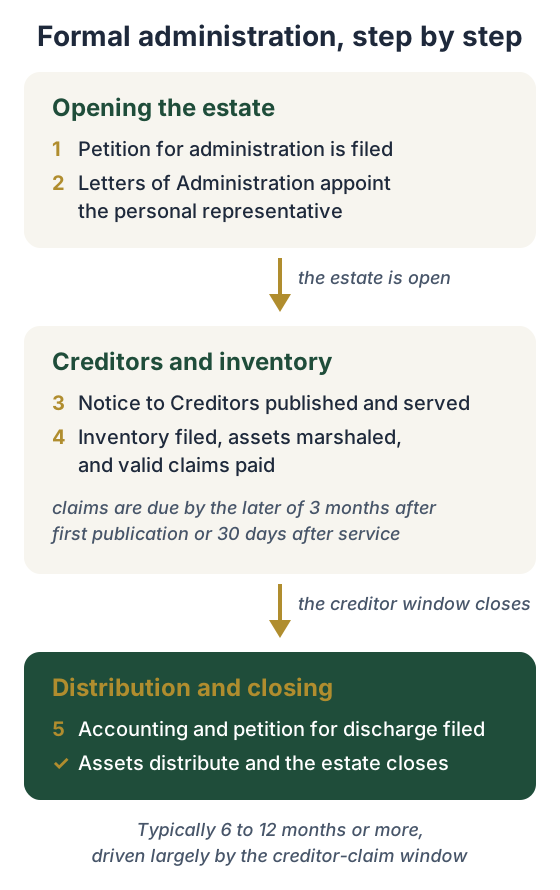
Not every estate needs the full process. A smaller estate, or one where the death was more than two years ago, may qualify for summary administration, which is faster and cheaper. Larger or more recent estates go through formal administration, which usually takes several months, partly because Florida gives creditors a set window to come forward. Living out of state does not raise the cost with us. A summary administration is a flat fee from $2,500 and a routine formal administration is a flat fee from $3,500, the same figures a family down the street pays. You can estimate the statutory fee with our probate cost calculator, and we quote you a flat number at the consult, often below the statutory figure.
Handling this from another state? Get the free checklist
The one-page Out-of-State Family Florida Checklist: what to do first, what not to touch, and how the whole Florida side happens without flying down.
We'll email the PDF and nothing else unless you ask. Downloading it does not create an attorney-client relationship; please don't send confidential details yet.
Frequently Asked Questions
Can I Probate a Florida Estate if I Live in Another State?
Yes. You do not have to live in Florida, or even travel here, to handle a Florida probate. Florida attorneys file everything through a statewide electronic court portal, so the whole case can be run by phone, email, and video while you stay home. We handle Florida probates every day for adult children scattered across the country.
Can an Out-of-State Person Serve as Personal Representative in Florida?
Often, but Florida has a specific rule. A person who lives outside Florida can serve as personal representative (the person in charge of the estate) only if they are related to the person who died, a spouse, child, parent, sibling, or certain other relatives, or married to such a relative. A non-relative who lives out of state generally cannot serve. If you are the deceased’s child, you almost always qualify. We confirm this early so there are no surprises.
Can My Out-of-State Friend Be My Personal Representative?
In Florida, no. A person who lives outside Florida can serve only if they are family within the statute's list, a spouse, child, parent, sibling, or certain other close relatives, or the spouse of one. A trusted friend in another state does not qualify no matter what your will says, and naming one just forces the court to pass over them. If the people you trust are not Florida residents or relatives, the plan needs a different answer, such as a qualifying relative, a Florida resident, a trust company, or a trust-based plan that avoids the appointment entirely.
Do I Have to Fly to Florida for the Probate?
Almost never. Because Florida courts accept electronic filing and remote online notarization, you can sign what you need to sign from home and we appear for the estate here. In a typical probate, the out-of-state family never sets foot in a Florida courthouse. That is the entire point of hiring a Florida firm that works with you wherever you are.
My Parent Lived in Florida but I Need to Sell Their Home. What’s the Process?
If the home was in the parent’s name alone, it usually has to pass through Florida probate before it can be sold with clear title, and a title company will insist on it. We open the probate, get the personal representative authority to sell, and coordinate the closing, all without you having to be here. If your parent had set up a lady bird deed beforehand, the home would have passed without probate, which is worth knowing for your own planning.
What if My Parent Lived in Another State but Owned a Florida Vacation Home?
Your situation is the mirror image, and it has its own name, ancillary probate. When someone dies in their home state but owns real estate in Florida, the Florida property needs a separate, smaller Florida probate alongside the main one back home. We handle the Florida side and coordinate with the lawyer running the main estate, so the two pieces fit together.
What Is Ancillary Probate in Florida, and How Much Does It Cost?
Ancillary probate (or ancillary administration) is a secondary Florida probate opened when a person who lived in another state dies owning property here, usually a vacation home or condo. The main probate happens in their home state, but that state has no authority over the Florida real estate, so a Florida ancillary case is needed to clear title. It is generally smaller and faster than a full Florida probate, and we quote a flat or clearly estimated fee. You can also estimate the statutory figure with our probate cost calculator.
How Long Does a Florida Probate Take?
The type of probate decides it. A small or older estate may qualify for summary administration, which can finish in a few weeks to a couple of months. A full formal administration usually runs about 6 to 12 months, partly because Florida law gives creditors a set window to come forward. We tell you which path your situation fits at the consult.
How Much Does an Out-of-State Florida Probate Cost?
The same as any Florida probate; living out of state does not cost extra with us. Florida law sets a presumed-reasonable attorney fee based on the size of the estate, but it is a ceiling, not a mandate, and a flat-fee firm usually comes in under it. You can estimate the statutory figure with our probate cost calculator, then we quote you a real, flat number at the consult.
Common Situations
The daughter in Ohio. Her mother passed away in a Naples condo, leaving the home and two bank accounts. The daughter qualifies to serve because she is the child, signs everything by remote notary, and never flies down. We open the probate, clear the title, and help her sell the condo, all by phone and video.
The snowbird’s vacation home. A father who lived in New York owned a Fort Lauderdale condo. His estate is being probated in New York, but the Florida property needs its own ancillary case. We handle the Florida side and hand off cleanly to the New York attorney.
The two-years-later estate. A son never got around to probating his father’s small Florida estate, and it has now been three years. Because more than two years have passed, summary administration is available, a faster, lighter process that gets the house sold without the full formal probate.
Sources of Law
- Fla. Stat. §733.304: who may serve as personal representative when not a Florida resident (relatives of the decedent and their spouses). (retrieved 2026-06-07)
- Fla. Stat. ch. 734: ancillary administration of Florida property owned by a nonresident decedent.
- Fla. Stat. ch. 735: summary administration and disposition without administration. §733.6171: presumed-reasonable attorney fees (a ceiling, not a mandate).
- Objections to a personal representative: §733.212(3) (the 3-month window after service of the notice of administration, which today covers the will’s validity, venue and jurisdiction); §733.3101 (a representative who was not qualified must resign, and pays the costs of removal if he does not); §733.504 (removal of a representative who was not qualified at appointment). Case: Hill v. Davis, 70 So. 3d 572 (Fla. 2011), approving 31 So. 3d 921 (Fla. 1st DCA 2010), decided under the 2007 text of §733.212(3), which then listed the representative’s qualifications among the objections barred after 3 months. Both opinions read in full from the official text (retrieved 2026-09-03).
What a Florida Supreme Court Case Shows About Out-of-State Representatives
I keep a copy of every Florida opinion that touches this, and I check new ones as they come down. The nonresident rule is short, 4 categories in one sentence of the statute, and the opinions on it are about what happens when a family reads that sentence too late.
The calls I take about this almost always start with the same worry, that the family will have to move the case, or themselves, to Florida. Nobody has to. The rule that actually decides these files is the one about who may serve, and a Florida Supreme Court decision from 2011 shows how it plays out. A woman named Katherine Davis died in Florida in 2007. Her will named her stepson as personal representative, and he lived in New York. His father, Katherine’s husband, had died before her, so on the day she died he was the son of a man who was no longer her spouse. The court appointed him in 2007, he published the notice of administration on July 13, and a copy reached Katherine’s mother on July 24. Her mother fought the will first. On August 6, 2008, more than a year after that notice arrived, she raised the point that decides this page, that a New York stepson whose father was already dead was not related to Katherine in any of the ways the nonresident statute lists. The trial court held two hearings in 2009 and ruled that he qualified, and added that she had filed too late. The First District never reached whether he qualified, because the objection had a 3-month deadline and she had missed it by 10 months. In September 2011 the Florida Supreme Court agreed. The mother had known from the first petition that he was the son of the deceased husband, nothing had been hidden from her, and an objection to a representative’s qualifications had to be filed inside those 3 months or not at all. Four years after the death, no court had decided whether the stepson was ever eligible to serve, and the Supreme Court said in a footnote that it was not deciding it either.
In reading those two opinions against the current statute, I have a few take-home points.
The first is the calendar, and the Legislature has since moved it. The 3-month window the court enforced now covers the will’s validity, the venue and the court’s jurisdiction, and the representative’s qualifications came out of that list. Today a representative who was never qualified must be removed, a representative who knows he was not qualified must resign at once, and one who stays on pays the costs and attorney fees of the proceeding that removes him. The practice pointer runs in both directions. For an heir, the notice of administration is the document that starts every deadline in the estate, so the day it arrives is the day to have a lawyer read it. For the person named in the will, the petition I file states the relationship that qualifies you, in the statute’s own words, with the birth or marriage record attached, because a qualification that is plain on the first page is never litigated.
Second, the stepchild is the trap, and so is the partner who never married. The statute qualifies an out-of-state person only through blood, adoption or marriage, and a stepchild reaches it only as a child of the decedent’s spouse. When the spouse dies first, whether that door stays open is the question the Supreme Court left unanswered in 2011, and I have not found a Florida appellate decision that has answered it since. The practice pointer is that I do not tell a stepchild he qualifies. I tell him the question is open, and we plan as if the answer is no, which means a Florida resident or a lineal relative named as co-representative, or a trust that makes the appointment unnecessary.
Third, an unqualified nominee does not stop the probate, he changes who runs it. The court passes over a person the statute does not reach and moves to the next person in the order of preference, which in a will is whoever a majority of the beneficiaries choose. A family that expected the out-of-state friend to be in charge finds a sibling in charge instead, and the fights I see afterward are about that, not about the friend. The practice pointer is to read the will for the nominee’s residence and relationship before anyone is told they are the executor. Avoid a will that names an out-of-state friend, partner or stepchild as personal representative with no qualified alternate behind them, because the court will pass over the person you chose and the family will learn who serves from a judge. Had Katherine’s will named a lineal relative or a Florida resident as the alternate, or had her mother filed her objection inside the 3 months, the eligibility question would have been settled in 2007 in one hearing instead of carried to the Supreme Court in 2011. On the planning side the fix is one sentence naming a qualified alternate, and the will plan that carries it is a flat fee from $1,200 for one person and $1,950 for a couple. On the probate side, a formal administration for a family in another state is a flat fee from $3,500 here, the same figure a family down the street pays.
What the opinions do not tell you is whether the stepson was ever qualified, because the deadline made the question unnecessary, and I will not fill that gap with a guess. What they do show is that the eligibility of an out-of-state representative is a fact in the first filing, and that the time to test it is at the start.
Kevin D. Klagge, Esq., admitted in Florida since 2012. Each case described above is a decision of a Florida court rather than a matter handled by this firm. Past results do not guarantee a similar outcome.
Updated on September 3, 2026. Reviewed by Kevin D. Klagge, Esq., Fla. Bar No. 99502. General information about Florida law, not legal advice, and no attorney-client relationship is created. Whether and how an estate must be probated depends on the specific facts. Do not send confidential information until we have agreed to represent you.
More Guides on Florida Probate
- Ancillary Probate in Florida
- Form 706 Estate Tax Return
- How to Find a Will or Probate Records in Florida
- How to Become Executor of an Estate Without a Will in Florida
- How Long Do You Have to File Probate After Death in Florida?
- How Much Does a Probate Lawyer Cost in Florida?
- Can a Beneficiary Be the Executor?
- How Long Does Probate Take in Florida?