The Short Answer
The person a Florida court puts in charge of settling an estate is the personal representative, which is simply Florida’s word for the executor (or administrator). You gather the assets, deal with creditors, pay debts and taxes, and distribute what is left, all under a fiduciary duty to do it right. You become official only when the court issues your letters of administration, and Florida requires an attorney to walk a formal estate through. Done correctly it is straightforward; done wrong it can land on you personally.
Is a Personal Representative the Same as an Executor in Florida?
A common question I hear is, "Is a personal representative the same as an executor in Florida?" Yes. "Executor" is the everyday term and the one used in many other states. "Administrator" historically meant the representative when there was no will. Florida rolls them into one title, personal representative, whether or not there is a will. So if a Florida will named you executor, you are the personal representative, and the job is the same.
Who Can Serve
A Florida resident who is 18 or older, able, and not a convicted felon can serve. Someone out of state can serve only if they are related to the person who died (spouse, child, parent, sibling, or certain other relatives, or married to one). A child or spouse qualifies even from another state; a friend or distant connection out of state generally cannot. See serving from out of state →
How You Get Appointed: Letters of Administration
You are not in charge until the court appoints you and issues your letters of administration (often called letters testamentary when there is a will). Those letters are what prove your authority to banks, title companies, and the rest. Getting them means filing a petition in the right county, admitting the will if there is one, and the court issuing the letters. We handle the petition, the filings, and the appearances so your authority is in place without the guesswork.
Named to serve, and not sure where to start?
Book a No-Cost Phone Consult with Attorney Kevin D. Klagge, Esq. We will get you appointed and guide every step, wherever you are, on flat or quoted fees.
Book a no-cost consultYour Duties (and the Liability Traps)
- Gather and value the assets.
- Notice to creditors, then handle valid claims (there is a strict order of who gets paid).
- Pay debts, expenses, and taxes before anyone inherits.
- Account to the beneficiaries and keep clean records.
- Distribute what remains and close the estate.
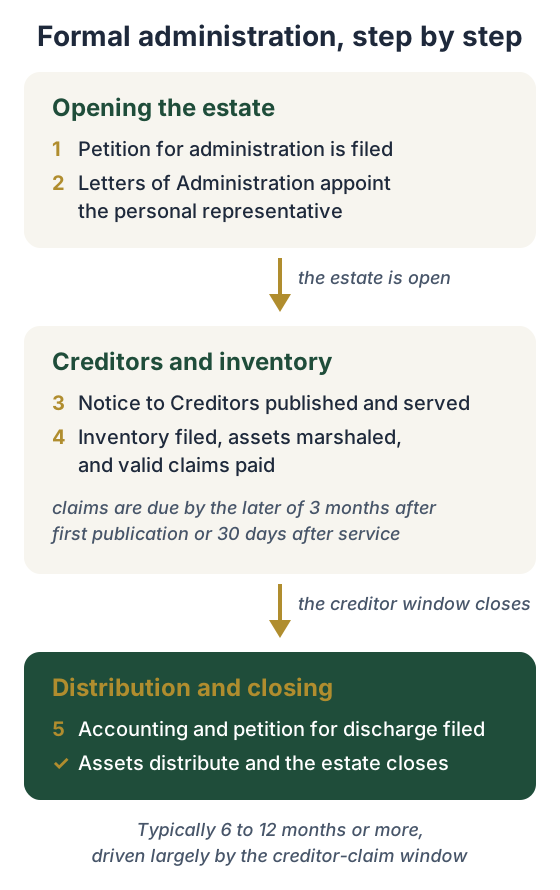
Here is the danger. Paying the wrong creditor first, or distributing before debts and the creditor period are handled, can make you personally liable. That is the single biggest reason representatives work with an attorney rather than going it alone. See how long it takes →
The other deadline the representative sets in motion is the one for challenging the will. Serving the notice of administration starts a 3-month clock for any interested person to object to the will’s validity, and an objection filed after that is barred, whatever a will contest would have shown. Serve it early, on everyone with a stake, and keep the proof of service in the file.
What You’re Paid
Florida sets a presumed-reasonable commission tied to the size of the estate (a tiered percentage, for example 3% on the first $1 million), plus reimbursement of your costs. It is taxable income to you, and many family members who serve waive it. The full schedule, the waiver decision, and the tax math are in our Florida personal representative fees guide, and you can estimate the numbers first.
Can I Have Two Executors?
Yes. A Florida will can name two or more people to serve together as co-personal representatives, and each one has to qualify on their own, including the rule that lets someone who lives outside Florida serve only as a close relative of the person who died.
Co-personal representatives act by majority for a will signed on or after October 1, 1987, unless the will says otherwise. With two of them, a majority means both, so every check, listing agreement and deed needs two signatures. Florida carves out three situations where one can act alone, namely receiving property owed to the estate, an emergency where waiting for the other would put the estate at risk, and a matter the other has delegated. A co-personal representative who disagrees with a decision and says so in writing before it is carried out is protected from liability for it.
Two personal representatives can also cost the estate more. On an estate of $100,000 or more, each of two co-personal representatives is entitled to the full commission a sole representative would receive. With three or more, the estate pays two commissions split among them according to the work each did, and under $100,000 one commission is split. Our personal representative fees guide shows the schedule.
If one co-personal representative stops serving, the one who remains can exercise every power alone unless the will or a court order says otherwise, and no new appointment is needed.
Practice pointer. Two siblings named together often deadlock over the house. A will naming co-personal representatives should say whether either may act alone and whether both take a commission, because the default answers are both must agree and both get paid.
What Happens if the Executor Dies?
The probate court appoints a successor personal representative to finish the estate. The executor’s own personal representative does not take over, because Florida does not let the estate of a deceased personal representative administer the first estate.
The answer depends on when the executor dies. If the executor named in the will dies before being appointed, an alternate named in the will has first priority. With no alternate, Florida’s order of preference moves to the person chosen by a majority in interest of the beneficiaries and then to a beneficiary under the will, and the court picks among applicants if more than one asks.
If the executor dies partway through the administration and a co-personal representative is still serving, the survivor keeps going without a new appointment. If the executor was serving alone, someone with priority petitions for appointment as successor, the court issues new letters, and the successor takes over the estate’s accounts, files and the deadlines already running.
A successor still has to meet every qualification, which matters for families spread across states. A beneficiary who lives outside Florida and is not a close relative of the person who died cannot step in, however willing.
Practice pointer. Name at least one alternate personal representative in the will, and pick an alternate who lives in Florida or is a close relative. A will with a single named executor leaves the choice to the beneficiaries and the court if that person dies first.
Frequently Asked Questions
What Is a Personal Representative in Florida?
It is Florida’s name for what most people call the executor or administrator of an estate. The personal representative is the person (or institution) the probate court puts in charge of settling someone’s estate, gathering the assets, paying the debts and taxes, and distributing what is left to the heirs or beneficiaries. If there is a will, it usually names this person; if there is no will, Florida law sets who has priority to serve. Same job, different label.
Is a Personal Representative the Same as an Executor?
Yes. "Executor" is the common term and the word used in many other states, but Florida’s statutes call the role the personal representative. You may also hear "administrator," which historically meant the representative when there was no will. In Florida it is all one role, the personal representative, whether or not there is a will. So if you were named executor in a Florida will, you are the personal representative.
Who Can Serve as Personal Representative in Florida?
A Florida resident who is at least 18, mentally and physically able, and not a convicted felon can serve. Someone who lives outside Florida can serve only if they are related to the person who died (a spouse, child, parent, sibling, or certain other relatives, or married to one). A non-relative who lives out of state generally cannot serve. If you are the deceased’s child or spouse, you almost always qualify even from another state. We confirm eligibility before anything is filed.
How Do I Become the Personal Representative? (Letters of Administration)
You are not officially in charge until the court appoints you and issues "letters of administration" (sometimes called letters testamentary when there is a will). Those letters are the document that proves your authority to banks, title companies, and others. To get them, a petition is filed in the county where the person lived, the will (if any) is admitted, and the court issues the letters. Florida requires an attorney for a formal administration, and we handle the filing and appearances so you get your letters without the guesswork.
What Are the Duties of a Personal Representative?
You have a fiduciary duty to act in the estate’s best interest. The core tasks are to identify, gather, and value the assets; publish and serve a notice to creditors and handle valid claims; pay debts, expenses, and any taxes; keep careful records and account to the beneficiaries; and finally distribute what remains and close the estate. Getting the order wrong, paying the wrong creditor first or distributing too early, can make you personally liable, which is the main reason representatives use an attorney.
Does a Personal Representative Get Paid in Florida?
Yes. Florida law sets a presumed-reasonable commission based on the size of the estate (a tiered percentage, for example 3% on the first $1 million), and the representative is also reimbursed for out-of-pocket costs. The fee is taxable income to you, and many family members who serve choose to waive it. We explain how the commission works and how it interacts with the attorney’s fee at the consult.
Who Becomes the Personal Representative if There Is No Will in Florida?
When there is no will, Florida sets an order of priority. The surviving spouse has the first right to serve, then the person chosen by a majority of the heirs, then the heir nearest in relationship. The court appoints that person and issues letters of administration, the same process as with a will, except the statute decides who is eligible instead of the will naming someone. So "who becomes the executor" without a will is usually the spouse or a close heir, and we can get you appointed if that is you.
Who Should Be the Executor of My Will?
Choose someone organized and trustworthy who also qualifies under Florida law. The person must be at least 18, mentally and physically able to do the work, and never convicted of a felony or of abusing an elderly or disabled adult. A person living outside Florida can serve only as a close relative, such as a child, parent, sibling, niece or nephew, so a friend in another state cannot. A Florida trust company can serve, and so can a lawyer, although a lawyer who drafted a will signed on or after October 1, 2020 and is named in it receives no pay for serving unless related to you or unless you signed specific written disclosures.
Is a Power of Attorney the Same as an Executor?
No. An agent under a power of attorney acts for a living person, and every Florida power of attorney ends when the person who signed it dies. The executor, called the personal representative in Florida, has no authority until the probate court appoints the executor after the death and issues letters of administration. One person can hold both roles, but holding a power of attorney gives no right to sign checks, close accounts or sell property after the death.
Can an Executor Be Removed in Florida?
Yes. Any interested person, usually a beneficiary, can petition the probate court handling the estate to remove the personal representative, and the court can also act on its own. Grounds include wasting or mismanaging the estate, failing to account for assets or for a sale, ignoring a court order, and holding interests that conflict with the estate. A felony conviction is also a ground, and so is moving out of Florida when Florida residence was the basis for the appointment. Removal ends the appointment without ending liability, and the removed representative must hand every asset and record to the successor.
What Can You Do if an Executor Refuses to Act?
When the executor named in a will does not apply for appointment, Florida law moves down the order of preference, so the person selected by a majority in interest of the beneficiaries, or a beneficiary, can petition to serve instead. Whoever holds the original will must still deposit it with the clerk within 10 days of learning of the death, and a court can compel a holder who refuses. An executor who was appointed and then stalls can be removed on a petition for failing to obey court orders or for mismanaging the estate, and the court then appoints a successor.
Can You Help Me Serve as Personal Representative?
Yes, that is most of what a probate attorney does. We get you appointed, guide every step (creditors, taxes, the sale of a home, distributions), keep you on the right side of the deadlines, and keep you from the personal-liability traps. We handle Florida estates wherever you are, including for representatives who live out of state, so you can serve without flying back and forth. The phone consult costs nothing.
Common Situations
The out-of-state child. A son in New York is named executor of his Florida father’s estate. He qualifies as a relative, we get his letters, and we run the whole probate wherever you are while he stays home.
The "I paid a creditor early" worry. A daughter starts paying her mother’s bills out of the estate before the creditor period runs. We step in, sort the priority of claims, and keep her clear of personal liability.
No will. A man dies without a will; his spouse has priority to serve as personal representative. We get her appointed and walk the estate through under Florida’s intestacy rules.
Sources of Law
- Fla. Stat. ch. 733 (administration of estates): §733.301-.305 (who may serve, priority, nonresident rule), §733.401 (letters), §733.601-.620 (duties and powers), §733.617 (compensation, including (5) on co-personal representatives); §733.615 (joint personal representatives act by majority for wills signed on or after October 1, 1987; exceptions; written dissent); §733.616 (powers of surviving personal representatives); §733.307 (succession of administration on the death of a personal representative). Read from the 2026 Florida Statutes (retrieved 2026-10-01). Fla. Prob. R. 5.030 (attorney required for formal administration). flsenate.gov (retrieved 2026-07-11)
- Surcharge and the claims periods: Fla. Stat. §733.609 (breach of fiduciary duty; fees), §733.702 (3 months from first publication), §733.710 (2 years from death); Fla. Prob. R. 5.490(e) (a representative's own claim). Cases: Rich v. Narog, No. 3D21-1631 (Fla. 3d DCA Sept. 21, 2022); In re Estate of Simon, 549 So. 2d 210 (Fla. 3d DCA 1989); Law v. Williams, No. 5D2025-1054 (Fla. 5th DCA May 29, 2026). Each read in full from the official opinion text (retrieved 2026-09-03).
What Two Surcharge Cases Show About Serving as Personal Representative
In the matters I handle, the money is usually lost to delay rather than to any single bad decision. A personal representative who files the inventory late, leaves the tax return for next quarter, and pays whoever calls first is doing nothing that looks wrong on the day, and the bill arrives years later as a petition to surcharge. I read the Florida opinions on those petitions in full, and two of them show the shape of it.
In one case I have reviewed, a son was appointed personal representative of his father’s estate in Monroe County five weeks after the death. Over the nine years before he asked to be discharged, he paid his father’s old debts out of the estate account, fifteen payments in all, roughly $2.41 million, and one of them was $1,368,675 to himself for a loan he had made toward a yacht. He had a reason for every payment (the debts were owed to companies his father had owned, and he believed paying them protected what the estate’s shares were worth). The other beneficiaries objected to his final accounting, and the court surcharged him about $2.54 million, which the appellate court affirmed in 2022. The one fact that decided it was that none of those creditors, himself included, had filed a claim in the probate, and under Florida law every claim against his father was barred 2 years after the death. A claim for his own loan, filed inside those 2 years and served on the beneficiaries with notice of their right to object, would have put the loan in front of the judge on its merits. A routine formal administration here is a flat fee from $3,500, and a claim like that is a short filing made in the first months rather than the ninth year.
In another case I have reviewed, a personal representative appointed in 1981 was still administering the estate in 1984, when the beneficiaries petitioned to remove him for late inventories and slow settlement. The court kept him and appointed a co-representative to close the estate. The one claim that stuck was that he had filed the state and federal tax returns late, which he admitted. The interest and penalties came to $4,522, and the fight over who paid the beneficiaries’ lawyers ran to a $75,300 fee award and another appeal in 1989, eight years after his appointment.
Reading the two together, I have a few take-home points.
The first is the calendar. A creditor has 3 months from the first publication of the notice to creditors to file, and every claim is barred 2 years after the death, so after those dates a debt is not paid, no matter how real it was. Those are the two dates I check before anything else in an estate file. Practice pointer. Put the two-year date on the first page of the file and treat any payment of the decedent’s debt after it as money the beneficiaries can make the representative give back.
Second, the representative’s own money is the most dangerous money in the estate. A representative who lent the decedent money, or who paid a bill from a personal account, is a creditor like any other. Practice pointer. A representative who is owed money files the claim in the first weeks, serves it on every beneficiary with notice of the right to object, and keeps the estate account free of anything that is not an estate asset, because the yacht proceeds in that case went into the estate account for convenience and the mixing is what shifted the burden of proof onto him.
Third, the person writing the will chooses who carries this risk. When I draft a will, the choice of representative is a question about who is owed money, because a creditor in the representative’s chair has a claim to file and a conflict to disclose on the first day. Practice pointer. Name the child who keeps records over the child who has been paying the bills, and if they are the same person, say so in the will and plan for the claim.
Avoid the estate that runs for years with nobody watching the dates, because in both cases the representative believed he was handling the money properly, and the belief was no defense to the surcharge.
One limit is worth stating. A surcharge has to match the actual loss to the estate, and in a 2026 case I have reviewed the Fifth District reversed a $300,000 surcharge against a representative who let a sale fall through, because the estate still owned the property and had not lost that money. The lesson I take from that reversal is that delay exposes a representative to the loss it caused, and the beneficiaries still have to prove what that loss was.
Kevin D. Klagge, Esq., admitted in Florida since 2012. Each case described above is a decision of a Florida court rather than a matter handled by this firm. Past results do not guarantee a similar outcome.
Updated on October 1, 2026. Reviewed by Kevin D. Klagge, Esq., Fla. Bar No. 99502. General information about Florida law, not legal advice, and no attorney-client relationship is created. A personal representative’s duties depend on the specific estate. Do not send confidential information until we have agreed to represent you.