How Does the Step-Up in Basis Work?
When you inherit an asset, its tax basis (the number used to measure capital gain at a sale) resets to its value on the day the owner died. An heir who sells soon after owes little or no tax, even if the owner paid a small fraction of the sale price. The step-up removes the tax on the growth during the owner’s lifetime. Much of estate planning, from the choice of deed to the choice of which assets to give away, is built around keeping it. If you are weighing a transfer during life, start with the four ways to transfer property to a family member in Florida.
How Much Tax Does the Step-Up Save on an Inherited Home?
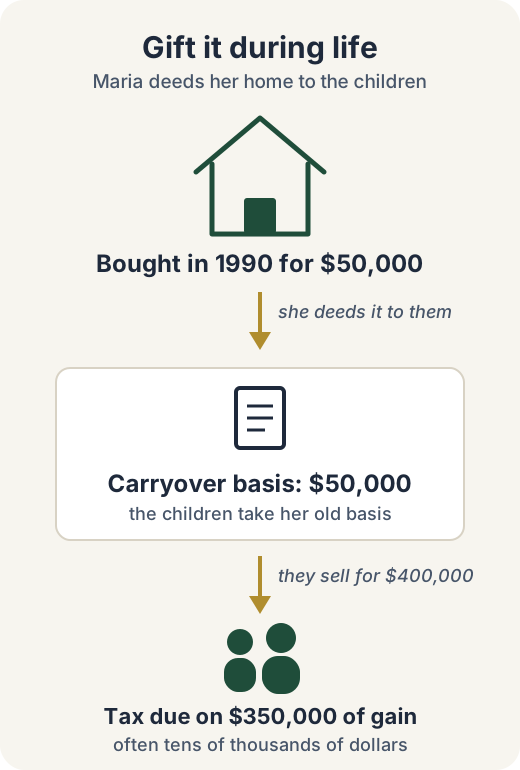
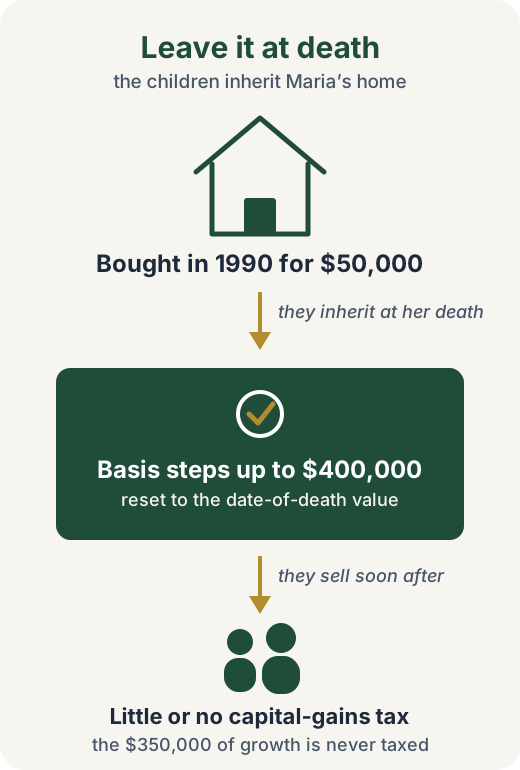
Maria bought her home in 1990 for $50,000. The home is worth $400,000 today.
- Her children inherit it at her death. Their basis steps up to $400,000. The children sell for $400,000 and owe capital gains tax on close to nothing, so the $350,000 of growth is never taxed.
- She deeds it to them during her life instead. The children take her old $50,000 basis. When they sell for $400,000, they owe tax on $350,000 of gain that a step-up would have removed.
The house, the family and the sale price are identical in both versions. The only difference is whether the home passed at death or was given away during life, and that difference is the step-up.
Which Transfers Keep the Step-Up and Which Lose It?
The rule is to let appreciated assets pass at death rather than as gifts during life. Each of the following keeps the full step-up, because none is a completed gift during life.
- Property that passes through a will or a revocable living trust.
- A home that passes by a lady bird deed, which also keeps the home out of probate while delivering the full step-up.
- Investment real estate traded through 1031 exchanges (tax-deferred swaps of one investment property for another) until the owner dies. The deferred gain is never taxed, and the heirs take the stepped-up basis. Many retiring landlords make the last exchange into a Delaware statutory trust.
The step-up is lost when you transfer an appreciated asset outright during life. A quitclaim deed to the children is the usual example, and the deed trades a probate goal for a tax bill and can start a Medicaid penalty under the five-year look-back. See what a lifetime gift costs on the gift tax calculator →
| Keeps the full step-up (passes at death) | Loses the step-up (lifetime gift) |
|---|---|
| Property passing through a will | A quitclaim deed to the children during life |
| A revocable living trust | Adding the children to the deed while you live |
| A lady bird deed, which also skips probate | Any outright gift of an appreciated asset |
How Does the Step-Up in Basis Work for Married Couples?
For most assets a married couple owns jointly, only the deceased spouse’s half steps up at the first death, and the survivor’s half keeps its old basis. With Maria’s numbers, a couple who bought the home jointly for $50,000 would leave the survivor a basis of $225,000 at the first death, $200,000 for the deceased spouse’s half and $25,000 for the survivor’s half. Community property is the exception, because the entire asset steps up at the first death, and the survivor’s basis would be the full $400,000.
Florida is not a community property state by default. A Florida community property trust lets a married couple opt in and aim for that double step-up, which can remove the capital gains tax on highly appreciated stock or real estate. The IRS has not formally confirmed the double step-up for trusts a couple opts into, and the community property trust page explains that uncertainty.
Own an appreciated home, stock or business?
Book a No-Cost Phone Consult with Attorney Kevin D. Klagge, Esq. We check that your plan keeps the step-up and does not give it away through an early transfer.
Book a no-cost consultWhy Don’t Retirement Accounts Get a Step-Up?
Retirement accounts do not get a step-up. IRAs, 401(k)s and similar accounts pass to your heirs still carrying income tax, because the money going in was never taxed. The rule affects how you divide your estate. Leaving appreciated taxable assets (which get the step-up) to your children and directing retirement accounts elsewhere, often to a spouse or a charity, usually lowers the family’s total tax. A charity pays no income tax on an IRA it inherits, and a child pays income tax on withdrawals from an inherited traditional IRA. The beneficiary side of that planning, including when a trust should be the IRA beneficiary, is covered in naming a trust as IRA beneficiary.
Does Florida Tax the Gain on Inherited Property?
Florida has no state income tax, no estate tax and no inheritance tax, so the only tax on the sale of an inherited asset is federal capital gains tax, and the step-up is the federal rule that reduces it. A Florida family therefore plans around one layer of tax. The lady bird deed and the community property trust work here with no state tax on top. For larger estates, portability handles the separate federal estate tax exemption, which is $15 million per person in 2026.
Frequently Asked Questions
What Is the Step-Up in Basis?
When you inherit an asset, its tax basis (the figure used to measure capital gain when the asset is sold) resets to its fair market value on the date the owner died. If you inherit a home worth $400,000 and sell it soon after for $400,000, there is little or no taxable gain, even if the owner paid $50,000 for it decades ago. The step-up removes the tax on the growth during the owner’s life, and much of estate planning is built around keeping it.
How Does Gifting During Life Destroy the Step-Up?
When someone gives you an asset during their life, you take their old basis (called carryover basis) instead of a stepped-up one. A parent who bought a home for $50,000 and deeds it to a child during life passes along a $50,000 basis. If the home is worth $400,000 when the child sells, the child owes capital gains tax on $350,000 of growth that a step-up would have removed. The lost step-up is the main reason that putting the children on the deed is usually a costly mistake.
How Do I Keep the Step-Up for My Heirs?
Let assets pass at death rather than giving them away during life. Property that passes through a will, a revocable living trust or a lady bird deed keeps the step-up, because none of those is a completed gift during life. A lady bird deed keeps your home out of probate and still delivers the full step-up to your children, for a flat fee from $399 plus recording. The step-up is lost when appreciated assets are transferred outright during life, which trades a probate goal for a tax bill.
What Is the Double Step-Up for Married Couples?
For most assets a couple owns jointly, only the deceased spouse’s half gets a step-up at the first death, and the survivor’s half keeps its old basis. Community property gets a step-up on the entire asset, both halves, at the first death. Florida is not a community property state by default, and its community property trust lets a married couple opt in and aim for that double step-up, which can remove the capital gains tax on highly appreciated stock or real estate. The IRS has not formally confirmed the double step-up for these opt-in trusts, so we structure them with that uncertainty in mind.
Do Retirement Accounts Get a Step-Up?
No. IRAs, 401(k)s and similar retirement accounts do not get a step-up in basis. Your heirs pay income tax on the withdrawals just as you would have, because the money was never taxed going in. Leaving appreciated taxable assets, which do get the step-up, to your heirs and directing retirement accounts to a spouse or a charity usually lowers the family’s total tax.
Does a Lady Bird Deed Preserve the Step-Up?
Yes. A lady bird deed reserves full control to you for life and makes no completed gift, so your home passes at your death with a full step-up to its date-of-death value. Your children can sell soon after with little or no capital gains tax, and the home never goes through probate. Deeding the home to them outright loses the step-up and can start a Medicaid penalty.
Does Florida Tax the Gain or the Inheritance?
Florida has no state income tax, no estate tax and no inheritance tax, so the only tax on the sale is federal capital gains tax, and the step-up is the federal rule that reduces it. A Florida family plans around one layer of tax with no state tax on top, and the tools that keep the step-up work the same way here.
Common Situations
The $40,000 mistake. A father deeds his paid-off home to his daughter during his life to "keep it simple." The daughter takes his low basis, and when she sells after his death she owes capital gains tax on decades of growth. A lady bird deed would have passed the home with a full step-up and no tax on that growth.
The long-held stock. A widow holds stock her late husband bought for very little. The stock was community property, so the whole position stepped up at his death, and she can sell with little capital gains tax instead of paying tax on the growth during his lifetime.
The right asset to the right heir. A couple leaves their appreciated brokerage account to their children, who get the step-up, and directs their IRA to charity, which pays no income tax on it. Matching each asset to the right heir saves the family thousands in tax.
The rental property. A retiree wants to deed his long-held rental duplex to his son now, "to keep things simple." Given away during life, the duplex would carry the retiree’s old basis, and the son would owe capital gains tax on decades of growth when he sold. The retiree puts the duplex in his revocable trust instead, so the duplex skips probate and still passes at death with a full step-up. The son inherits at date-of-death value and can sell with little or no tax, and the father gives up nothing while he lives.
Sources of Law
- IRC §1014 (basis of property acquired from a decedent, the step-up to date-of-death value) and §1014(b)(6) (both halves of community property step up at the first spouse’s death). (retrieved 2026-06-08)
- IRC §1012 (cost basis for purchased property); §1015 (carryover basis for gifts); §2040(b) (half of property held jointly by spouses is included at the first spouse’s death); §691 (income in respect of a decedent, why retirement accounts get no step-up).
- Florida imposes no state income, estate, or inheritance tax.
What Families Ask After Somebody Dies
In 14 years of law practice, the step-up is the one piece of tax law that arrives as good news, and the mistake people make is giving it away before they understand it.
A common question I hear is, "Do I owe tax on the house I inherited?" The answer is usually far less than people expect, because an heir is treated as acquiring the house at its value on the date of death rather than at what the parent paid. A house bought for $60,000 and worth $400,000 at the date of death gives the heir a $400,000 starting point, and the $340,000 of gain the parent never realized is never taxed.
What I see cost families real money is the gift made during life. A parent who deeds the house to a child while living hands over the parent’s own basis with it, so the same house sold later carries the whole gain. The transfer that felt generous is the one that created the tax.
Practice pointer. Before transferring any appreciated asset to a child, work out the basis. Where the goal is avoiding probate rather than moving ownership now, a lady bird deed reaches the same place and keeps the step-up.
Avoid assuming everything steps up. Retirement accounts do not, and a family that treats an inherited IRA like an inherited house is planning around a rule that does not apply to it.
Kevin D. Klagge, Esq., admitted in Florida since 2012. Any case described is a decision of a court rather than a matter handled by this firm. General information rather than advice on your situation.
Updated on September 23, 2026. Reviewed by Kevin D. Klagge, Esq., Fla. Bar No. 99502. General information about federal and Florida law, not legal or tax advice, and no attorney-client relationship is created. Tax outcomes depend on your specific facts and on federal law that may change. Do not send confidential information until we have agreed to represent you.
More Guides on Florida Estate Planning
This guide is part of Florida Estate Planning.
- State Estate Tax Calculator
- Estate Tax by State
- Florida Irrevocable Trusts
- Does Florida Have an Estate Tax?
- Do You Pay Taxes on an Inheritance in Florida?
Try the Which Estate Plan Do I Need? (quiz).