
The Short Answer
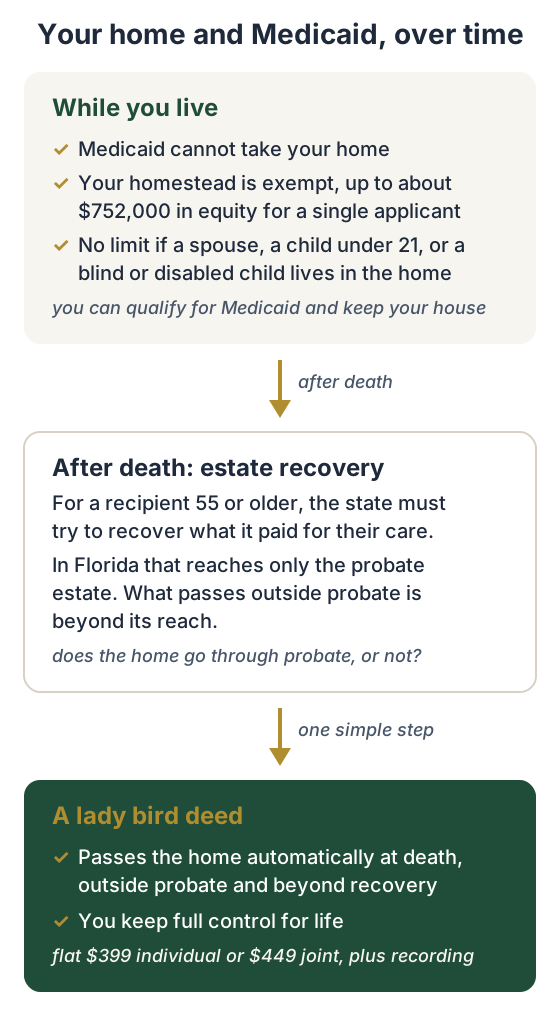
A nursing home is paid for the care it provides, and it has no claim to your house. The worry families bring to me is really about Medicaid, the program that pays for most long-term nursing care in Florida. Medicaid cannot take your home while you are alive, and the house stays yours the entire time you receive care. The risk begins after death, and it reaches the home only if the home passes through probate.
Can Medicaid Take Your Home While You Are Alive?
Florida’s Medicaid rules treat your homestead as an exempt asset while you live there or intend to return. For a single applicant in 2026 the exemption covers home equity up to about $752,000. The limit disappears when your spouse, a child under 21, or a blind or disabled child lives in the home. You can qualify for Medicaid, move into a nursing home and still own your house, and nobody requires you to sell it to pay for your care. A husband or wife who stays in the home keeps more than the house, and the rules on what the community spouse can keep cover the savings and income.
What Happens to the House After You Die?
When a Medicaid recipient who was 55 or older dies, federal law requires the state to try to recover what it paid for that person’s long-term care. The process is called estate recovery. In Florida, the claim reaches only the probate estate, meaning the property that passes through the probate court after death. Property that passes outside probate is beyond the claim. Whether your family keeps the home therefore depends on one question, which is whether the home goes through probate.
How Do You Keep the House in the Family?
Estate recovery reaches only the probate estate, so the fix is to have the home pass outside probate. The tools below run from the simplest to the most involved.
- A lady bird deed. The deed passes your home at death to the people you name, outside probate and beyond estate recovery. You keep full control for life, including the right to sell or change your mind. The flat fee is $399 for one owner and $449 for two, plus recording. How a lady bird deed works →
- Tenancy by the entirety. Married couples who own the home together this way are protected at the first death, because the home passes to the surviving spouse without probate. The survivor still needs a plan for the home at the second death.
- A Medicaid asset protection trust. An irrevocable trust holds the home and savings, and it works only when it is signed more than five years before a Medicaid application. The flat fee starts at $6,000. More on the trust →
A common question I hear is, “Does a lady bird deed have to be made out five years before a person goes into a nursing home?” On a homestead it does not. Florida’s Medicaid manual treats the deed as no transfer at all, so the deed starts no look-back period, and a lady bird deed can often be recorded after a parent has already entered care. The parent still has to understand what he or she is signing, so the deed should be done while the parent can do that.
What About a Second Home or Rental Property?
Everything above concerns your homestead, meaning your primary Florida home. A second home, vacation home or rental property gets none of that protection. Medicaid counts a non-homestead property as an asset, so its value can keep you from qualifying, and the property is fully exposed to estate recovery if it passes through probate. For many families the second home is the property most at risk.
The right approach depends on your timing and on what you want from the property.
- Rent it at a fair price. Florida treats a property that earns reasonable rent as income-producing and disregards its whole value for eligibility, with no cap, even when it is rented only seasonally. The rent itself counts as income. For a rental or a vacation home you can lease out, renting is often the simplest answer.
- Sign a Medicaid asset protection trust at least five years ahead. The irrevocable trust takes the second home out of your countable assets and out of probate, which protects the property from both the spend-down and estate recovery.
- Record a lady bird deed. The deed keeps the property out of probate, so estate recovery cannot reach it at death. The deed does not make the property exempt while you are alive, so for a second home the deed is usually one part of a larger plan.
The table compares the homestead and the second home.
| Your homestead | A second home or rental |
|---|---|
| Exempt while you live there or intend to return | A countable asset, and its value can keep you from qualifying |
| After death, estate recovery can reach it only if it passes through probate | Fully exposed to estate recovery if it passes through probate |
| Protect it with a lady bird deed, tenancy by the entirety (married couples), or a Medicaid asset protection trust | Rent it at a fair price (the rent counts as income), plan five years ahead with a Medicaid asset protection trust, or use a lady bird deed (out of probate, but not exempt while you live) |
Your homestead is largely protected. A second property needs its own plan, and I will tell you at the consult which approach fits it.
Should You Give the House to Your Children?
Deeding the home to the children is the costliest mistake I see families make on their own. A gift of the home is a transfer that can start a five-year Medicaid penalty, which leaves the parent unable to qualify when care is needed. The gift also passes the parent’s old tax basis to the children, so they lose the step-up in basis and can owe capital-gains tax on decades of appreciation when they sell. The house becomes exposed to the children’s own creditors and divorces as well. A lady bird deed keeps the home out of probate and beyond recovery without any of those costs. The Medicaid penalty calculator shows what a gift would cost in lost coverage.
Practice pointer. Families usually give the house away because they believe Medicaid is about to take it, when the homestead was exempt the whole time. Before anyone signs a deed on a parent’s home, confirm whether the home is already exempt and whether a lady bird deed does the same job for $399.
Worried about the house and a parent who needs care?
Book a No-Cost Phone Consult with Attorney Kevin D. Klagge, Esq. I will tell you which tool the home needs, whether that is a $399 deed or a full plan, before you spend anything on it.
Book a no-cost consultWhat It Costs to Protect the Home
For most families the answer is a lady bird deed, a flat fee of $399 for one owner or $449 for two, plus county recording. A Medicaid asset protection trust, which protects savings as well as the home, is a flat fee from $6,000 and works only when it is signed more than five years before an application. The consult is free, and I will recommend the least expensive tool that does the job. When care is needed soon, it is often not too late to protect a real share. See Medicaid planning → or check eligibility →
Frequently Asked Questions
Can a Nursing Home Take Your House in Florida?
A nursing home is paid for the care it provides and has no claim to your house. The worry is really about Medicaid, the program that pays for most long-term nursing care. Medicaid cannot take your Florida home while you are alive. The risk comes after death, through a process called estate recovery, and the claim reaches only property that passes through probate. A home set up to pass outside probate stays in the family.
Will Medicaid Take My Home While I Am Alive?
Medicaid cannot take your Florida homestead while you are alive. The home is an exempt asset while you live there or intend to return, up to a 2026 home-equity limit of $752,000 for a single applicant. There is no limit if your spouse, a child under 21, or a blind or disabled child lives in the home. You can qualify for Medicaid and keep your house, and the home is not sold to pay for your care during your lifetime.
What Is Medicaid Estate Recovery?
Estate recovery is the state’s claim for what Medicaid spent on a person’s long-term care. After a recipient who was 55 or older dies, federal law requires the state to try to recover that cost. In Florida the claim reaches only the probate estate, meaning property that passes through the probate court. Property that passes outside probate is beyond the claim, and a home can be set up to pass outside probate.
Will Medicaid Put a Lien on the House?
Florida does not put a lien on your homestead while you are alive. The state files a claim after death, in the probate case, and the claim reaches only property that actually passes through probate. The lien stories online usually come from states that record liens before death, and Florida uses the probate claim instead. The fix is structural. A home that passes outside probate, usually by a lady bird deed, leaves the claim nothing to attach to.
How Do I Protect My House From Medicaid Estate Recovery?
For most Florida families the simplest tool is a lady bird deed. The deed passes your home to your children at death, outside probate, so estate recovery cannot reach it, and you keep full control during your life. Married couples who own the home as tenants by the entirety are also protected at the first death, because the home passes to the surviving spouse without probate. To protect savings as well as the home, an irrevocable Medicaid asset protection trust works if it is signed at least five years before an application. I will tell you at the consult which one fits.
Should I Just Give My House to My Kids to Protect It?
Giving the house away usually backfires, so talk to a lawyer before you sign anything. A gift of the home is a transfer that can start a five-year Medicaid penalty, which leaves you unable to qualify for care when you need it. The gift also costs your children the step-up in basis, which can mean tens of thousands of dollars in capital-gains tax when they sell, and it exposes the home to their creditors and divorces. A lady bird deed reaches the same goal without any of those costs.
What if My Spouse Still Lives in the House?
A home your spouse still lives in has two protections. The home is exempt while your spouse lives there, with no equity limit, and Florida cannot pursue estate recovery while a surviving spouse is alive. When one spouse needs nursing care and the other stays home, Florida’s spousal rules are written to keep the well spouse in the house with a share of the couple’s savings. Medicaid planning handles this situation well.
What About My Second Home, Vacation Home, or Rental Property?
A second home gets none of the homestead’s protection, and it is usually the property most at risk. Medicaid counts a non-homestead property as an asset, so its value can keep you from qualifying, and the property is fully exposed to estate recovery if it passes through probate. Renting it at fair value makes it income-producing, and Florida disregards income-producing property for eligibility with no cap, even if it is rented only seasonally, although the rent counts as income. An irrevocable Medicaid asset protection trust signed five years ahead removes the property from your countable assets and from probate. A lady bird deed at least keeps it out of probate and beyond recovery at death. The right combination depends on your timing, and I sort it out at the consult.
Is My House Safe if I Have Not Done Any Planning?
The house is exempt while you are alive. Without planning, it will likely pass through probate at your death, and probate is where estate recovery reaches it. A lady bird deed can often be recorded even after a parent has entered care, because the deed is not a gift, and the home then passes outside probate and beyond recovery. Sooner is safer, and a consult is worth having at any stage.
How Much Does It Cost to Protect the Home?
A lady bird deed, the most common tool, is a flat fee of $399 for one owner or $449 for a joint deed, plus county recording. A Medicaid asset protection trust, which protects savings as well as the home, is a flat fee from $6,000. The phone consult costs nothing, and I will tell you whether you need the deed alone or the larger plan.
Common Situations
A daughter who fears the house is lost. Her father needs nursing care, and she assumes the home will go to pay for it. The home is exempt while he lives, so he can qualify for Medicaid and keep it. A lady bird deed recorded now passes the home to her at his death, outside probate, where estate recovery does not reach.
A couple with one spouse in care. A husband enters a nursing home and his wife stays in their Naples home. Because she lives there, the home is exempt with no equity limit, and Florida’s spousal rules let her keep the house and a share of their savings. Estate recovery cannot begin while she is alive.
A widow who already gave the house to her son. She deeded the home to her son to protect it, applied for Medicaid six months later and ran into a transfer penalty. A lady bird deed would have kept the home out of probate with no penalty and no loss of the step-up in basis.
What I See When Families Ask About the House
In my practice, the most expensive answer to this question is the one a family reaches before calling anyone, which is deeding the house to a child. The deed takes a week to record, and the Medicaid application that follows months later runs straight into the five-year look-back.
The first point I make is about timing. The homestead was exempt the whole time, so the gift protected nothing while the parent was alive, and it created a penalty period during which Medicaid pays nothing and the family pays the facility itself.
The second point is about the house after the parent dies. A home given away carries the parent’s old tax basis, so a child who sells a home bought for $90,000 and worth $300,000 pays tax on $210,000 of gain. The same home passing by a lady bird deed at death takes a new basis of $300,000. Avoid signing any deed on a parent’s house until someone has checked whether the home is already exempt, because in most Florida families it is.
The limit on all of this is that the figures move. The $752,000 equity limit changes every January, and the legislature decides what estate recovery reaches, so a plan signed today should be checked against the rules in the year of the application.
Kevin D. Klagge, Esq., admitted in Florida since 2012. The patterns described above are general and do not describe any client’s matter. Past results do not guarantee a similar outcome.
Chapter 14 of Kevin D. Klagge’s free book, Are Florida Lady Bird Deeds Just for Women?, covers this question with every statute and case cited to its source.
Sources of Law
- Fla. Stat. §409.9101: Florida Medicaid estate recovery, limited to the probate estate. flsenate.gov (retrieved 2026-07-11)
- Federal Medicaid rules: 42 U.S.C. §1396p (estate recovery for recipients 55+, the homestead exemption while residing, and the five-year transfer look-back).
- 2026 Florida ICP home-equity limit (about $752,000, single applicant; no limit with a spouse or a child under 21 or a blind or disabled child in the home). Lady bird (enhanced life estate) deeds are recognized by Florida common law and title practice.
- Medicaid estate recovery rules and the treatment of a house passing by lady bird deed, transfer on death deed, joint tenancy or revocable trust in all 50 states and DC are in the 50-state Medicaid estate recovery table (verified 2026-09-28).
Updated on September 23, 2026. Reviewed by Kevin D. Klagge, Esq., Fla. Bar No. 99502. General information about Florida law and 2026 Medicaid figures, not legal advice; figures change annually and eligibility turns on your specific facts. No attorney-client relationship is created. Do not send confidential information until we have agreed to represent you.
More Guides on Florida Elder Law
This guide is part of Florida Elder Law.
