
What Does a Florida Nursing Home Cost in 2026?
A shared room in a Florida nursing home costs about $10,300 a month, and a private room about $12,200. Assisted living, a lower level of care, costs about $5,600 a month. The table gives the yearly figures.
| Type of care | Average monthly | Average yearly |
|---|---|---|
| Nursing home, semi-private room | ~$10,300 | ~$124,000 |
| Nursing home, private room | ~$12,200 | ~$146,000 |
| Assisted living facility | ~$5,600 | ~$67,000 |
| In-home caregiver (44 hrs/wk) | ~$6,100 | ~$73,000 |
Figures are Florida statewide medians from the CareScout (Genworth) 2025 Cost of Care Survey, rounded. Actual prices vary by county and facility and rise most years.
Does Medicare Pay for a Florida Nursing Home?
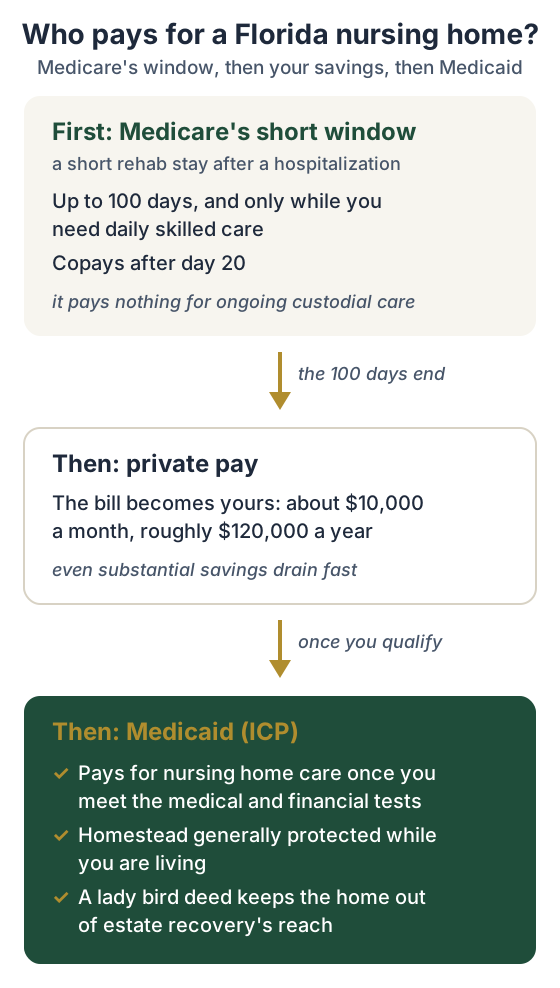
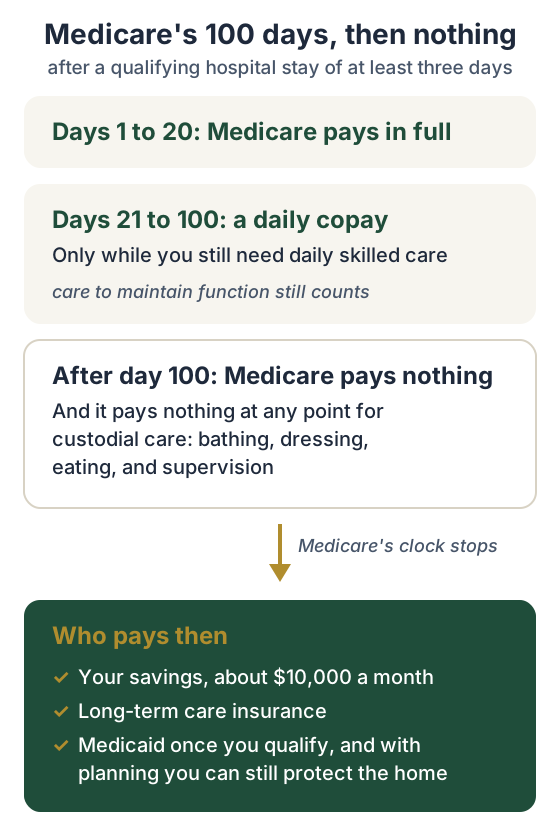
Medicare does not pay for a long nursing home stay, and no misunderstanding on this subject costs families more. Medicare is health insurance. After a hospital stay of at least three days, Medicare covers a short rehab stay of up to 100 days, and only while you need daily skilled care. Days 1 to 20 are covered in full, and days 21 to 100 carry a copay of $217 a day in 2026. Medicare pays nothing for custodial care, meaning the daily help with bathing, dressing and eating that most nursing home residents need for months or years. When the 100 days end, the bill becomes yours. For assisted living the answer is shorter, because Medicare does not pay for assisted living room and board at all. See exactly what Medicare does and doesn’t cover →
A common question I hear is, “Will Medicare keep paying after the 100 days?” Medicare will not. The 100 days is a maximum for each benefit period, and coverage ends sooner when you no longer need daily skilled care.
Practice pointer. Families often wait for the Medicare days to run out before anyone looks at Medicaid. Start the Medicaid review during the rehab stay, because the private-pay bill begins the day Medicare coverage ends, and the application takes weeks to assemble.
Does Florida Medicaid Pay for Nursing Home Care?
Florida’s Institutional Care Program (ICP Medicaid, the program for nursing home residents) pays for nursing home care once you meet the medical and financial tests. The financial limits are strict, and many assets are exempt, including your homestead while you are living. The goal of Medicaid planning is to qualify without spending everything you have first. The Medicaid eligibility calculator shows where you stand today.
When income is over Florida’s cap, a qualified income trust is required. The trust is a special account that holds the income over the cap so you can still qualify, and I prepare one for a flat fee of $750, which includes getting the account opened.
How Do Families Protect the Home From the Bill?
The house is usually the largest asset a family has at stake. Two rules work in your favor, and one mistake works against you.
- The homestead is exempt while you are alive and on Medicaid.
- Estate recovery reaches only the probate estate. A lady bird deed passes the home outside probate, which keeps the home beyond the claim. The flat fee is $399 for one owner and $449 for two, plus recording.
- Giving the home away is the mistake. A gift starts the five-year Medicaid look-back penalty and costs your heirs the step-up in basis. The gift tax calculator shows how gifting backfires, and the penalty calculator shows what a transfer would cost in lost coverage.
Planning before care begins leaves the most options.
Even in a crisis, an elder law attorney can often protect a real share of the estate. Book a No-Cost Phone Consult with Attorney Kevin D. Klagge, Esq., and I will tell you what is possible.
Book a no-cost consultFrequently Asked Questions
How Much Does a Nursing Home Cost in Florida in 2026?
A shared (semi-private) room in a Florida nursing home averages about $10,300 a month, and a private room about $12,200 a month, roughly $124,000 to $146,000 a year, according to the CareScout (formerly Genworth) 2025 Cost of Care Survey. Assisted living, a lower level of care, averages about $5,600 a month. Prices vary by region and facility and rise most years.
Does Medicare Pay for Nursing Home Care in Florida?
Medicare pays only for a short stay. After a qualifying hospital stay, Medicare covers skilled nursing care for up to 100 days, and only while you need daily skilled care, with a copay of $217 a day from day 21 in 2026. Medicare pays nothing for long-term custodial care, meaning the daily help with bathing, dressing and eating that most nursing home residents need. The gap between those two kinds of care is what surprises families.
Who Pays for Long-Term Nursing Home Care, Then?
Long-term nursing home care is paid from your own savings, from long-term care insurance if you bought it, or by Medicaid once you qualify. Most Florida families end up on Medicaid, because at $10,300 a month even substantial savings run out quickly. The real question for most families is how much of the estate is gone before Medicaid starts paying.
Does Florida Medicaid Cover Nursing Home Costs?
Florida’s Institutional Care Program (ICP) Medicaid pays for nursing home care for people who meet the medical and financial rules. The 2026 income and asset limits are strict, and many assets are exempt, including in most cases your homestead while you are alive. Planning aims to qualify without spending down everything first.
Will I Lose My House to Pay for a Nursing Home?
Your Florida homestead is generally exempt while you are alive and on Medicaid, so you do not lose the house automatically. The risk comes after death, through Medicaid estate recovery, and Florida’s claim reaches only the probate estate. A lady bird deed passes the home outside probate, which is why the deed is the standard tool for protecting the house. Giving the home away is the wrong move, because a gift starts a Medicaid penalty.
How Long Will My Savings Last at $10,000 a Month?
At $10,000 a month, $200,000 in savings covers about 20 months of nursing home care, and $500,000 covers about 50 months. The estimate near the top of the page runs your own numbers. Most families are surprised by how short the runway is, and planning before a crisis leaves the most options.
Can I Protect Assets and Still Qualify for Medicaid?
Often you can, with planning done in time. Florida allows several legitimate strategies, including converting countable assets into exempt ones, certain annuities, personal services agreements, and the protections for a husband or wife still at home. None of them involves hiding money. The strategies work best before the five-year look-back matters, which is why early advice saves the most.
When Should I Talk to a Medicaid Planning Attorney?
Talk to one as early as possible, ideally years before care is needed, although it is rarely too late. Even after someone has entered a nursing home (a crisis case), an elder law attorney can often protect a meaningful share of the estate. The most damaging move is to start gifting or transferring on your own, because that usually makes the Medicaid problem worse.
How Long Will Medicaid Pay for a Nursing Home?
Florida Medicaid pays for nursing-home care for as long as the resident stays eligible, with no 100-day limit of the kind Medicare uses. Eligibility rests on the same three tests that applied at the start, meaning income at or under $2,982 a month or a qualified income trust, countable assets of $2,000 or less for a single resident, and a need for nursing-home level care. A resident whose countable savings climb back over $2,000, from a tax refund or an inheritance, can lose coverage, so whoever manages the money should watch the balance.
Do You Have to Pay Anything Once Medicaid Covers the Nursing Home?
Yes, most residents pay part of the bill from their own income. Almost all monthly income, including Social Security and any pension, goes to the facility as the resident’s share, and Medicaid pays the rest. The resident keeps a personal needs allowance of about $160 a month plus enough to cover health insurance premiums. Where a husband or wife still lives at home on a small income, part of the resident’s income can go to that spouse instead, up to a 2026 maximum allowance of $4,067 a month.
Common Situations
The 100-day surprise. A daughter assumes Medicare covers her father’s nursing home. After 100 days the facility hands her a private-pay bill of about $10,000 a month. The next steps are to qualify him for ICP Medicaid and to record a lady bird deed on the homestead before estate recovery can reach it.
A couple afraid of losing everything. A couple believes that one spouse entering care means losing everything. Florida’s spousal protections let the spouse at home keep the house and a share of the savings, and planning decides how large that share is.
The early planner. A healthy 68-year-old wants to be ready. She plans well before the five-year look-back matters, so she has the widest set of options and the least expensive way to protect her Sarasota home.
What I Tell Families About the Bill
I see cases where the family first learns the price of a nursing home from the facility’s business office, on the day Medicare coverage ends. By then the parent has been in the building for weeks, and the first private-pay invoice for a shared room is about $10,300.
I make two points in the first conversation. The first is arithmetic. At $10,300 a month, $300,000 of savings lasts about 29 months. Twenty-nine months is less time than most families assume, and it is enough time to plan if the planning starts in the first month.
The second point is the house. The Florida homestead is exempt while the parent is alive, so nobody has to sell it to pay the facility, and a lady bird deed recorded now keeps the home out of the probate estate that recovery reaches. Avoid selling the house or borrowing against it to pay the first months until someone confirms whether the home is exempt, because equity spent on the facility is equity Medicaid would have ignored.
The limit on this arithmetic is that the survey figures are statewide medians, and your facility’s rate may be higher or lower. Run the estimate with the rate on the facility’s own admission paperwork.
Kevin D. Klagge, Esq., admitted in Florida since 2012. The patterns described above are general and do not describe any client’s matter. Past results do not guarantee a similar outcome.
Sources of Law
- Cost figures: CareScout (Genworth) 2025 Cost of Care Survey, Florida statewide medians, rounded. carescout.com (retrieved 2026-07-11)
- Medicare skilled-nursing coverage limits (up to 100 days, post-hospitalization): 42 U.S.C. §1395, Medicare benefit policy; 2026 day 21 to 100 coinsurance $217/day per CMS CY 2026 rates. (retrieved 2026-07-11)
- Fla. Stat. §409.9101: Florida Medicaid estate recovery, limited to the probate estate. flsenate.gov
- Federal Medicaid transfer rules: 42 U.S.C. §1396p (5-year look-back; homestead exemption while residing).
Updated on October 1, 2026. Reviewed by Kevin D. Klagge, Esq., Fla. Bar No. 99502. General information about Florida law and average costs, not legal, tax, or financial advice; figures are estimates that change over time. No attorney-client relationship is created.
More Guides on Florida Elder Law
This guide is part of Florida Elder Law.
