What a Beneficiary Form Controls
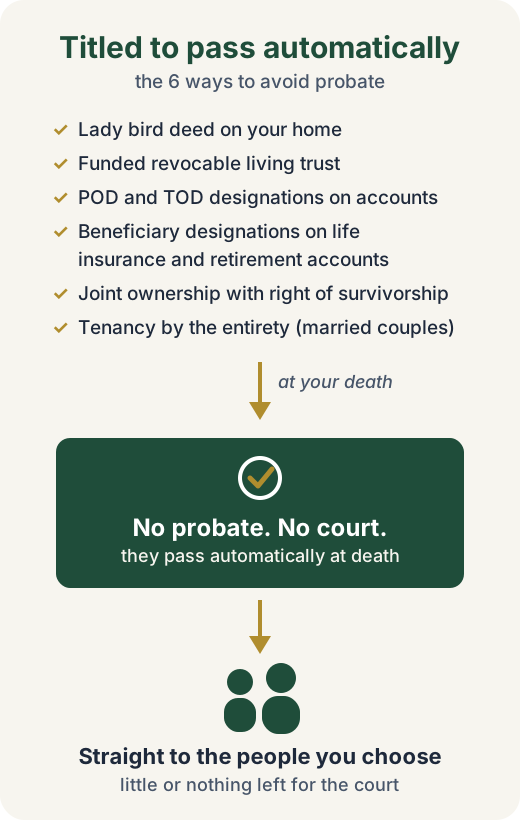
Your retirement accounts, life insurance, annuities, and any pay-on-death or transfer-on-death accounts pass directly to the person named on the beneficiary form, outside your will or trust. If the form and the will disagree, the form wins. A well-drafted will can still leave your savings to the wrong person when a form is out of date. See what happens to your IRA or 401(k) when you die →
What Happens When a Form Is Out of Date
The risk is a form nobody updated, such as a life insurance policy that still names an ex-spouse or a 401(k) that names a parent who has died. Florida law voids most designations to an ex-spouse at divorce, but the Florida rule does not reach 401(k)s and other employer plans. Federal law overrides Florida’s rule for those plans and pays whoever is on the form, ex-spouse included. The state rule also has exceptions, and a company that never learned of the divorce can pay under the old form before anyone objects. If you do not change the forms yourself, your ex-spouse can still collect, even when your will and trust are current.
When did you last check your beneficiary forms?
Book a No-Cost Phone Consult with Attorney Kevin D. Klagge, Esq. We review every designation and align it with your plan.
Book a no-cost consultWhat Happens to My 401(k) When I Get Divorced?
A divorce does not take your ex-spouse off your 401(k). Florida voids a designation naming a former spouse, as of the date the marriage was dissolved, where the designation was signed before the divorce, and the former spouse is then treated as though they had died first. The Florida statute yields wherever controlling federal law provides otherwise, and for a 401(k) or another employer plan federal law does provide otherwise. The plan administrator pays the name on the form.
The accounts therefore fall into two groups, and only you can fix one of them. An individual retirement account and a life insurance policy you own privately fall under the Florida rule, as does a pay-on-death bank account. An employer 401(k), a pension and most employer group life insurance fall outside it. A reader who remembers only "Florida takes my ex off automatically" has the wrong answer for the 401(k), which is often the largest account.
Two smaller points also matter. The Florida rule applies to anyone who died on or after July 1, 2012, whenever the form was signed, so an old form is still covered. A company that never heard about the divorce can pay the old designation before anyone objects, and getting the money back then takes a lawsuit.
Primary, Contingent, and Why Backups Matter
Your primary beneficiary is first in line, and your contingent (backup) beneficiary takes only if the primary cannot. If your only named beneficiary dies before you and no backup is named, the asset can pass into your probate estate, which is what the designation was meant to avoid. Name both, and keep both current.
Who Should You Name?
Naming "my estate" usually sends the asset through probate and can speed up the income tax on a retirement account, so an estate is rarely the right choice. Naming a person is simple but gives no protection if the beneficiary is a minor or has trouble managing money. A properly drafted trust can protect the money, and for a retirement account the trust has to be drafted around the SECURE Act’s ten-year payout rule. The right choice depends on your family. For bank and brokerage accounts, see how POD and TOD accounts work in Florida.
Frequently Asked Questions
Do Beneficiary Designations Override a Will in Florida?
Yes. Your retirement accounts, life insurance, annuities, and any pay-on-death or transfer-on-death accounts pass to the person named on the beneficiary form, outside your will or trust. If your will says one thing and your 401(k) beneficiary form says another, the form controls. A well-drafted will can therefore still send money to the wrong person, and reviewing the designations matters as much as the will itself.
What Happens if I Forget to Update a Beneficiary?
The old designation controls, even if your life has changed. A life insurance policy can still name an ex-spouse, and a 401(k) can still name a parent who has since died. Florida law voids most beneficiary designations in favor of an ex-spouse at divorce, but do not rely on it. Federal law overrides the Florida rule for 401(k)s and other employer plans, so the plan pays the named ex-spouse. The statute also has a list of exceptions, and a company that has not been told about the divorce can pay under the old form. Update every form after a divorce.
What Is the Difference Between a Primary and Contingent Beneficiary?
The primary beneficiary is first in line to receive the asset. The contingent (backup) beneficiary receives it only if the primary has died or cannot take it. If your only named beneficiary dies before you and no backup is named, the asset can pass into your probate estate, which is the result a beneficiary designation is meant to avoid. We make sure both levels are named and current.
Which Assets Pass by Beneficiary Designation?
Retirement accounts (IRAs, 401(k)s), life insurance, annuities, and bank or brokerage accounts set up as pay-on-death (POD) or transfer-on-death (TOD). Florida real estate can also pass outside probate through a lady bird deed. None of these pass under your will. The assets that do pass under your will are the ones in your sole name with no beneficiary, survivorship or POD feature, so a working plan coordinates the forms with the will.
Should My Beneficiary Be My Estate, My Trust, or a Person?
The answer depends on the account and the family. Naming "my estate" usually sends the asset through probate and can speed up the income tax on a retirement account, so an estate is rarely the right choice. Naming a person is simple but gives no protection if the beneficiary is a minor or has trouble managing money. A properly drafted trust can protect the money, and for a retirement account the trust has to be drafted around the SECURE Act’s ten-year payout rule. We match the designation to your goals.
How Often Should I Review My Beneficiary Designations?
Review them after every major life event, such as a marriage, a divorce, a birth or a death, and otherwise every few years. A review takes minutes. When we build a plan, we check the designation on every IRA, insurance policy, POD account and joint account, and align each one with your will or trust so no form sends money to someone you did not intend.
Common Situations
The ex who inherited. A man divorced, remarried, and updated his will, but never changed the beneficiary on his employer 401(k). At his death, federal law required the plan to pay his ex-wife, whose name was still on the form, rather than his current wife. The form controlled over both the will and Florida’s divorce rule.
The missing backup. A widow named only her sister on her IRA. Her sister died first, and with no contingent beneficiary the IRA’s default terms paid the account to her estate. The money went through probate, which delayed it and reduced what reached her children.
The minor grandchild. A grandmother names her eight-year-old grandson as the beneficiary of her life insurance. An insurer will not pay a large sum to a child, and above a modest amount Florida requires a court-appointed guardian to hold a minor’s money, with court oversight until he becomes an adult. The family ends up in guardianship court over a designation meant to keep things simple. Naming a trust for the grandson, or an adult custodian under Florida’s transfers-to-minors law, delivers the same gift without a guardianship.
A beneficiary who does not want an inheritance has a limited time to refuse it. See how disclaiming an inheritance works and the 9-month deadline.
Each institution writes its own rules into its form, and the beneficiary designation rules dataset quotes what 247 banks, brokers, plans and insurers say about per stirpes, trusts, spousal consent and divorce.
Sources of Law
- Beneficiary designations, POD/TOD accounts, and life insurance/retirement proceeds pass outside the will or trust. Fla. Stat. §732.507 (divorce voids will provisions for a former spouse); §736.1105 (annotated) (trusts); §732.703 (divorce also voids most non-ERISA beneficiary designations to a former spouse, with exceptions and payor protections). ERISA preemption: Egelhoff v. Egelhoff, 532 U.S. 141 (2001); Kennedy v. Plan Administrator for DuPont, 555 U.S. 285 (2009). Retirement payout: SECURE Act 10-year rule. (retrieved 2026-06-10)
- Effect of divorce on a designation: Fla. Stat. §732.703(2) (a designation to a former spouse "is void as of the time the decedent's marriage was judicially dissolved", where the designation was made before the dissolution, and the interest passes as if the former spouse predeceased); §732.703(4)(a) (the section does not apply "[t]o the extent that controlling federal law provides otherwise", which is why employer plans are not reached); §732.703(4)(b) to (j) (further exceptions, including a later instrument expressly benefiting the former spouse, a court order requiring the asset be maintained, an irrevocable designation, another state's governing law, co-owned assets passing to a survivor, remarriage to the same person, and chapter 121 state plans); §732.703(9) ("This section applies to all designations made by or on behalf of decedents dying on or after July 1, 2012, regardless of when the designation was made").
- Cooper v. Muccitelli, 682 So. 2d 77, 78-79 (Fla. 1996), read in full. Two policies named the wife, the dissolution settlement released all claims but never mentioned the policies, one policy was changed a month before death and the other left alone, and the proceeds of roughly $100,000 went to the former spouse. "To determine whom Thomas intended as beneficiary, we need look no further than the plain language of the policy itself." Footnote 1 records the counterfactual, that "a settlement agreement that specifically requires one of the parties to maintain a named individual as beneficiary will control the disposition of proceeds upon notice to the insurer", citing Cantrell v. Home Life Ins. Co., 524 So. 2d 1063 (Fla. 5th DCA 1988). Decided before §732.703 was enacted. (Opinion read 2026-09-08; statute retrieved 2026-09-08.)
What I Have Learned About These Forms
In 14 years of law practice, the mistake I see on these forms is rarely ignorance that the form exists. Somebody updates one account and stops.
A Florida case from 1996 shows what that costs, and I keep it in mind whenever a client tells me the paperwork is handled. A man bought two life insurance policies during his marriage and named his wife the primary beneficiary of both, with his sister as the backup on one of them. The couple divorced in July 1992. Their settlement released every claim each of them had against the other and said nothing at all about the policies. His former wife remarried the following month and moved to Germany.
In December he sat down with his paperwork and changed the beneficiary on one of the two policies, naming his stepdaughter, his two children from an earlier marriage, and his parents. He left the other policy exactly as it was. He died the next month. His sister and his former wife both claimed the money, and the Florida Supreme Court gave the roughly $100,000 to the former wife in Germany, holding that it need look no further than the plain language of the policy to know whom he had named.
The detail I find useful is that he was not confused about how any of this worked. He proved he knew how to change a beneficiary, because he had just done it on the other policy, weeks earlier. He simply did not finish. A court reading two forms afterward cannot give effect to the half of the job he intended and did not do.
A question I hear about this is, "Doesn't my divorce take my ex off automatically?" For some accounts Florida now says yes, and the answer above explains which ones. For a 401(k) the answer is still no.
Practice pointer. When a divorce is what prompted the review, the settlement agreement is where I want the policy named. The same court noted, in a footnote, that an agreement specifically requiring one party to keep a named person as beneficiary does control, once the insurer is told. A general release of all claims does not do it, which is exactly what that settlement had. Naming the policy and the person in the agreement, and then giving the insurer notice, is what makes the agreement control the proceeds.
Avoid reviewing accounts one at a time as they come to mind. The failure mode is a partial pass, where the accounts a person happens to think of get fixed and the forgotten one carries an ex-spouse or a dead parent for another decade. I ask for a list of every account first, then work down it, because the account nobody mentions is the one that generates the lawsuit.
An honest limit belongs here. The 1996 case was decided before Florida enacted the statute that now voids a former spouse's designation, so a private life policy on those facts would probably come out differently today. What has not changed is the carve-out for accounts governed by federal law, and what has never changed is that a form nobody updated speaks for itself. I would rather spend twenty minutes reading your forms than argue afterward about what you meant.
Kevin D. Klagge, Esq., admitted in Florida since 2012. General information rather than advice on your situation.
Updated on September 23, 2026. Reviewed by Kevin D. Klagge, Esq., Fla. Bar No. 99502. General information about Florida law, not legal or tax advice, and no attorney-client relationship is created. Coordinating designations depends on your facts. Do not send confidential information until we have agreed to represent you.
More Guides on Florida Estate Planning
Try the Which Estate Plan Do I Need? (quiz).