The Short Answer
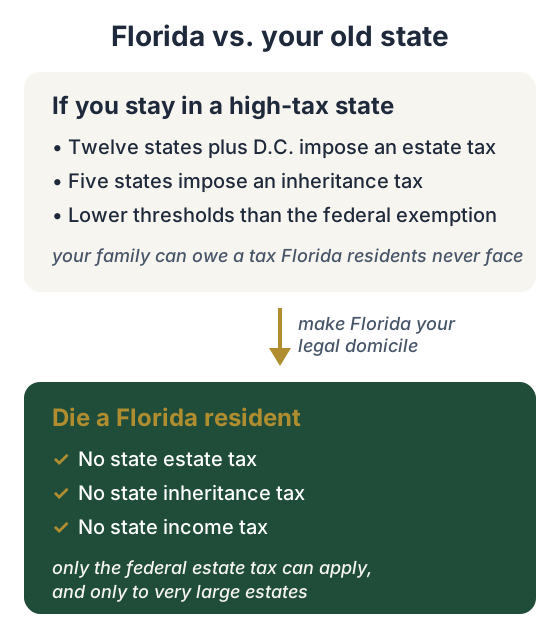
Florida charges no estate tax, no inheritance tax and no income tax. When a Florida resident dies, the only death tax that can apply is the federal estate tax, and the federal exemption is $15,000,000 per person in 2026. A Florida estate below that figure owes no death tax. The state you are leaving is a separate question, because several states tax estates at a fraction of the federal threshold.
The States That Still Tax Your Estate
Most states, Florida included, have no estate or inheritance tax. A person who lives in, or owns real estate in, one of the states below can leave the family a tax bill that a Florida resident does not face.
Swipe the table sideways to see each state’s threshold.
| State | Type | What it taxes |
|---|---|---|
| Massachusetts | Estate | Taxes estates over $2,000,000, and the exemption does not carry over to a surviving spouse |
| Oregon | Estate | Taxes estates over $1,000,000 |
| New York | Estate | Taxes estates over $7,350,000. Above $7,717,500 the exemption is lost and the entire estate is taxed |
| Washington | Estate | Taxes estates over $3,000,000 at 10% to 20% for deaths from July 1, 2026. For deaths from January 1 to June 30, 2026, the exclusion was $3,076,000 and rates reached 35% |
| Illinois, Minnesota, Rhode Island, Vermont, Hawaii, Maine | Estate | Illinois taxes estates over $4,000,000, Minnesota over $3,000,000, Rhode Island over $1,838,056, Vermont over $5,000,000, Hawaii over $5,490,000 and Maine over $7,160,000 |
| New Jersey, Pennsylvania, Kentucky, Nebraska | Inheritance | Tax the person who inherits, at rates set by the heir’s relationship to the person who died, and a surviving spouse pays none. Iowa repealed its inheritance tax for deaths on or after January 1, 2025 |
| Connecticut | Estate | Follows the federal exemption of $15,000,000 |
| Maryland | Both | Taxes estates over $5,000,000 and also taxes inheritances, the only state with both |
Figures are for 2026 and change often. We confirm the current figures for your state at the consult.
Plan to the State Number, Not the Federal One
The federal exemption is $15,000,000 per person, and advisors routinely tell clients below that figure they have nothing to worry about. The advice is correct for the federal tax. A family worth $3,000,000 owes no federal estate tax and can still owe estate tax in Massachusetts or Oregon, and a plan built only to the federal figure leaves that state bill in place. Congress made the $15,000,000 federal figure permanent in 2025, which moves most of the planning work to the state level, and we sorted through what the change does and does not do for Florida families in what the $15 million exemption means here.
How Florida Saves It: Change Your Domicile
A person who makes Florida their legal domicile before death leaves an estate generally governed by Florida law, which has no estate tax, rather than the old state’s law. New York taxes estates over $7,350,000 in 2026, and above $7,717,500 the exemption is lost and the entire estate is taxed, so a New York family near that figure has the most at stake. The move has to be real. New York and other high-tax states run domicile audits, and buying a Florida condo is not enough. You establish Florida as your true home and document it with a recorded Declaration of Domicile, a Florida license and voter registration, the homestead exemption, an estate plan redone under Florida law, and a day-count that clearly favors Florida. We prepare the documents and give you the checklist.
Moving to Florida from a state that taxes estates?
Book a No-Cost Phone Consult with Attorney Kevin D. Klagge, Esq. We map the domicile move and the Florida estate plan, and work with your home-state counsel where needed.
Book a no-cost consultHow Many Months Do I Have to Live in Florida to Be a Resident?
The question I get most about this is, “How many months do I have to live in Florida?” Florida sets no month requirement for domicile. Florida asks where your permanent home is and treats that as a question of fact. The day count that decides your tax bill belongs to the state you left, and many high-tax states apply a 183-day test of their own, so the calendar matters even though Florida never mentions one.
Five months a year in Florida can be enough for Florida and not enough for a state that counts 183 days against you. The old state runs the audit, so the record of your days has to satisfy that state’s rules rather than ours. Flight receipts, credit card statements and the phone’s own location history are worth keeping year by year rather than reconstructing later.
Out-of-State Real Estate and the Planning Tools
Real estate outside Florida. Real estate you keep in another estate-tax state can still be taxed by that state, because real property is taxed where it sits. A Florida retiree with a vacation home in Maine or Massachusetts can owe that state’s estate tax on the home, and the usual fix is holding the property in an entity or trust. Run your own numbers on the state estate tax calculator. If you cannot move, certain irrevocable trusts and lifetime gifts can reduce a taxable estate in your home state. Common tools include a qualified personal residence trust for the home, an irrevocable life insurance trust for policy proceeds, and a charitable remainder trust for charitably inclined families. For married couples, estate tax portability preserves a deceased spouse’s federal exemption (claimed by filing Form 706). A community property trust and other irrevocable trusts address the tax on appreciated assets, and a QTIP trust can provide for a surviving spouse while controlling where the assets go afterward. We match the tools to your state and your goals.
Frequently Asked Questions
Does Florida Have an Estate Tax or Inheritance Tax?
No. Florida has no state estate tax, no state inheritance tax and no state income tax. When a Florida resident dies, the only death tax that can apply is the federal estate tax, and the federal exemption is $15,000,000 per person in 2026. A Florida estate below that figure owes no death tax at all.
Which States Still Have an Estate or Inheritance Tax?
As of 2026, twelve states and Washington, D.C. impose an estate tax, namely Connecticut, Hawaii, Illinois, Maine, Maryland, Massachusetts, Minnesota, New York, Oregon, Rhode Island, Vermont and Washington. Five states impose an inheritance tax, namely Kentucky, Maryland, Nebraska, New Jersey and Pennsylvania, and Maryland is the only state that imposes both. Iowa repealed its inheritance tax for deaths on or after January 1, 2025. A person who lives in one of these states, or owns real estate there, can leave the family a tax bill that a Florida resident does not face.
Does Moving to Florida Really Avoid State Estate Tax?
Yes, when the move is real. State estate tax follows domicile at death, so a genuine move to Florida removes the old state's estate tax from everything except real estate still owned there. Proof decides the question. A driver license and voter registration alone convince nobody, and the old state's auditors look at where you spent your days, where your home, doctors and advisors are, and whether you recorded a Florida declaration of domicile. The audit happens after death, when you are not there to explain, so the record has to be built during life.
Why Does the Federal Exemption Hide the Real Problem?
The federal estate tax exemption is $15,000,000 per person in 2026, so many advisors tell clients below that figure they have nothing to worry about. The advice is correct for the federal tax and incomplete for the state tax. Massachusetts taxes estates over $2,000,000 and Oregon taxes estates over $1,000,000. A family worth $3,000,000 owes no federal estate tax and can still owe estate tax in either state, so a plan has to be built to the state threshold.
How Does Moving to Florida Save Estate Tax?
A person who changes legal domicile to Florida before death leaves an estate governed by Florida law, which has no estate tax, instead of the former state's law. New York, for example, taxes estates over $7,350,000 in 2026, and above $7,717,500 the exemption is lost and the entire estate is taxed. The move has to be real, because New York and other high-tax states audit domicile, and buying a Florida condo is not enough. You establish Florida as your true home and document it, and we handle the legal side of that move.
If I Move to Florida, Is My Whole Estate Safe?
Nearly all of it. Real estate you keep in another state that has an estate tax can still be taxed by that state, because real property is taxed where it sits, not where the owner lives. A Florida retiree who keeps a vacation home in Maine or Massachusetts can owe that state's estate tax on the home. The usual fix is to change how the out-of-state property is owned, often by placing it in an entity or trust, and we plan that as part of the move.
What Does It Take to Establish Florida Domicile?
A genuine relocation, backed by paperwork. The steps are a recorded Declaration of Domicile, a Florida driver license and voter registration, the Florida homestead exemption, an estate plan redone under Florida law, a majority of your time spent here, and cutting ties to the old state. The day count carries the most weight, because high-tax states count your days. An auditor weighs the whole pattern rather than any single step, and we give you the checklist and prepare the documents.
I Can’t Move. Can I Still Reduce My State Estate Tax?
Sometimes, yes. A person who stays in a high-tax state can reduce the taxable estate with certain irrevocable trusts and lifetime gifts, and a married couple can plan to use both spouses’ state exemptions. The rules differ from state to state, so this work is coordinated with counsel in your home state, and we do that coordination.
Does Florida Have a Gift Tax?
No. Florida has no gift tax. The only gift tax is federal, and most people never owe it because of the annual exclusion of $19,000 per recipient in 2026 and the $15,000,000 lifetime exemption. A Florida resident making lifetime gifts deals with the federal rules only.
Common Situations
The Boston couple worth $3 million. Their advisor said they were "under the exemption," meaning the federal one. Their estate was over the Massachusetts $2,000,000 threshold and faced Massachusetts estate tax. Establishing Florida domicile, with the paperwork to back it up, removed the Massachusetts bill.
The New York snowbird audited. A retiree spent winters in Naples but kept a New York apartment and most of his life up north. New York treated him as still domiciled there. We built a domicile record (days, license, declaration, plan redone under Florida law), so the next time the question came up, the record pointed to Florida.
The Maine vacation home. A Florida couple assumed their Florida domicile covered everything they owned. Their Maine cottage remained subject to Maine estate tax, and changing how the cottage was owned resolved it.
Sources of Law
- Florida imposes no state estate, inheritance, or income tax (Fla. Const. Art. VII). The federal estate and gift tax exemption is $15,000,000 per person in 2026 (IRC §2010, One Big Beautiful Bill Act). (retrieved 2026-06-07)
- State estate and inheritance taxes are set by each state’s own law and change frequently; 2026 thresholds include Massachusetts $2,000,000, Oregon $1,000,000 and New York $7,350,000 (lost entirely above $7,717,500), and are confirmed at the consult.
- Florida domicile: Fla. Stat. §222.17 (Declaration of Domicile). Real property is generally subject to estate tax in the state where it is located.
The Small Things That Decide a Florida Move
In 14 years of law practice, the clients who move here for the tax are usually still being taxed by the state they left. I prepare the Florida side of these moves, and I read the residency and death tax decisions that come out of the states people are leaving, because the argument is always made under that state’s rules rather than ours.
In one case I have reviewed, a couple who had built a business in a city in the middle of the country retired and moved to Florida, and they meant it. The couple updated their passports to show Florida addresses. The couple moved business relationships here and hired a Florida attorney. Both of them testified about their intention to live in Florida for good.
Their state taxed them as residents anyway, for four straight years, and its highest court affirmed that result in 2022. What struck me reading it is how small and how factual the state’s evidence was. Two of their daughters still lived in the old city. The husband had kept a senior golf membership at the country club there. Vehicles, a jet ski, a boat and a boat trailer were all still registered up north. And during the four years under audit, he made forty-four political contributions.
A political contribution is a public filing with an address on it. I count forty-four of them, spread across the exact years the state was auditing, as forty-four written statements about where a man thought he lived, and I doubt he considered any of them a tax decision. The court applied a presumption against any change of domicile, put the burden of proof on the couple, and declined to reweigh the facts. The husband had died by then, and his personal representative was the one still litigating it.
In reading that decision with Florida arrivals in mind, I have a few take-home points.
The first is registrations. A boat trailer and a golf membership are the cheapest facts in the file to change and among the easiest for an auditor to count, because each one sits in a public or institutional record with a date and an address attached. I would rather spend an afternoon moving those than argue later about what somebody intended, and I ask about the boat, because people volunteer the house and forget the trailer.
The second is that the numbers on the other side are large enough to justify the afternoon. Massachusetts taxes estates over $2,000,000 and Oregon starts at $1,000,000, while the federal exemption is $15,000,000, so a family worth $3,000,000 can be entirely clear federally and squarely inside a state bill. The Florida side of the fix is priced in the hundreds. A Declaration of Domicile is a flat fee from $350, or $499 for a couple, because a couple is two separate declarations, with the notary and the county recording additional. A Florida estate plan is a flat fee from $1,200 for one person and $1,950 for a couple with a will, or $3,200 and $4,500 with a trust. A domicile review where I map the old state’s factors against your actual year is quoted at the consult. Fees are posted as of September 2026 and honored for 90 days from that date. Measured against a state estate tax assessment, I think the arithmetic answers itself.
Practice pointer. I have clients list every record that carries their address, and we work through it in the year of the move rather than after. The registrations, the club memberships, the medical practice, the mailing address for business correspondence and anything that generates a public filing all belong on that list. My reason is that a move which shrinks the old state is what makes the ties unequal, and unequal is what survives an audit.
Avoid treating the paperwork as the move. What I have not seen a declaration of domicile do is carry a residency question by itself, and I have read a decision where a recorded one lost next to a life that plainly continued somewhere else. A filing is evidence of intent, and a calendar is evidence of a life.
An honest limit belongs here. The case I described was decided about income tax rather than about a death tax, and under one state’s statute, so I would not tell you it settles what your state will do with your estate. Each state weighs these factors differently and some give their auditors more deference than others. Florida imposes no day count of its own, which helps, and it also means I cannot tell you from here how many days the state you are leaving will want to see. The answer comes from reading that state’s test with your calendar next to it.
Kevin D. Klagge, Esq., admitted in Florida since 2012. The case described above is a published decision of another state’s supreme court rather than a matter handled by this firm. Past results do not guarantee a similar outcome.
Updated on September 23, 2026. Reviewed by Kevin D. Klagge, Esq., Fla. Bar No. 99502. General information about Florida and federal law, not legal or tax advice, and no attorney-client relationship is created. State tax rules and figures change; outcomes depend on your facts and on coordinating with your home-state counsel. Do not send confidential information until we have agreed to represent you.
More Guides on Florida Estate Planning
This guide is part of Florida Estate Planning.