
The Short Answer
An irrevocable trust is one you generally cannot change or undo once it is created. You place assets inside, give up direct control of them, and in exchange those assets can be protected in ways your own name never could be. That sounds like a sacrifice, and it is a real one, but it is exactly what makes the protection possible. If keeping full control is your priority, a revocable living trust is your tool. If a specific protection is the goal, an irrevocable trust is how you get there.
Revocable vs. Irrevocable: the Real Difference
This is the question most people are really asking, so here it is side by side.
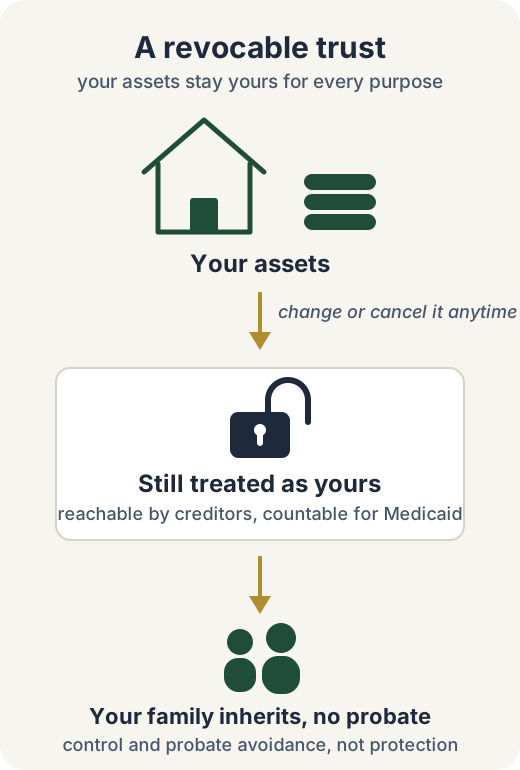
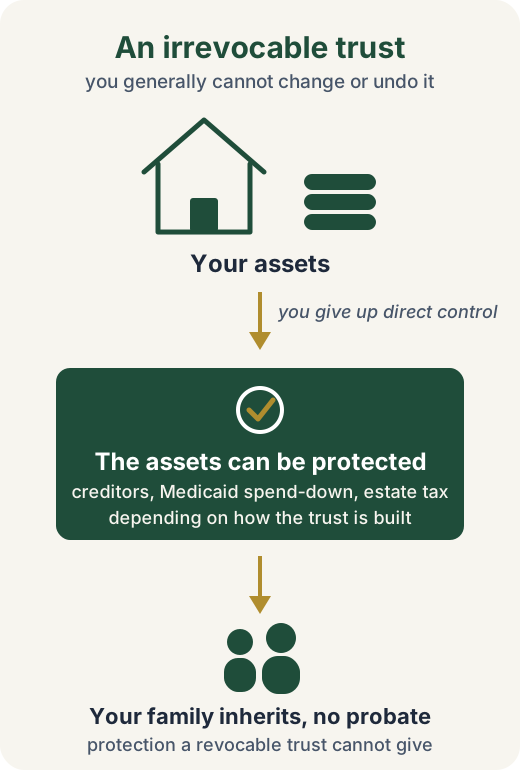
The same comparison in words:
| Question | Revocable trust | Irrevocable trust |
|---|---|---|
| Can you change or cancel it? | Yes, any time | No (with limited exceptions) |
| Avoids probate | Yes | Yes |
| Protects from your creditors | No | Yes |
| Protects from a Medicaid spend-down | No | Yes |
| Can reduce estate tax | No | Yes (certain types) |
The pattern is simple: a revocable trust is about control and probate avoidance; an irrevocable trust is about protection. A revocable trust does not guard against creditors or Medicaid, because you can still reach the assets, so the law says they are still yours.
The Main Types of Florida Irrevocable Trust
"Irrevocable trust" is a category, not a single document. The right one depends on the problem you are solving:
- Medicaid asset protection trust shields the home and savings from nursing-home costs, when set up at least five years ahead.
- Dynasty trust keeps wealth in the family for generations, protected from each generation’s creditors and divorces.
- Irrevocable life insurance trust (ILIT) keeps a life-insurance payout out of your taxable estate.
- Special needs trust provides for a disabled loved one without costing them their benefits.
- Florida community property trust gives a married couple a double step-up in basis on appreciated assets.
- QTIP trust provides for a surviving spouse for life while guaranteeing your own children inherit the remainder (the blended-family tool).
- Spendthrift trust protects a beneficiary’s inheritance from their creditors, a divorce, or their own poor judgment.
- Charitable remainder trust (CRT) turns an appreciated asset into lifetime income and a tax deduction, with the remainder to charity.
- Qualified personal residence trust (QPRT) passes a home to your children at a discounted gift-tax value and freezes it out of your estate.
Why Families Across the Country Use a Florida Trust
Here is where Florida law genuinely stands out, and why a family in a high-tax state will set up a Florida trust with a Florida trustee, often working alongside their home-state attorney. These are benefits the home state frequently cannot match:
- A double step-up in basis (the FCPT). Florida’s community property trust can reset the basis on a couple’s appreciated assets at the first death, wiping out a large capital-gains bill. Only a handful of states offer this, and Florida pairs it with the rest of its trust toolkit. See the FCPT →
- A trust that lasts up to 1,000 years. Florida lets a trust run for ten centuries, where many states still cap trusts near 90 years. That is what makes a true multi-generation dynasty trust possible.
- A modern directed-trust law. Florida cleanly separates who controls investments from who serves as trustee, which is ideal for a trust holding a family business or a concentrated stock position. See directed trusts →
- Flexible decanting. Florida’s mature decanting law lets a trustee move an old irrevocable trust into a better one as the family and the law change. See decanting →
- No state income tax. Income kept and accumulated in a Florida trust escapes state income tax, a real benefit for an accumulation trust or one for beneficiaries outside a high-tax state. (Income paid out to a beneficiary is still taxed on their own state return, so this works best for income that stays in the trust.)
The Honest Trade-Offs
An irrevocable trust is a serious commitment, and we will make sure you understand it before you sign. You give up direct control of what goes in. The transfer can carry tax or Medicaid-timing consequences if done without planning. And the most aggressive tax strategies are not guaranteed by the IRS, so they have to be entered with eyes open. For many families a revocable trust or a simple lady bird deed is the better, lighter answer, and we will tell you so rather than sell you complexity you do not need.
Not sure whether you need an irrevocable trust?
That is exactly what the consult is for. In 30 free minutes we will tell you which trust, if any, fits your goal, and what it costs.
Book your free consultWhat It Costs
Because these trusts are built to the job, we quote the fee at the consult. A Medicaid asset-protection plan and the other irrevocable trusts are flat fees priced to their complexity, quoted at the consult. We work with clients throughout Florida and, for the national tools above, alongside their home-state counsel. See our flat-fee planning prices →
Frequently Asked Questions
What Is an Irrevocable Trust?
It is a trust you generally cannot change or revoke once it is set up. You move assets into it, give up direct control of them, and in exchange the assets can be protected from creditors, kept out of your taxable estate, or shielded from a Medicaid spend-down, depending on how the trust is built. That loss of control is not a flaw; it is the very thing that makes the protection work. A revocable trust, by contrast, gives you full control but none of these protections.
What Is the Difference Between a Revocable and an Irrevocable Trust?
A revocable living trust is about control and probate avoidance: you keep the power to change or cancel it, your assets stay yours for every purpose, and at death they pass without probate. An irrevocable trust is about protection: you give up the power to freely take assets back, and in return you get benefits a revocable trust cannot provide, like creditor protection, Medicaid asset protection, or estate-tax savings. Most families start with a revocable trust; an irrevocable trust is added when one of those specific protections is the goal.
Does a Revocable Trust Protect Me From Creditors or Medicaid?
No, and this is the most common misunderstanding in estate planning. Because you can revoke a revocable trust and take the assets back, the law still treats them as yours, so they remain reachable by creditors and countable for Medicaid. Only an irrevocable trust, where you have truly given up control, can put assets beyond that reach. Same word, very different tool.
What Are the Main Types of Florida Irrevocable Trusts?
The common ones are a Medicaid asset protection trust (to shield the home and savings from nursing-home costs), a dynasty trust (to pass wealth to children, grandchildren, and beyond for generations), an irrevocable life insurance trust or ILIT (to keep life insurance out of your taxable estate), a special needs trust (to provide for a disabled loved one without losing benefits), and the Florida community property trust (for a married couple seeking a double step-up in basis). Each solves a specific problem.
Can an Irrevocable Trust Ever Be Changed?
More often than people think. Florida has a strong "decanting" law that lets a trustee move assets from an old irrevocable trust into a new one with better terms, and other tools (trust modification, a trust protector) can adjust an irrevocable trust as the law and the family change. So "irrevocable" does not mean "frozen forever," and that flexibility is one reason Florida is a favorable place to hold a trust.
Why Would Someone Out of State Use a Florida Trust?
Because Florida law offers things their home state may not: no state income tax on income kept in the trust, a trust that can last up to 1,000 years (most states are far shorter), a modern directed-trust law that cleanly separates investment control from the trustee role, a flexible decanting statute, and the community property trust for a double basis step-up. With a Florida trustee, a family in a high-tax state can access these benefits. We often work alongside the family’s home-state attorney to put the pieces together.
Will an Irrevocable Trust Save Estate Taxes?
It can, for larger estates, by removing assets (and their future growth) from your taxable estate, which is the job of tools like an ILIT or certain gifting trusts. For most families, federal estate tax is not the concern because the exemption is high, and the goals are protection and probate avoidance instead. Florida has no state estate tax, so this is purely a federal question, and we will tell you honestly whether it applies to you.
How Much Does a Florida Irrevocable Trust Cost?
It depends entirely on the type and complexity, so we quote it at the consult. A Medicaid asset-protection plan and the other irrevocable trusts are flat fees priced to the work involved. Because these are not one-size-fits-all, the free 30-minute consult is where we confirm which trust (if any) fits your goal and what it will cost, before you commit.
Common Situations
The Medicaid planner. A healthy 68-year-old wants to protect her home and savings in case she ever needs years of care. A revocable trust would do nothing for that; an irrevocable Medicaid asset protection trust, set up now, shields both, with the five-year clock long past before she needs care.
The Boston couple with appreciated stock. A Massachusetts couple holds $1.5 million of low-basis stock. Their home state cannot give them a double step-up, but a Florida community property trust with a Florida trustee can, potentially erasing the capital-gains tax at the first death. We build the Florida piece and coordinate with their Massachusetts attorney.
The family thinking in generations. Grandparents want a trust that protects children, grandchildren, and beyond from creditors and divorces. Florida’s 1,000-year trust term makes a real dynasty trust possible, where their home state’s shorter limit would not.
The parents of a disabled son. A Fort Myers couple wanted to leave a full share to their adult son, who receives means-tested government benefits. Handed to him outright, the inheritance would have cost him that support. A special needs trust funded with the parents’ own money holds his share to supplement his benefits rather than replace them, and because the money was never his, Medicaid has no payback claim against it when he dies. His siblings inherit their shares outright, and no one’s benefits are disturbed.
Sources of Law
- Florida Trust Code, Fla. Stat. ch. 736 (irrevocable trusts, modification, and decanting at §736.04117). flsenate.gov (retrieved 2026-06-07)
- Fla. Stat. §689.225: Florida’s rule against perpetuities, allowing a trust term up to 1,000 years (for trusts created on or after July 1, 2022).
- Fla. Stat. §§736.1401 to 736.1416 (Florida Uniform Directed Trust Act); §§736.1501 to 736.1512 (Florida Community Property Trust Act). Florida has no state income or estate tax. IRC §1014 (basis step-up).
Updated on July 12, 2026. Reviewed by Kevin D. Klagge, Esq., Fla. Bar No. 99502. Attorney Kevin Klagge represents families, businesses, and international clients in estate planning and international law, with a focus on Florida legal tools. He litigates estate and business issues in court. General information about Florida and federal law, not legal or tax advice, and no attorney-client relationship is created. Whether a trust is right depends on your specific facts; the most aggressive tax results are not guaranteed. Do not send confidential information until we have agreed to represent you.