
What a Prenup Decides
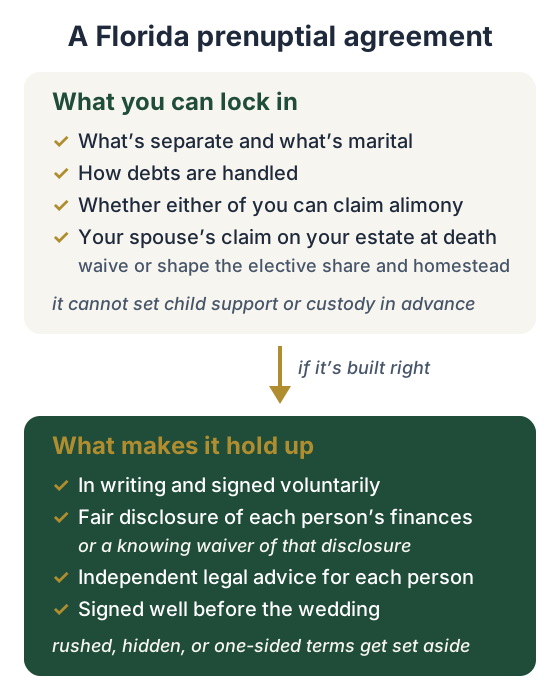
A Florida prenuptial agreement lets the two of you set the rules in advance, instead of inheriting the default ones. Under Florida law (the Uniform Premarital Agreement Act), you can decide:
- What’s separate and what’s marital. Keep a business, a property, or premarital savings clearly yours.
- How debts are handled, so you are not on the hook for your spouse’s.
- Whether either of you can claim alimony, and how much.
- What happens at death, including waiving or shaping your spouse’s claim on your estate (see below).
What a prenup cannot do: predetermine child support or custody. Florida decides those later, by the child’s best interests, no matter what the agreement says.
The Estate-Planning Side Most Couples Miss
Here is the piece a divorce-only mindset overlooks. In Florida, a surviving spouse can claim roughly 30% of your estate (the elective share), plus homestead and other rights, regardless of what your will says, unless those rights were waived in a valid agreement. A prenup (or postnup) is how you waive or shape them. That matters most in a second marriage: you want to provide for your spouse but leave the bulk to your children from a prior relationship. We coordinate the agreement with your will or trust and beneficiary designations so they do not contradict each other.
Side by side, here is what changes, and what does not:
| Without a prenup | With a Florida prenup |
|---|---|
| A statute or a judge decides the rules | The two of you set them in advance |
| Florida’s default rules decide what is separate and what is marital | A business, a property, or premarital savings stays clearly yours |
| Alimony is left to the default rules | You decide whether either of you can claim it, and how much |
| Your spouse can claim roughly 30% of your estate (the elective share), plus homestead and other rights, regardless of what your will says | Those rights are waived or shaped in the agreement |
| Child support and custody are decided later, by the child’s best interests | The same: a prenup cannot set them in advance |
Protect what you built, and your peace of mind.
A free 30-minute consult covers what to include, what it costs, and how to keep it enforceable.
Book your free consultWho Really Needs One
- Second marriages and blended families, to protect children from a prior relationship.
- Business owners, so a divorce or death does not drag the company into a marital fight (this pairs with business succession planning).
- Anyone with an inheritance, separate property, or a big gap in assets or debts between the two of you.
Will It Hold Up?
It holds up when it is built right. Florida requires a prenup to be in writing, signed voluntarily, with fair disclosure of each person’s finances (or a knowing waiver). Agreements get set aside when someone was pressured into signing on the eve of the wedding, when assets were hidden, or when the terms are unconscionable. The cure is straightforward: full disclosure, independent legal advice for each person, and signing well before the date. That is how we draft them.
Does It Travel to Other States?
Usually, yes. Florida follows the Uniform Premarital Agreement Act, which most states (around 28) have adopted, and we include a Florida choice-of-law clause, so a well-drafted agreement generally travels with you. The notable exception is Louisiana, a civil-law state with its own community-property rules. If your life or assets touch more than one state, we draft for portability and flag anything that needs local review.
What It Costs
It depends on complexity, a simple agreement costs far less than one involving a business, multiple properties, or a blended family. We quote a flat fee at your free consult, so you know the number before you commit. Government and recording costs, if any, are separate and passed through at cost.
Frequently Asked Questions
What Does a Florida Prenuptial Agreement Actually Do?
It lets you and your future spouse decide in advance what is separate property and what is marital, how debts are handled, whether either of you can claim alimony, and what happens to your property at death. Under Florida law (the Uniform Premarital Agreement Act), those choices are enforceable if the agreement is done right. A prenup is not planning for divorce; it is deciding the rules yourselves instead of leaving them to a statute or a judge. What it cannot do: set child support or custody in advance, those are always decided later by the child’s best interests.
How Much Does a Prenup Cost in Florida?
It depends on complexity. A straightforward agreement is far less than one involving a business, multiple properties, or a blended family. In the Florida market, prenups commonly run from a couple of thousand dollars to the mid five figures for complex estates. We quote a flat fee at your free consult so you know the number before you commit, and we keep it efficient by sorting out the issues up front.
Will a Florida Prenup Hold Up in Court?
It holds up when it is built correctly. Florida requires the agreement to be in writing and signed voluntarily, with fair and reasonable disclosure of each person’s finances (or a knowing waiver of that disclosure). Agreements get thrown out when someone was pressured into signing days before the wedding, when assets were hidden, or when the terms are so one-sided they are unconscionable. The fix is simple: full disclosure, independent legal advice for each person, and signing well before the wedding. That is exactly how we draft them.
Does a Florida Prenup Work if We Move to Another State?
Usually yes. Florida follows the Uniform Premarital Agreement Act, which most states (around 28) have adopted, and a well-drafted agreement includes a Florida choice-of-law clause. So a prenup we draft generally travels with you. The main exception is Louisiana, a civil-law state with its own community-property rules. If you have ties to more than one state, we draft for portability and flag anything that needs local review.
What’s the Estate-Planning Side of a Prenup?
This is the part most couples miss. In Florida, a surviving spouse can claim about 30% of your estate (the elective share) and has homestead and other rights, no matter what your will says, unless those rights were waived in a valid agreement. A prenup or postnup is how you waive or shape them, which is essential for a second marriage where you want to provide for your spouse but leave the bulk to children from a prior relationship. We coordinate the prenup with your will, trust, and beneficiary designations so they all say the same thing.
Can We Do This After We’re Already Married?
Yes, that is a postnuptial agreement. It covers the same ground but is signed after the wedding. It is not governed by the premarital statute, so Florida courts apply contract law with extra scrutiny, because spouses owe each other a duty of fairness. Done with full disclosure and independent advice, a postnup is enforceable and is often the right tool after a business takes off, an inheritance arrives, or a second marriage begins.
Can We Change or Cancel a Prenup After the Wedding?
Yes. Under Florida law, once you are married the prenup can be changed or canceled entirely, but only by a written agreement signed by both of you. A conversation, an email, or simply ignoring the agreement for years does not undo it. Couples update a prenup when life moves: a business takes off, children arrive, or the deal you struck before the wedding no longer fits the marriage you have. We draft the amendment with the same disclosure and care as the original, so the updated version holds up too.
Sources of Law
- Fla. Stat. §61.079 (Florida Uniform Premarital Agreement Act). Spousal-rights waiver: §732.702 and §732.7025. Elective share: §§732.201 to 732.2155. Postnuptial agreements are governed by Florida contract law. (retrieved 2026-06-09)
Related Guides
What a prenup costs in Florida · what a prenup covers · do I need a prenup? · second-marriage prenups · prenups for business owners · how to get a prenup · postnuptial agreements
Updated on July 12, 2026. Reviewed by Kevin D. Klagge, Esq., Fla. Bar No. 99502. Attorney Kevin Klagge represents families, businesses, and international clients in estate planning and international law, with a focus on Florida legal tools. He litigates estate and business issues in court. General information about Florida law, not legal advice, and no attorney-client relationship is created. Each spouse should have independent counsel. Do not send confidential information until we have agreed to represent you.