
The Short Answer
Summary administration is Florida’s shortened probate. Instead of appointing a personal representative and running a full case for months, the court reviews a petition and signs an order distributing the assets straight to the heirs. It is faster, cheaper, and far less paperwork, and for estates that qualify it is almost always the path you want.
Do You Qualify?
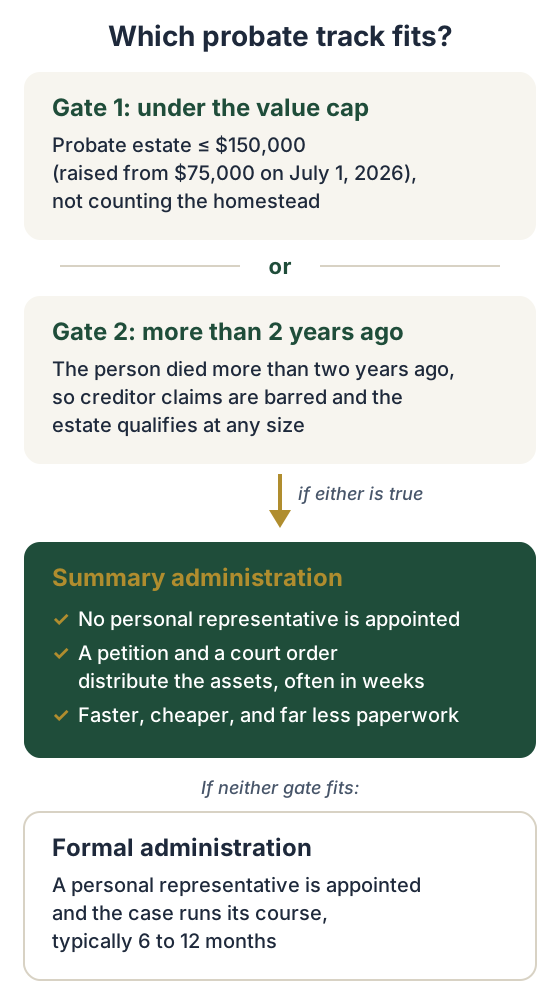
You qualify if either is true:
- The probate estate (not counting exempt property like the homestead) is worth $150,000 or less (raised from $75,000 on July 1, 2026), or
- The person died more than two years ago (Florida bars creditor claims after two years, so an older estate can be wrapped up simply, at any size).
If neither fits, the estate generally needs a formal administration with an appointed representative. See the timeline by type →
Think the estate is small enough?
Book a free 30-minute consult. We will confirm whether summary administration fits and quote a flat fee.
Book your free consultEven Smaller: Disposition Without Administration
For the very smallest estates, with no real estate and only enough left to cover the final expenses, there is an even simpler step that is not really a probate at all: disposition without administration, where whoever paid the final bills is reimbursed from the small remaining assets, often without a lawyer or a hearing. See if disposition without administration fits your situation →
The Summary Administration Forms (and Why They Trip People Up)
Summary administration runs on a Petition for Summary Administration and, once the court approves it, an Order of Summary Administration. The clerk and the Florida courts publish these forms, but they are deceptively easy to get wrong: the petition has to state the assets, the heirs, and the creditors accurately, because the order that distributes the estate relies on every word of it. A mistake can cloud title to a home or leave a creditor unaddressed, which surfaces later when someone tries to sell. We prepare and file the petition so the order holds up.
Summary vs. Formal Administration
| How they compare | Summary | Formal |
|---|---|---|
| Personal representative | None appointed | Appointed |
| Typical time | Weeks to ~2 months | 6 to 12 months |
| Qualifies | $150,000 or less (raised from $75,000 on July 1, 2026), or death more than 2 years ago | Most larger or more recent estates |
| Cost | Lower | Higher |
Frequently Asked Questions
What Is Summary Administration in Florida?
Summary administration is Florida’s shortened, less expensive form of probate. Instead of appointing a personal representative and running a full case, the court reviews a petition and enters an order that distributes the assets directly to the heirs and beneficiaries. It is available for smaller estates and for older deaths, and it can finish in weeks rather than the many months a formal administration takes. For estates that qualify, it is the path most families want.
Do I Qualify for Summary Administration?
You qualify if either of two things is true: the value of the probate estate (not counting property that is exempt, like the homestead) is $150,000 or less, or the person died more than two years ago. A 2026 Florida law (Chapter 2026-57) raised that cap from $75,000 to $150,000 effective July 1, 2026, so larger estates now use this faster path too. The two-year option exists because Florida bars creditor claims two years after death, so an older estate can be wrapped up simply regardless of size. If neither applies, the estate generally needs a formal administration instead. We confirm which fits at the consult.
How Is Summary Administration Different From Formal Probate?
Formal administration appoints a personal representative who manages the estate over months, with a creditor period, accountings, and court oversight. Summary administration skips the appointment entirely: a petition is filed, and the court signs an order distributing the assets. It is faster, cheaper, and far less paperwork. The trade-off is that no representative is appointed to act on the estate’s behalf, so it fits clean estates where the assets and heirs are clear.
What Is "Disposition Without Administration"?
It is an even simpler step for the smallest estates, technically not a probate at all. If the person left no real estate and only modest assets that do not exceed the cost of their final illness and funeral expenses plus certain exempt property, whoever paid those expenses can ask the clerk to release the assets to reimburse them, usually without a lawyer or a court hearing. It is meant for cases like a small bank account left after a funeral was paid for.
How Long Does Summary Administration Take?
Often just a few weeks to a couple of months, compared with the 6 to 12 months a formal administration usually runs. Because there is no personal representative to appoint and no creditor period to wait out in the same way, the timeline is driven mainly by how quickly the petition is prepared and the court signs the order. We move it as fast as the court allows.
Do I Need a Lawyer for Summary Administration?
In most cases yes, and it is worth it. The petition has to be accurate about the assets, the heirs, and creditors, because the order that distributes the estate relies on it; mistakes can cloud title to a home or expose you to a missed creditor. We prepare and file the petition, handle the required creditor diligence, and get you the order, on a flat or clearly quoted fee. Disposition without administration is simpler and sometimes done without counsel.
Common Situations
The older estate. A father died three years ago and a bank account in his name alone just surfaced. Because it has been more than two years, summary administration releases it quickly regardless of the amount.
The small estate. A mother’s probate assets total about $40,000 outside her homestead. Summary administration distributes them in a few weeks, no representative needed.
The reimbursement. A daughter paid her father’s $9,000 funeral and final bills; his only asset is a $7,000 account. Disposition without administration reimburses her without a full case.
Sources of Law
- Fla. Stat. ch. 735: §735.201-.2063 (summary administration; $150,000 or 2-year threshold, cap raised by ch. 2026-57), §735.301 (disposition without administration). §733.710 (2-year claim bar). flsenate.gov (retrieved 2026-06-08)
- 2026 change: Laws of Fla. ch. 2026-57 (CS/HB 1337) raises the §735.201 summary-administration cap from $75,000 to $150,000, effective July 1, 2026. flsenate.gov (retrieved 2026-06-23)
Updated on July 11, 2026. Reviewed by Kevin D. Klagge, Esq., Fla. Bar No. 99502. Attorney Kevin Klagge represents families, businesses, and international clients in estate planning and international law, with a focus on Florida legal tools. He litigates estate and business issues in court. General information about Florida law, not legal advice, and no attorney-client relationship is created. Eligibility depends on the specific estate. Do not send confidential information until we have agreed to represent you.