What Is a Lady Bird Trust in Florida?
No legal instrument in Florida carries the name "lady bird trust." The phrase blends two real planning tools, and understanding each one matters before you decide what to sign.
A lady bird deed is an enhanced life estate deed. The deed splits ownership into an enhanced life estate that you keep and a remainder (the part that passes at death) that goes to your named beneficiaries. You keep full lifetime control to sell, mortgage, lease, refinance, change beneficiaries, or revoke the deed entirely. No present transfer of ownership occurs at signing, and the beneficiaries have no enforceable interest while you are alive. At your death the home passes automatically, outside probate, by operation of law.
A revocable living trust is a separate document that holds assets you transfer into it during life. You remain the trustee and keep full control. The trust avoids probate only for assets actually titled in the trust's name. An unfunded trust, meaning one you never transferred anything into, does nothing at death and the home goes through probate anyway.
Florida has no statutory transfer-on-death deed, so the lady bird deed is the primary deed-based probate avoidance tool for real property. The Florida Supreme Court recognized the enhanced life estate in 1917, and the Florida Uniform Title Standards confirm that a life tenant with enhanced powers can convey the full fee without the remainderman's consent.
People searching for a lady bird trust usually mean one of the following. They want a simple, inexpensive deed that keeps the home out of probate. They want a full trust plan that covers all assets. Or they want both together, with the deed naming the trust as the beneficiary at death.
How Is a Lady Bird Deed Different From a Living Trust?
A lady bird deed and a revocable living trust both avoid probate, but they work differently and fit different situations. The choice depends on what you own, who your beneficiaries are, and whether you need protection that continues after your death.
The deed is a recorded document that applies only to one piece of Florida real property. You sign it once, record it, and the home passes at your death. The trust is a private document that can hold any asset you transfer into it, including bank accounts, brokerage accounts, real property in multiple states, and business interests. The trust works only for assets you actually re-title into the trust's name. An unfunded trust does nothing at death.
A revocable trust does not protect assets from your creditors during your lifetime. Florida law treats revocable trust assets as fully reachable by the settlor's creditors. The trust also does not help with Medicaid eligibility, because federal law treats the corpus (the body of assets) of a revocable trust as resources available to you. A revocable trust is liable for estate debts when the probate estate falls short to pay them.
A lady bird deed keeps your home exempt for Medicaid. The Florida homestead is already exempt while you live there or intend to return, subject to the current program equity limit of $752,000 where applicable. Recording a lady bird deed does not change that status and does not trigger a look-back penalty. Florida's Medicaid manual treats the deed as an incomplete gift because you keep full powers. You can record the deed and apply for Medicaid the next day.
The trust wins when you own property in more than one state, because it avoids ancillary probate (a second probate in the other state). The trust also wins for minor or disabled beneficiaries, because it can hold and protect assets after your death through continuing sub-trusts. A direct remainder to an individual vests fully at death and is exposed to that person's creditors immediately.
| Feature | Lady Bird Deed | Revocable Living Trust |
|---|---|---|
| Lifetime control | Full | Full |
| Avoids probate | Yes | Yes, if funded |
| Medicaid effect | Exempt homestead unchanged | Countable resource |
| Homestead tax exemption | Preserved | Preserved |
| Step-up in basis at death | Yes | Yes |
| Property in other states | Florida only | Covers all states |
| Minor or disabled beneficiaries | Not protected after death | Protected through sub-trusts |
| Cost | Flat fee from $399 | Flat fee from $2,400 for the trust alone |
The two tools are not mutually exclusive. Many families use both, with the deed naming the trust as the beneficiary.
Not sure whether you need the deed or the trust?
Book a no-cost 30-minute consult. We will tell you which one fits, and it is often the cheaper one.
Book a no-cost consult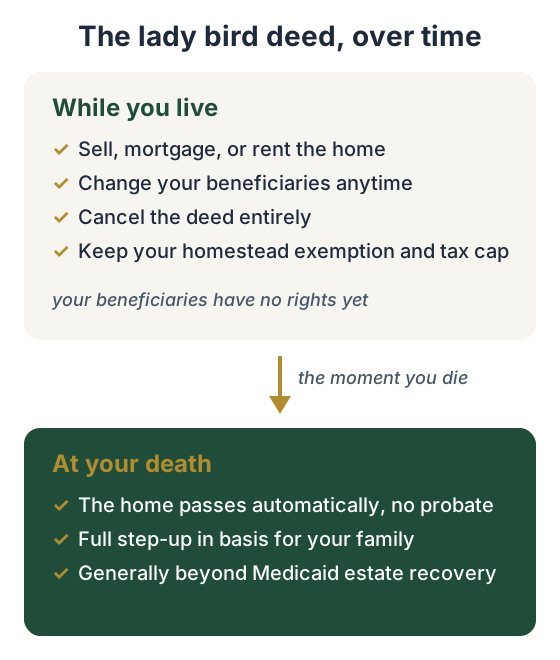
When Should a Lady Bird Deed Name Your Trust as the Beneficiary?
A lady bird deed can name your revocable living trust as the remainder beneficiary instead of naming individuals directly. The standard Florida structure keeps the homestead in your individual name during life and routes the home into the trust at death.
Naming the trust instead of a child outright matters when any complication exists. A trust absorbs a predeceased, minor, disabled, or unable-to-serve beneficiary, and you fix changes by amending the trust rather than recording a new deed. Multiple beneficiaries who take as co-owners can end up in a partition action (a court proceeding to force a sale when co-owners cannot agree) if they disagree about selling the home. A trustee with a power of sale avoids that problem.
An outright remainder to an individual vests fully in that person at death. After death, the property is subject to the beneficiaries' creditors and divorce exposure. A continuing trust can hold and protect that property after your death through a spendthrift provision or a special needs sub-trust.
The deed must name the trust correctly. Florida law converts a grant to a person "as trustee" with nothing more into a personal fee (outright ownership by that person rather than the trust). A grant directly "to the trust" goes to no one, because a trust cannot take title. The correct form names the trustee as a natural person "as Trustee of the [Name] Revocable Trust dated [date], or the successor trustee then serving." The deed should also recite the powers paragraph required by Florida law so a successor trustee can sell without recording the full trust instrument.
A remainder to a trust is still a testamentary disposition of homestead (a transfer of homestead property that takes effect at death) under the Florida Constitution. A married grantor's spouse must still join the deed with the statutory waiver statement if the remainder goes to anyone other than the spouse outright. A minor child's constitutional protection cannot be waived, so a lady bird deed to a trust fails when a minor child survives the owner.
The no-cost consult is where we confirm which structure fits your family.
How Do You Set Up a Lady Bird Deed That Names Your Trust?
The order matters because the deed names a trust that must already exist. Recording a deed before the trust is signed vests the remainder in nobody or in the trustee personally (as outright ownership), and either way the death transfer fails.
- Sign the revocable trust first with two witnesses. Florida law treats a revocable trust with testamentary aspects (provisions that dispose of property at death) as requiring the same formalities as a will. The witnesses may be physically present or may appear by audio-video communication under the online notarization rules, unless one of the required screening questions is answered yes. The trust must bear the exact name and date the deed will recite.
- Sign the lady bird deed after the trust exists. The deed requires your signature, two subscribing witnesses, and a notary. The remainder runs to a named natural person "as Trustee of the [Name] Revocable Trust dated [date], or the successor trustee then serving." A grant directly "to the trust" goes to no one because a trust cannot take title. A grant to "X, as trustee" without the trust's name and date converts the grant into outright ownership by that person under Florida law.
- Include the powers recital in the deed. The six powers listed in the statute let a successor trustee sell the property without recording the full trust document.
- Record the deed promptly. Recording puts the world on notice and anchors your place in the chain of title. A deed delivered but not recorded can still pass title, yet it loses priority to a later creditor or buyer for value who records first without notice of your deed.
- Confirm the homestead rules. A remainder to a trust is still a testamentary disposition of homestead (a death transfer of homestead property). A married owner's spouse must join the deed with the statutory waiver statement. A minor child's protection cannot be waived at all, and a lady bird remainder over a minor child can be void.
- Review on any family change. A new marriage, a new child, or a divorce may change the homestead calculus and call for a new deed or an amendment to the trust.
Which One Do You Need?
People often ask whether a will, a living trust, and a lady bird deed together is overkill or a good plan. The answer depends on what you own and whom you want to protect.
A lady bird deed alone handles a single Florida home with adult beneficiaries cleanly. The home passes outside probate, you keep full control for life, the property gets a stepped-up basis at your death, and Medicaid treats the deed as no transfer at all. The flat fee from $399 makes it the lowest-cost option for that one parcel.
A revocable living trust does more when you need more. A trust handles property in multiple states and avoids a second probate in each. A trust names successor trustees who can step in during your incapacity without court intervention. A trust holds protective sub-trusts for minor children or beneficiaries who are disabled or on benefits. A trust gives co-beneficiaries a sale mechanism instead of a partition action (court-ordered sale). The Complete Trust Plan runs $3,200 for one person or $4,500 for a couple and includes the will-plan documents, one funding deed, and successor trustee instructions.
The combination of a deed and a trust captures both advantages. The lady bird deed keeps your homestead in your individual name during life, which preserves every lifetime tax and Medicaid benefit. At your death the remainder pours into the trust you already have, where all those protective provisions catch it.
Most people with only a Florida home and adult children start with the deed. People with out-of-state property, minor grandchildren, or a blended family usually need the trust. People who have both a home and any of those complications benefit from the pairing. We sort out the fit in the no-cost consult; you do not need to have it figured out first.
Is Joint Ownership With Survivorship an Alternative?
Adding a child or partner to the deed as a joint tenant with right of survivorship is a common do-it-yourself approach. The property passes automatically at the first death and avoids probate, which sounds like the same result as a lady bird deed. The differences matter.
Florida law presumes a tenancy in common unless the deed expressly provides for survivorship. Getting the language wrong means the share passes through probate anyway.
Adding a co-owner gives that person a present ownership interest. A child who is on title can borrow against the property, face a judgment lien, or have the home pulled into litigation. A creditor of the co-owner can reach the property during your lifetime, not just after your death.
A lady bird deed gives the named remainder beneficiaries nothing until you die. You keep full control, including the power to sell, mortgage, or revoke the deed without anyone's consent. The beneficiaries have no present share for creditors to reach, no veto over a sale, and no knowledge that the deed exists unless you tell them.
For married couples, tenancy by the entireties already offers automatic survivorship and strong creditor protection while both spouses are alive. A lady bird deed can still make sense when the couple wants to name children as the remainder beneficiaries after both deaths without exposing the property to a partition dispute.
The no-cost consult walks through how your current title is held and what each option does for your situation.
Can a Lady Bird Deed Cover a Second Home in Florida?
A lady bird deed works for any Florida real property, not only a homestead. A vacation home, a rental property, or a vacant lot can pass outside probate the same way.
The differences show up in tax treatment. Only a homestead qualifies for the current $50,000 homestead exemption on property taxes and the Save Our Homes cap on assessment increases (Amendment 3 on the November 2026 ballot would change these figures). A second property is non-homestead, so those lifetime benefits do not apply regardless of which deed you use.
The step-up in basis at death applies to all real property, homestead or not. A child who inherits a non-homestead parcel through a lady bird deed takes it at the fair market value on the date of death, wiping out years of built-in gain the same way a homestead does.
Medicaid treats homestead and non-homestead property differently. A homestead is an exempt resource when the applicant lives there or intends to return, subject to the current program equity limit of $752,000 where that cap applies. A non-homestead property is generally countable unless it produces income and is essential to self-support.
An unmarried owner, or a married owner whose spouse is not on title, can sign a lady bird deed on a non-homestead parcel alone. The spousal joinder and waiver requirements in the Florida Constitution apply only to homestead.
A separate lady bird deed for each parcel keeps the chain of title clean. A standalone deed on a second property runs a flat fee from $399 for one owner, or $449 for a couple, plus recording.
What Happens to the Mortgage?
A lady bird deed does not pay off the mortgage, and a later refinance does not cancel the deed. The owner signs alone under the reserved power to mortgage, the deed stays operative, and the beneficiaries take title subject to the lien at death. The same is true for a home equity line of credit. Beneficiaries inherit ownership and the obligation to keep paying.
A common worry is that the lender will call the loan due when the owner dies or when title passes. Federal law answers that concern. A lender may not accelerate a residential mortgage on property with fewer than five units when title passes to a relative at the borrower's death, when a spouse or child becomes an owner, or when the home moves into a living trust in which the borrower remains a beneficiary and occupancy rights do not change.
The practical question is whether the heir can afford the payments. If the loan is current and the heir qualifies, assuming or refinancing may be possible depending on the lender and loan terms. If the heir cannot pay, selling the property and paying off the balance is the typical outcome. The deed itself does not change any of this. Recording a lady bird deed today and refinancing five years from now does not require revoking the deed, although a particular lender may ask for a temporary release and re-recording before it will close.
A home that passes through either a lady bird deed or a revocable trust reaches the beneficiaries outside probate. The mortgage follows the property either way.
Can You Sign From Home?
Florida law allows both deeds and revocable trusts to be signed remotely. A deed requires the grantor's signature in the presence of two subscribing witnesses and a notary. Florida's electronic-signature statutes permit those witnesses to be present by audio-video communication technology. The notary may perform an online notarization while physically located in Florida, regardless of where the signer sits.
A revocable trust carries one additional layer. Because the trust disposes of property at death, it must be executed with the formalities of a will (two witnesses who watch the settlor sign). When fewer than two witnesses are in the same room as the signer, a remote-online-notarization service provider must ask three screening questions. The questions ask whether the signer is under the influence of any drug or alcohol that impairs decision-making, whether the signer has any physical or mental condition or long-term disability that impairs daily activities, and whether the signer requires assistance with daily care. A yes to any question means the signing must have physical witnesses present.
Florida's online notarization rules let most clients complete both documents from home in a single sitting. The attorney prepares the trust and deed, schedules an online notarization, and walks the client through the signing. Remote signing is especially useful for clients who travel, live part of the year outside Florida, or have mobility concerns. The no-cost consult covers whether remote signing fits your situation and what the session looks like.
What Florida Courts Have Said
Two Florida decisions show how the reserved powers work and what happens when the deed and the trust fall out of step.
A case decided by the First District Court of Appeal in May 2025 began with a promise to two grandchildren. Grandparents had placed two properties in their living trust in 2006. A decade later the grandson moved in to help them, and in 2017 the grandfather promised both grandchildren the parcels. An attorney prepared lady bird deeds, and the grandfather signed. The problem was that the attorney never discovered the trust owned the properties. As the court put it, "[I]n getting the property descriptions to prepare the deeds the attorney did not discover that the properties were held by the trust and not by James individually."
The grandfather died in 2020, and his daughter, the successor trustee, sued to evict her own children (the grandchildren who had been promised the homes). "It is undisputed that James, Dominic, and Caroline were mistaken, and all made the same mistake in believing that James could convey the property as an individual." The trial court reformed the deeds for mutual mistake, and the First District affirmed roughly five years after the death. "If the deeds had been prepared for James to sign as trustee rather than individually, then the parties' intention would have been carried out." The appeals court added that "[m]ore than simple negligence is required to preclude reformation." Reformation saved the plan, but it took half a decade of litigation.
An earlier case from the Florida Supreme Court in 1917 shows the reserved powers at work. A father in feeble health deeded parcels to his children, reserving a life interest and the right to resell. He later sold one parcel. His daughter, who had been named in the original deed, sued and lost. "The conveyance to Mary E. Gamble was a gift from the father to the daughter and the reservation therein that is quoted above clearly contemplated and reserved to the grantor the right to sell the land. As the father conveyed the land as contemplated and provided for in the deed of gift to the daughter she has no title to be clouded by the conveyances complained of." The reserved powers meant the father could sell, and the daughter's claim failed.
What Mistakes Do People Make With a Deed and a Trust?
The most common mistake happens when someone signs a deed on a house the trust already owns. A deed must be signed by whoever holds title. A grandfather who transferred his properties to a living trust years ago cannot later sign a lady bird deed as an individual. The deed passes nothing because he owns nothing in his own name. Florida courts have reformed deeds like this for mutual mistake, but the fix took five years after a death and forced family members into litigation against each other.
Another mistake is naming the trustee bare, without the trust's name and date. Florida law converts a grant to a person "as trustee" with nothing more into a personal fee (outright ownership by that person). The trust never takes title. A deed naming "John Smith as Trustee" without "of the Smith Family Revocable Trust dated January 15, 2024, or the successor trustee then serving" may vest the property in John Smith outright.
A third pattern is the trust that was never funded. The trust document can be fifty pages, but it controls only assets actually titled in the trust's name. A family that signs a trust and never retitles the house, the brokerage account, or the bank accounts has accomplished nothing. The house goes through probate, and the trust sits empty.
Naming no alternate beneficiaries creates the same problem. A lady bird deed to a single child, without per stirpes language (to descendants by right of representation) or a surviving beneficiaries clause, may force that child's share through probate if the child dies first.
A remainder to the trust over a minor child's homestead rights is the hardest to fix. The Florida Constitution protects minor children. A spouse can waive the devise restriction. A minor child cannot. A lady bird deed that names a trust as remainder beneficiary when a minor child survives may be void as an unauthorized devise, and the home passes under the constitutional default instead.
What Does Each One Cost?
A lady bird deed is a flat fee from $399 for one owner, or $449 for a couple, plus recording. Government costs are extra and passed through at cost. The deed alone is often the right answer when the home is the only significant asset and the beneficiaries are adults without complications.
A revocable trust drafted alone is $2,400, or $3,200 for a couple. That price covers the trust document only, with no will, no power of attorney, no funding and no deed. Most people who need a trust also need the supporting documents.
A complete trust plan is $3,200, or $4,500 for a couple. The plan includes the durable power of attorney, health care surrogate designation, living will, HIPAA authorization, the revocable living trust, a pour-over will, one funding deed moving the Florida homestead into the trust (recording additional), funding instructions and help retitling accounts, beneficiary designations coordinated with the trust, and successor trustee instructions.
Each additional funding deed is $199 plus recording. A family with a rental property and a vacation home would add two deeds to the plan.
A no-cost consult sorts out which option fits your family.
Frequently Asked Questions
Is there such a thing as a lady bird trust?
No legal instrument in Florida is called a lady bird trust. The term confuses two separate tools. A lady bird deed is an enhanced life estate deed that passes your home at death without probate while you keep full control during life. A revocable living trust is a separate document that can hold any asset and provide instructions for management and distribution. People often combine them by naming the trust as the remainder beneficiary of the deed.
What is the difference between a lady bird deed and a trust?
A lady bird deed transfers one Florida property at death and costs a flat fee from $399 plus recording. A revocable living trust can hold any asset, including property in other states, bank accounts and investments. The trust costs more (a complete trust plan runs $3,200 for one person or $4,500 for a couple) because it includes the trust document, a pour-over will, powers of attorney, health care documents, a funding deed and help retitling accounts.
Which one do I actually need?
Your situation determines the answer. A lady bird deed alone works well for a single Florida home passing to one or two healthy adult beneficiaries with no complications. A revocable living trust fits better when you own property in more than one state, when a beneficiary is a minor or receives disability benefits, or when you want to keep the home protected inside the trust after your death. Many families use both together by naming the trust as the deed's remainder beneficiary.
Does a lady bird deed avoid probate like a trust does?
A lady bird deed avoids probate for the one property it covers. Title vests in the beneficiaries the moment you die, by operation of law, with no court order or new deed. A revocable living trust avoids probate for every asset funded into it. The trust also catches assets in other states, which a deed cannot do. Either tool removes the property from the probate estate if properly prepared and recorded or funded.
Can I put my home in a trust instead of using a lady bird deed?
A revocable living trust can own your Florida home outright. Many families prefer that approach when the home is part of a larger plan involving multiple assets or beneficiaries with special needs. The tradeoff is cost. A deed alone runs a flat fee from $399 plus recording. A complete trust plan runs $3,200 for one person or $4,500 for a couple. We discuss which structure fits your facts at the no-cost consult.
What happens if my home is already in a trust and I sign a lady bird deed?
A deed signed by you individually does nothing when the trust already owns the house. The trust, not you, holds title. A Florida court reformed two deeds on these facts five years after the owner died, but only after the successor trustee sued her own children. The safer path is to confirm ownership before preparing the deed. When the trust owns the home, the trustee signs the deed on behalf of the trust.
How much does each cost in Florida?
A lady bird deed runs a flat fee from $399 for one owner or $449 for a couple, plus recording. A revocable trust drafted alone runs $2,400 or $3,200 for a couple (the trust document only, no will, no power of attorney, no funding). A complete trust plan runs $3,200 or $4,500 for a couple and includes the trust, a pour-over will, powers of attorney, health care documents, one funding deed and help retitling accounts. Each additional funding deed is $199 plus recording.
Do the people named in a lady bird deed have any right to the home while the owner is alive?
Named beneficiaries have no enforceable interest while the owner lives. A lady bird deed reserves full powers to the owner, including the right to sell, mortgage, lease or revoke the deed without consent or even notice. The beneficiaries' remainder interest is divestible, meaning the owner can record a new deed naming different people at any time. The remainder becomes real only at death, when title passes by operation of law.
What happens to the mortgage when I inherit a home through a lady bird deed or a trust?
Beneficiaries take the home subject to any existing mortgage. The deed and the loan are separate. Federal law prevents most lenders from calling the loan due when a relative inherits through the owner's death, when a spouse or child becomes an owner, or when the home transfers into a living trust where the borrower stays a beneficiary and occupancy rights do not change. The debt does not disappear. Beneficiaries either keep paying, refinance in their own names or sell.
Should a married couple use joint ownership with survivorship or a lady bird deed?
Joint ownership with survivorship passes the home to the surviving spouse at the first death. Florida law does not presume survivorship except for spouses holding as tenants by the entirety. Adding a child as a co-owner gives that child a present share, which exposes the home to the child's creditors and prevents a sale without the child's signature. A lady bird deed gives no one anything until death. Many couples use a deed so they can name the next generation without giving up control.
Can I have a will, a living trust and a lady bird deed at the same time?
Many families hold all three. The lady bird deed passes the home outside probate. The revocable trust holds other assets and can receive the home as remainder beneficiary of the deed if the deed names the trust. The pour-over will catches anything that was never funded into the trust and pours the residue into it. Each document does a different job. The goal is to leave nothing that must pass through a court order.
Does a living trust or a lady bird deed protect my home from Medicaid?
A lady bird deed does not change Medicaid eligibility while you live in the home. Florida's homestead is already exempt for an applicant who lives there or intends to return, up to the current program equity limit of $752,000. A lady bird deed is not treated as a transfer because you keep full powers. Florida's Medicaid manual states that no transfer has occurred when an owner signs a lady bird deed and keeps the right to sell without consent. You can record the deed and apply for Medicaid the next day. A revocable trust provides no extra protection because federal law treats its assets as resources available to the owner.
Common Situations
A widower in his seventies wanted his daughter to inherit his Florida home without probate. He owned no property outside the state. His daughter was in her forties, employed, with no creditors or disability. A lady bird deed naming her directly fit his situation. The deed cost $399 plus recording, and his daughter will record a death certificate when the time comes. No trust was needed because no contingency existed.
A couple in their sixties owned a home in Florida. Their son had a disability and received government benefits. A lady bird deed naming their son directly would have disqualified him from those benefits. The solution was a revocable trust with a special needs sub-trust as the remainder beneficiary, and a lady bird deed naming the trust. The deed kept the home out of probate, and the continuing trust protects the son's eligibility after their deaths.
Chapter 32 of Kevin D. Klagge’s free book, Are Florida Lady Bird Deeds Just for Women?, covers this question with every statute and case cited to its source.
Sources of Law
- The lady bird (enhanced life estate) deed is recognized by Florida common law and the Florida Bar’s Uniform Title Standards; there is no "lady bird deed" or "lady bird trust" statute. Revocable trusts are governed by the Florida Trust Code, Fla. Stat. ch. 736. (retrieved 2026-06-08)
- Fla. Stat. §689.06: how trust property is conveyed, by a deed signed by the trustee in the presence of two subscribing witnesses. (retrieved 2026-09-03)
- The case retold below: Johnson (Krippes Living Trust) v. Johnson, No. 1D2024-1139 (Fla. 1st DCA May 7, 2025) (slip op.; not final until any timely rehearing motion is resolved) (lady bird deeds signed individually on property the trust owned, reformed for mutual mistake, ejectment by the successor trustee denied). Read in full; corpus in reference/caselaw/deeds/.
What One Florida Case Shows About a Deed and a Trust on the Same Property
In 14 years of law practice, I check the recording and the funding, because that is where I have seen most of these actually fail. The Florida case I use to explain what a deed and a trust do to each other was decided by the First District Court of Appeal on May 7, 2025, and the deed-versus-trust comparison tells the title side of it. The part that belongs here is the family.
A grandson moved in with his grandparents in 2016 to help with day-to-day life, and in 2017 they told him that if he stayed, their two properties would go to him and his sister. The properties had been in the grandparents’ living trust since 2006. After the grandmother died, the grandfather had the grandson call a Pensacola attorney to put the promise on paper, and the attorney, in gathering the property descriptions for the deeds, never learned that the trust owned the parcels. Lady bird deeds to the two grandchildren were signed in 2018 and recorded, and for two years nothing happened, which is how a defective deed usually behaves. The grandfather died in 2020. His daughter, who became successor trustee of the trust that still held title, sued that same year to evict her own two children from both properties, and her affidavit said her son had moved in to save money for school and had provided minimal help.
My reading of that case is that the agreement was treated as real and the paperwork never reached it. The grandchildren kept the properties, because the court reformed the deeds to read as signed by the trustee, but the answer arrived in May 2025, five years after the grandfather died and seven after the deeds were recorded. The court put the counterfactual in one sentence, that if the deeds had been prepared for the grandfather "to sign as trustee rather than individually, then the parties’ intention would have been carried out." A deed drawn from the trust’s own funding record, signed as trustee, would have passed both properties in 2020 without a lawsuit. I charge $399 for a lady bird deed, and reading the trust’s funding deed is part of that fee.
In reviewing that case, I have a few take-home points.
The first is the funding record. A trust that owns real estate should carry its own proof of what it owns, the recorded funding deed and a schedule of assets kept with the trust, so that the next attorney (or the next grandson) can see the title without guessing. Practice pointer. Every trust I draft leaves my office with its funding deed recorded and a schedule of what the trust holds, and every lady bird deed I draft on trust-owned property is signed by the trustee. Avoid leaving a caregiver’s promised inheritance to a deed alone when the property sits in a trust, because the successor trustee inherits the trust’s title and the lawsuit with it.
The second is the promise. Years of live-in help in exchange for the house is a contract, and in that case the daughter disputed how much help was given. Practice pointer. A promise like that goes into a signed writing at the time it is made, naming the property, the help expected and who signs as trustee, because the person who made the promise will not be in the courtroom to explain it.
Florida has no statute creating the lady bird deed, and no Florida court has addressed every way a deed and a trust can overlap, so when your property sits in a trust drafted in another state, I will tell you at the consult which questions the cases answer and which they do not.
Kevin D. Klagge, Esq., admitted in Florida since 2012. The case described above is a decision of a Florida court rather than a matter handled by this firm. Past results do not guarantee a similar outcome.
Updated on October 27, 2026. Reviewed by Kevin D. Klagge, Esq., Fla. Bar No. 99502. General information about Florida law, not legal advice, and no attorney-client relationship is created. Which tool fits depends on your facts. Do not send confidential information until we have agreed to represent you.