The Short Answer
The question I get most about this is, "What is the catch?" The catch is not hidden and it is not a defect. A lady bird deed does one thing well. It passes a single Florida home to your beneficiaries without probate while you keep full control for life. Its disadvantages all come from the same source. It is a one-asset, death-only tool, not a full plan. When your situation is simple, that is a strength. When it is not, the gaps matter.
What Are the Disadvantages of a Lady Bird Deed in Florida?
- The deed covers only the house. A lady bird deed does nothing for your bank accounts, your incapacity, your guardianship wishes, or property in another state. It is a single brick, not the house.
- A minor or special-needs beneficiary is a poor fit. A minor cannot sign to sell or refinance, which can force a guardianship of the property. A special-needs beneficiary who inherits the home outright can lose means-tested benefits. A trust can hold those shares; a deed cannot.
- Multiple beneficiaries have to agree. Leave the home to three children and, after your death, all three generally must sign to sell or refinance. One holdout, divorce, bankruptcy, or lawsuit among them can freeze the property or force a partition action. More on multiple beneficiaries →
- Homestead and spousal limits can void it. Under Florida's homestead rules, you cannot deed your home away if you are survived by a spouse or a minor child. Miss the required spousal signature and the deed can be void, with the home passing by state law instead.
- The deed does nothing if you become incapacitated. The deed speaks at death. If you can no longer manage your affairs while living, the house is sold by your agent under a durable power of attorney that specifically authorizes selling real property, or by a court-appointed guardian with a court order for the sale. The deed reserved the power to sell to you personally, and a deed can say in terms that your agent or guardian may exercise it. What the power of attorney has to say →
- No post-death protection for beneficiaries. Once the home vests in your beneficiaries, it is exposed to their creditors, divorces, and lawsuits. A trust can shield a share; a deed hands it over outright.
- Drafting errors create title friction. Vague reserved powers or a bad legal description can make a title underwriter cautious and slow a future sale. Clean drafting avoids it; a generic template invites it.
- The instrument is Florida-specific. Many states do not recognize the enhanced life estate deed, so it is not a portable solution if you own homes in more than one state.
When a Lady Bird Deed Still Wins
Despite the list, it is the right call for a large share of Florida homeowners. Use it when all of these are true.
- You own a single Florida home (often your homestead).
- Your beneficiaries are adults who get along.
- Your main goal is to avoid probate cheaply and keep full control while you live.
- You have no minor or special-needs beneficiary and (if married) you have addressed your spouse’s homestead rights.
For that homeowner the deed is hard to beat, at $399 for an individual owner or $449 for a joint deed, fully revocable, no probate, and the tax consequences are almost all good.
Practice pointer. Read the four conditions above as a checklist rather than a description, because failing any one of them is what turns this deed into the wrong tool. The condition that fails most often is the second, and it fails years after the deed was signed, when the adults who got along stopped getting along over a house.
When a Trust Beats a Deed
Lean toward a revocable living trust when the deed’s gaps line up with your life.
| Your situation | Better tool |
|---|---|
| Minor or special-needs beneficiary | Trust |
| Several beneficiaries who may disagree | Trust |
| Property in more than one state | Trust |
| Want a share protected from a beneficiary’s creditors/divorce | Trust |
| Single FL home, adult beneficiaries, keep it simple | Lady bird deed |
Not sure which line you fall on? The deed selector walks you through it in four questions, or compare them head to head with lady bird deed vs. living trust. (If you have seen the term "lady bird trust," it is not a real instrument; the real choice is between the deed and the trust.)
Worried a lady bird deed is wrong for you?
Sorting that out is exactly what a no-cost 30-minute consult is for. We will tell you whether a deed, a trust, or neither fits, before you spend a dollar.
Book a no-cost consultPractice pointer. Choose between the deed and the trust on the number of beneficiaries first, before price. One adult beneficiary makes the deed almost always right. Three beneficiaries make the trust almost always right, and the extra cost of the trust is smaller than one month of the dispute that three names on a deed can produce.
What It Costs to Do It Right
If a lady bird deed does fit, our flat fee is $399 individual / $449 joint, plus recording (about $18 to $30) and a $0.70 doc stamp. If a trust fits better, we will tell you that too, and quote it up front. The 30-minute consult is free either way. See the full cost breakdown →
Frequently Asked Questions
What Is the Main Disadvantage of a Lady Bird Deed in Florida?
It only handles one asset, your home, and only at death. It is a single-purpose tool, not an estate plan. If you have minor or special-needs beneficiaries, several heirs who may not agree, out-of-state property, or a need to manage things if you become incapacitated, a lady bird deed leaves those gaps open. For a single Florida home passing to adult beneficiaries who get along, it is often perfect; outside that, it can fall short.
Is a Lady Bird Deed a Bad Idea for Minor Beneficiaries?
Usually, yes. A minor cannot sign a deed or release an interest, so if the home must be sold or refinanced before the beneficiary turns 18, the family may need a court-appointed guardian of the property and a judge’s approval. And if you have a minor child of your own, Florida’s homestead rules can void the deed entirely. When minors are involved, a revocable living trust that holds the child’s share is almost always the better tool.
What Happens If I Name Several Beneficiaries on a Lady Bird Deed?
They take the home together at your death, and then they generally all have to agree to sell or refinance it. One beneficiary who refuses, files for divorce, files for bankruptcy, or gets sued can tie up everyone’s share, sometimes forcing a partition lawsuit. With multiple beneficiaries who might not see eye to eye, a trust with one trustee in charge usually avoids the standoff.
Can a Lady Bird Deed Be Void Because of My Spouse or a Minor Child?
Yes. Under Article X, Section 4(c) of the Florida Constitution, you cannot deed your homestead away if you are survived by a spouse or a minor child (you may leave it to your spouse only if there is no minor child). A deed that ignores this is void as to the homestead and the home passes by statute (§732.401) instead. This is one of the most serious and least understood limits on the deed.
Do Title Companies and Lenders Have a Problem With Lady Bird Deeds?
They are valid and routinely insured in Florida, but the deed has to be drafted correctly. A poorly worded deed (vague reserved powers, a bad legal description) can make a title underwriter cautious and slow a future sale or refinance. Clean drafting prevents almost all of this, which is one reason a template is risky and an attorney-drafted deed is not.
Does a Lady Bird Deed Help If I Become Incapacitated?
Not by itself. The deed controls what happens at death, and capacity is measured on the day you sign, so the deed holds through a later illness. What the deed cannot do is sign for you. A sale to pay for care while you are alive is signed by you or by your agent under a durable power of attorney that specifically authorizes selling and mortgaging real property, signed before two witnesses and a notary and recorded with the deed. Florida treats a clause letting the agent do anything you could do as granting nothing. Without a power of attorney, a court-appointed guardian needs a court order for each sale or mortgage. A complete plan pairs the deed with a $350 power of attorney and the health care documents.
Does a Lady Bird Deed Protect the Home From My Beneficiaries’ Creditors?
Only during your lifetime. While you are alive, your beneficiaries have no interest a creditor can reach. Once you die and the home vests in them, it becomes their asset, exposed to their creditors, divorces, and lawsuits. A trust can keep a beneficiary’s share protected after your death in a way a deed cannot.
Does a Lady Bird Deed Protect the Home From My Own Creditors?
No, and this is a real limit to understand. While you are alive you still own and control the home, so your own creditors’ judgment liens attach to it, and a recorded lien has to be cleared before you can sell. The deed cannot move the home beyond a creditor who already has a claim. What protects your Florida home is the constitutional homestead exemption, not the deed. One piece of good news is that a judgment lien against you that is never actually enforced while you are alive generally does not follow the home to your beneficiaries after you die.
When Is a Lady Bird Deed Still the Right Choice?
When you own a single Florida home, want it to pass to adult beneficiaries who get along, and your main goal is to avoid probate cheaply while keeping full control. In that common situation it is hard to beat, at a few hundred dollars, fully revocable, and no probate. The disadvantages mostly appear when your situation is more complicated than that.
What Are the Disadvantages of a Lady Bird Deed When Leaving Property to Children?
The children take the house outright at your death, so a child’s creditors, divorce or bankruptcy can reach the child’s share from that day. Several children must agree on a sale or a buyout, and one who refuses can force a partition lawsuit. A minor child cannot hold the property well, and a deed does nothing if you lose capacity while you live. For one adult child who manages money well, none of these usually applies.
What Are the Disadvantages of a Lady Bird Deed if the Beneficiary Is an Only Child?
Few. The problems of several beneficiaries who must agree disappear, so the deed is often a good fit. Two limits remain. A deed does nothing if you become incapacitated, since someone needs a power of attorney to act for you, and after your death the home is the child’s own property, reachable by the child’s creditors and subject to the child’s divorce. A minor only child is the exception, because a trust fits better.
What Are the Problems With a Florida Lady Bird Deed?
Most problems come from the drafting and recording. A deed that leaves out the divestment language becomes an ordinary life estate, a married owner who signs alone on the homestead leaves the deed void as to the home, and naming a minor child outright or leaving out survivorship language causes trouble at death. A deed that is never recorded cannot be relied on by the family. A lender that will not close a refinance with the deed on record sometimes asks for it to be revoked first, and a family that forgets to sign a new deed after closing has lost the plan without knowing it.
Does the Beneficiary Own Anything While I Am Alive?
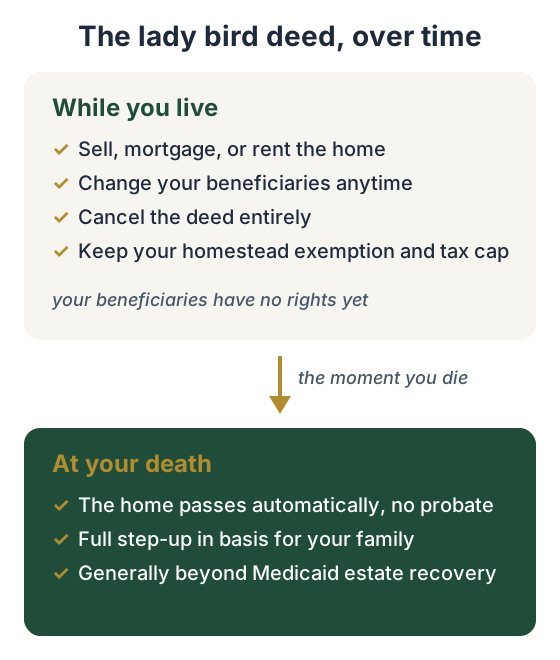
No. The beneficiary holds a remainder that you can cancel at any time by recording a new deed, and that right is what makes the deed work. It also means the beneficiary cannot borrow against the home, cannot block a sale or a refinance, and has no claim to the home that a creditor of the beneficiary can reach during your life. The beneficiary becomes the owner only at your death.
Common Situations
Three kids, one holdout. A mother leaves her home equally to three children by lady bird deed. After she dies, two want to sell and one wants to keep it. Because all three own it together, the disagreement stalls everything and ends in a partition suit. A trust naming one child as trustee would have set the rules in advance.
The special-needs son. A father deeds his home to his adult son, who receives means-tested disability benefits. Inheriting the house outright threatens those benefits. A special-needs trust would have held the home for the son’s benefit without disqualifying him.
The simple win. A widow with one paid-off Tampa home and two adult daughters who get along records a lady bird deed for $399. No trust needed, no probate later. Sometimes the simple tool is exactly right, and we will say so.
The two-state snowbird. A widower splits the year between Fort Myers and a lake cottage in Michigan. His lady bird deed covers the Florida home, but the deed is a Florida tool and cannot reach property in another state. At his death the cottage still puts his children through a probate up north, the cost and delay he thought he had planned away. A revocable trust holding both homes would have kept each one out of court.
What I Tell People Who Ask About the Downsides
In 14 years of law practice, most of what gets listed online as a disadvantage of this deed turns out to be the feature the owner wanted. The complaints usually come from somebody other than the owner.
I have reviewed a case going back to 1917 where a father deeded land to his daughter and kept the right to resell it. Years later he sold that land to somebody else, and when the daughter went to court she lost, because the deed said in plain words that he could. Read from the daughter’s chair that is a disadvantage. Read from the father’s chair it is the entire reason the document was written that way, and he stayed free to sell his own property until the day he died.
Trading flexibility for control is the honest frame I use for nearly every item on the disadvantages lists. You keep control, so your beneficiaries have none. You can revoke it, so nobody can rely on it. Your creditors can still reach the home while you are alive, because you still own it. None of that is a drafting defect. In my experience it is simply what an enhanced life estate is, and I would rather say so than pretend otherwise.
The real disadvantages are narrower, and I raise them directly. I tell people plainly that this deed only works on Florida real estate, so it does nothing for property you own in another state. It does not shield the home from your beneficiary’s divorce or creditors once they own it outright. And where the family situation is complicated, a trust usually does the job better than a deed. Cases like this keep coming up where a deed was asked to do work a trust should have handled.
Avoid choosing this deed because it is the cheapest document on the menu. I would rather tell you a deed is the wrong tool than sell you one that records cleanly and disappoints your family later.
Kevin D. Klagge, Esq., admitted in Florida since 2012. Any case described above is a decision of a Florida court rather than a matter handled by this firm. Past results do not guarantee a similar outcome.
Chapter 29 of Kevin D. Klagge’s free book, Are Florida Lady Bird Deeds Just for Women?, covers this question with every statute and case cited to its source.
Sources of Law
- Fla. Const. Art. X, §4(c): homestead may not be devised if survived by a spouse or minor child. flsenate.gov (retrieved 2026-06-07)
- Fla. Stat. §732.401: descent of homestead when devise is barred. flsenate.gov
- Lady bird (enhanced life estate) deeds are recognized by Florida common law and title-underwriting practice; there is no Florida statute creating them.
- Incapacity: Fla. Stat. §709.2201(1) (an agent exercises only specifically granted authority), §709.2105(2) (two witnesses and a notary), §695.01(1) (the power is recorded), §744.441(2) and (12) (a guardian exercises the ward’s powers and sells real property only after court approval). (verified 2026-10-18)
Updated on October 18, 2026. Reviewed by Kevin D. Klagge, Esq., Fla. Bar No. 99502. General information about Florida law, not legal advice, and no attorney-client relationship is created. Do not send confidential information until we have agreed to represent you.