Does Florida Have a Transfer on Death Deed?
Florida has no statute that creates a transfer on death deed for real property. A TOD deed form from another state has no legal backing in Florida. Nothing in Florida law gives that form effect.
The majority of states now allow them. Thirty-four states and the District of Columbia (35 of the 51 jurisdictions in our dataset) recognize a transfer on death deed by statute. Florida is not one of them. The practical question is what Florida property owners can use instead.
The answer is an enhanced life estate deed, usually called a lady bird deed. Florida law recognizes this deed under common-law authority, not statute. The Florida Supreme Court recognized the form in 1917, and the Florida Bar's Uniform Title Standards set out the consensus view of the Real Property, Probate and Trust Law Section. Florida's Medicaid agency also accepts the deed and treats it as no transfer for eligibility purposes, citing both the lady bird deed and the life estate with powers by name.
A lady bird deed gives you what you were looking for in a transfer on death deed. The deed names one or more beneficiaries who receive the property at your death, outside probate. You keep full ownership powers during your lifetime. You can sell, mortgage, lease, refinance, change the beneficiaries, or revoke the deed entirely, all without anyone's consent. No present transfer of ownership occurs at signing. The beneficiaries receive nothing until you die, and only if you have not conveyed the property or revoked the deed before then.
The common-law foundation matters for title insurance and closings. A statutory TOD deed in another state carries explicit legislative authority. A lady bird deed in Florida carries the 1917 Florida Supreme Court decision, over a century of title practice, and the Florida Bar's Uniform Title Standards. The instrument works. Florida simply arrived at the same result through a different legal path.
What Does a Transfer on Death Deed Do in Other States?
In states that allow them, a transfer on death deed lets you name a beneficiary for real property on a form that becomes effective only at death. You sign and record the deed during your lifetime, and the named person receives the property when you die. Until then, you keep full ownership and can revoke the deed at any time.
The TOD deed is not a life estate. As one appeals court in another state put it, "A life estate is not created by a transfer-on-death deed; the property owner retains all rights and interests in the property until their death." The owner can sell the property, mortgage it, or convey it to someone else entirely. If the owner does any of those things, the transfer on death deed no longer controls.
New York, for example, recognizes a transfer on death deed under state law. If you own property in New York, you can record a TOD deed there. But that New York statute does not extend to Florida property, because Florida has no TOD statute of its own.
The transfer on death deed was designed to offer a simple, inexpensive way to pass real estate outside probate. It works well for an owner with a single property, one clear beneficiary, and no complications. States that adopted such a statute gave property owners a deed-based alternative to a will or trust for that limited purpose.
Florida property owners have the same goal. They want to pass the home outside probate, keep control during life, and avoid forcing the family through a court proceeding after death. Florida just reaches that result through a different instrument.
What Does Florida Use Instead of a Transfer on Death Deed?
Florida uses an enhanced life estate deed, commonly called a lady bird deed. The deed splits ownership into two parts. The first part is an enhanced life estate that you keep for your lifetime. The second part is a remainder (the part that passes at death) that vests in your named beneficiaries when you die.
The word "enhanced" matters. An ordinary life estate lets you live in the property during your lifetime, but you need the remainderman's consent to sell or mortgage it. An enhanced life estate reserves additional powers. You keep the right to sell the property, mortgage it, lease it, refinance it, change the beneficiaries, or revoke the deed outright. You can do all of this without the beneficiaries' consent or even their knowledge. The beneficiaries have no enforceable interest while you are alive.
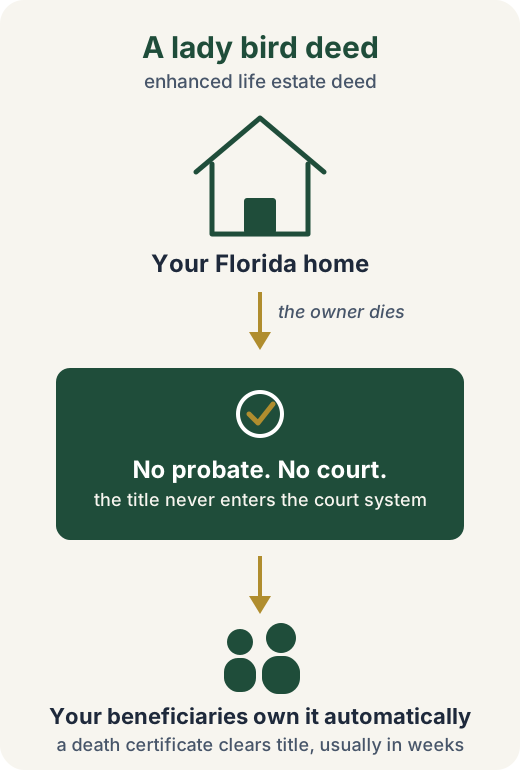
No present transfer of ownership occurs when you sign. The beneficiaries receive nothing during your lifetime. Their interest can be wiped out by any conveyance you make before death. Only if you still own the property at death does the remainder become effective. At that moment, title vests in the beneficiaries automatically, by operation of law. No court order, no probate proceeding, and no new deed is required.
Florida has no transfer on death deed statute, and Florida does not need one. The lady bird deed accomplishes the same result through common-law authority. The Florida Supreme Court recognized the form in 1917 in the Oglesby case, holding that a deed reserving to the grantor the right to resell was effective. The Florida Bar's Uniform Title Standards confirm the practice.
Florida's Medicaid agency accepts the lady bird deed by name. The agency's policy manual states that if an individual retains a life estate using a lady bird deed or life estate with powers, no transfer has occurred. The individual retains full ownership powers in the property. Only at death does the property transfer ownership to the remainderman. An owner can record a lady bird deed and apply for Medicaid the next day with no look-back penalty.
How Does a Lady Bird Deed Compare With a Transfer on Death Deed?
The two deeds share a purpose and produce a similar result. Both let you name a beneficiary for real property that will pass outside probate when you die. Both keep the property under your control during your lifetime. Both are revocable. The main difference is authority. A transfer on death deed exists only where a state statute creates it. A lady bird deed exists under Florida common law.
Swipe the table sideways to compare both deeds.
| Feature | Transfer on death deed | Lady bird deed (Florida) |
|---|---|---|
| What is created at signing | A deed that names a beneficiary; no estate or interest passes until death | A life estate to the owner, a remainder to the beneficiary; no possessory interest passes until death |
| Owner's control during life | Full control; can sell, mortgage, or revoke | Full control; can sell, mortgage, change beneficiaries, or revoke |
| Probate | Avoided; property passes outside the estate | Avoided; remainder vests at death by operation of law |
| Revoking | Owner records a revocation or a new deed | Owner records a new deed or conveys the property; no separate revocation form needed |
| Medicaid treatment | Varies by state | Florida treats it as no transfer; no look-back penalty |
| Basis step-up | Property included in taxable estate; full step-up | Property included in taxable estate; full step-up |
The Medicaid treatment deserves attention. In Florida, the Medicaid agency's policy manual confirms that a lady bird deed is not treated as a transfer. The owner retains full ownership powers, and the agency treats the deed as if the transfer has not happened. An owner can record a lady bird deed and apply for Medicaid the next day with no penalty period. Other states may treat a transfer on death deed differently.
The capital gains benefit is the same in both. Because you keep a retained interest in the property until death, the home stays in your taxable estate. That triggers a full step-up in basis to the fair market value on the date of death. If you bought your home for $90,000 and it is worth $300,000 at your death, your beneficiaries receive a basis of $300,000. A near-term sale produces little or no capital gains tax on the $210,000 of appreciation.
What Happens to the Home the Moment the Owner Dies?
Title vests in the remainder beneficiary at the instant of death, by operation of law. No petition goes to a court, no judge signs an order, and no new deed is needed. The beneficiaries hold title immediately, even if they have not yet recorded the death certificate. The life estate simply ends at that moment, and the beneficiary's existing interest becomes possessory.
Recording the death certificate alongside a survivorship affidavit clears the chain of title on the public record. The death certificate is a certified copy from the state, and the survivorship affidavit states that the owner has died and that the named beneficiary survives. Together these documents let a title company issue a clean policy, allowing the new owners to sell, refinance, or transfer the property without delay.
The parcel never enters the probate estate because the remainder was already conveyed when the owner signed the deed years earlier. Florida law defines the estate that goes through probate as the property of a decedent that is the subject of administration. Property that passed outside the estate before death is not subject to administration. The home is therefore not part of the probate proceeding.
A personal representative appointed to handle the probate estate has no authority over this home. The representative's powers reach only property the decedent owned at death, and the decedent had already conveyed away the full ownership. The home is therefore insulated from creditor claims filed against the estate, will contests, and the months or years of litigation that can freeze other assets. Beneficiaries can live in, rent, or sell the property without waiting for a probate court to close the case. The transfer happens automatically and privately, without the cost or publicity of a court proceeding.
What If a Beneficiary Dies First, or Several Heirs Inherit Together?
A beneficiary who dies before the owner creates an unintended problem. Without survivorship language or a contingent beneficiary in the deed, that beneficiary's remainder interest passes through the deceased beneficiary's own estate. The result is that a home meant to skip probate can end up in probate anyway, just through a different person's estate. The entire purpose of the deed is defeated.
Survivorship language prevents the gap. A deed stating that the remainder passes to the surviving beneficiaries, or per stirpes to a deceased beneficiary's descendants, keeps the transfer outside probate even when family circumstances change. Per stirpes means that if one of your two children dies before you, leaving grandchildren, those grandchildren take the deceased child's share. The family tree fills in the gap rather than routing through a probate court.
Recording a new deed is the simplest fix during your lifetime. You may change the beneficiaries at any time without the current beneficiaries' consent, so if one child has died or a relationship has changed, you can update the deed to reflect the new plan. Named beneficiaries have no enforceable interest during your life because the deed is fully revocable. You are free to record a replacement deed whenever circumstances require.
Multiple beneficiaries who inherit together become co-owners of the property. Co-owners must agree on whether to sell, rent, or live in the home. Disagreement can lead to a partition action, which is a lawsuit in which any co-owner can force a sale over the objections of the others. The court divides the proceeds, and everyone loses time and legal fees along the way.
A trust with a trustee who has a power of sale avoids partition. The trustee can list and sell the property without unanimity, distribute the proceeds according to the trust, and resolve disagreements through the trust's own terms rather than through court. Families with more than one beneficiary, or where any beneficiary has young children or special circumstances, often benefit from naming a trust instead of the children outright.
Why Name a Trust Instead of the Children?
A revocable living trust can be the remainder beneficiary of a lady bird deed. The standard structure in Florida is to keep the homestead in the owner's individual name while the deed names the trust as the remainder beneficiary. At death the trust becomes irrevocable, and the home passes into a continuing sub-trust under its terms.
Naming the trust instead of the children directly solves several problems. A predeceased, minor, or disabled beneficiary requires no new deed. You amend the trust document, which does not need recording, and the deed itself stays unchanged. A direct deed to children must be re-recorded whenever the family changes, adding cost and creating gaps where an outdated deed controls.
Multiple beneficiaries can disagree about what to do with the property. A trustee with a power of sale can list the home, accept offers, and distribute proceeds without needing every beneficiary to sign off. The trust's terms settle disputes rather than a partition lawsuit.
Protection past the owner's death is another reason. A remainder that vests in a child outright at death is immediately exposed to that child's creditors, divorcing spouse, or judgment holders. A continuing trust can hold and protect the property or its proceeds under the trust's spendthrift or protective terms.
Florida's homestead rules still apply when a trust is the remainder beneficiary. A remainder to a trust is treated the same as leaving the home to someone by will (a testamentary disposition). If a spouse or minor child survives, a lady bird deed to a trust (or anyone other than the spouse outright) can be treated as an improper devise of homestead, meaning the deed fails. The deed then drops to the constitutional default, which gives a life estate to the spouse and a remainder to descendants. Whether your deed can name a trust depends on your marital status and whether minor children survive you, something to confirm before signing.
Does a Transfer on Death Deed From Another State Work on Florida Property?
Florida land requires a Florida instrument. A transfer on death deed form printed under another state's statute has no legal effect on a parcel in Florida because Florida has no statute behind it. The form might recite a law that does not exist here, and the result is a document that does not transfer the property.
New York, for example, recognizes transfer on death deeds under its own statute. A New York house can use that statute, and the deed will work for that New York property. A Florida house cannot use that form. Florida has no TOD statute, so nothing in Florida law gives that form effect. The two deeds are not interchangeable.
Owning property in both states means two separate deeds. The New York property uses New York's transfer on death deed or another instrument recognized there. The Florida property uses a lady bird deed or a revocable trust, the instruments Florida recognizes. One deed cannot cover both.
A single trust can hold both properties, but the funding deeds are separate. The New York deed conveys the New York house into the trust (or directly to beneficiaries under New York law), and the Florida deed conveys the Florida house. Each deed is signed, witnessed, notarized, and recorded under the rules that apply to that property.
Families who relocate or inherit out-of-state property often discover this mismatch. If you moved from a state with a transfer on death deed statute and still own property there, you may keep that deed in place. The Florida home, however, needs its own Florida instrument. Reviewing both properties at a no-cost consult ensures each deed matches the law that applies to it.
I Already Recorded a Transfer on Death Deed in Florida. What Should I Do?
Florida has no transfer on death deed statute. The state does not recognize the instrument by law, and no Florida statute gives it any effect. Recording a document does not create legal validity if Florida law does not recognize that form of deed.
An appeals court in another state addressed what happens when a family uses transfer on death deeds in a state that does not recognize them. The court held the deeds void because no statute authorized the instrument.
Florida courts have not ruled on this question directly. Predicting what a Florida court would hold on a recorded TOD deed is beyond what any attorney can say for certain. The safer path is to replace the document with an instrument Florida does recognize.
A lady bird deed accomplishes what you were trying to accomplish with the TOD deed. The owner keeps full control during life, including the power to sell, mortgage or revoke without consent. At death, the home passes to the beneficiaries outside probate. Recording the lady bird deed replaces the questionable document with a valid Florida instrument.
The no-cost consult is the place to review what you recorded and confirm the fix. A lady bird deed for one owner is a flat fee from $399, or $449 for a married couple, plus recording. Replacing a document that may have no legal effect protects your family from confusion and possible probate when you intended to avoid it.
What Does Florida Allow Transfer on Death For?
Florida allows transfer on death registration for securities and investment accounts. Florida's Uniform Transfer-on-Death Security Registration Act covers brokerage accounts, stocks, bonds and other securities. An owner registers the account in beneficiary form, naming who will receive the assets at death. The statute says the registration indicates the present owner and the intention regarding the person who will become the owner when the present owner dies. The transfer is effective by reason of the contract between the owner and the registering entity. The assets pass outside probate because the statute makes the transfer not testamentary.
Bank accounts follow a similar path under a different rule. Florida law allows pay on death accounts at banks and credit unions. The account is a contract of deposit, and the owner names a beneficiary who receives the balance after the owner's death. The account avoids probate because the funds transfer by contract, not by will.
Real estate in Florida does not have a transfer on death deed statute. The instrument that accomplishes the same result is the lady bird deed (an enhanced life estate deed). The owner keeps a life estate with full powers to sell, mortgage, lease or revoke. At death the home passes to the remainder beneficiaries without probate, just as securities and bank accounts pass under their respective rules.
The difference is that the lady bird deed rests on common law and Florida Bar title standards rather than a statute. The principle is the same. The owner keeps control during life and names who receives the property at death. Recording the deed creates the remainder interest, and the death certificate and an affidavit complete the transfer after death with no court involvement.
Were you about to record a TOD deed?
Please wait. Book a no-cost 30-minute consult, and we will set up the deed Florida recognizes, for a flat fee.
Book a no-cost consultWhat Courts in Other States Show About Death-Time Deeds
Court decisions from other states show what can go wrong with deeds that transfer property at death, even in states that recognize them. One appeals court observed that even in a state that recognizes these deeds, there is not much case law interpreting them. The few cases that do exist offer lessons.
In one case, an owner recorded a transfer on death deed to his brother. Later the owner signed a quitclaim deed to himself and his nephew as joint tenants and gave the deed to his attorney with instructions to record. The owner died, and the quitclaim was recorded two weeks after his death. The trial court gave the house to the brother under the TOD deed. The appeals court reversed and gave the property to the nephew. The court wrote that "[s]ince Richard conveyed all of the property away during Richard's lifetime, there was nothing to transfer on his death via the transfer-on-death deed." A conveyance during life defeated the death time transfer entirely.
In another case, a husband and wife signed one enhanced life estate deed together as joint grantors, naming the husband's son as the remainderman. When the husband died, his half vested in the son immediately. The surviving wife and her agent could not revoke the deed as to that half. The lesson is that a joint deed works differently from separate deeds. When one spouse dies, that spouse's share passes at once, and the survivor cannot undo it.
A third court addressed a family that used transfer on death deeds in a state with no TOD deed statute and no recognized enhanced life estate deed. The court held the deeds void because the state did not recognize the instrument.
The lessons apply to Florida families planning ahead. A conveyance during life overrides the death transfer. A joint deed locks in the share of the first spouse to die. Using the right instrument for the property you own matters more than the label on the form.
What Does a Married Couple Need to Know?
Florida homestead law imposes two requirements when you are married. The first is a lifetime rule. Under the Florida Constitution, a married owner cannot convey or mortgage homestead property without the spouse joining the deed. A lady bird deed on homestead that names children but leaves out a non-joining spouse is void as to the homestead. The spouse must sign alongside the owner, even if the spouse has no ownership interest in the property. The failure to include the spouse is a recurring problem in Florida probate, and the result is expensive litigation to clear title afterward.
The second is a devise restriction. Florida law provides that homestead cannot be devised away from a surviving spouse or minor child. A deed that sends the home to someone other than your spouse at your death would ordinarily violate this limit. Florida addressed the problem in 2018 with a safe-harbor statement. The spouse who joins the deed may include specific language waiving the right to receive the homestead at your death. The waiver allows the home to pass to your children or to a trust rather than to the surviving spouse.
The waiver has limits. It releases only the devise restriction. The elective share is not waived. Homestead creditor protection is not waived. The lifetime-joinder requirement is not waived. And if a minor child survives you, a lady bird deed sending the home to anyone other than the spouse fails. A minor child's protection cannot be waived under Florida law. The deed structure must fit these rules before it is signed, and the no-cost consult covers how each applies to your family.
Can You Sign the Florida Deed From Home?
Florida law allows a deed to be witnessed and notarized remotely. The law provides that the requirement for two subscribing witnesses may be satisfied by witnesses being present through audio-video communication technology. The witnesses hear the person signing make a statement acknowledging the signature. The statute validates all acts of witnessing made in this manner and provides that recording may not be denied based on any alleged failure to have strictly complied with the witnessing rules.
Online notarization is also authorized. Florida law allows an online notary public to perform any of the functions authorized under Florida law as an online notarization. The principal may appear before the online notary public by means of audio-video communication technology. A witness may be remote from the principal as long as both use audio-video communication. The act of witnessing an electronic signature is satisfied when the witness hears the principal make a statement to the effect that the principal has signed the electronic record.
Certain documents require extra screening questions when witnesses are remote. Wills, revocable trusts with testamentary aspects, health care advance directives, powers of attorney authorizing specific transactions and certain spousal agreements fall into that category. A deed is not on that list. The remote witnessing and online notarization rules apply to deeds without the extra procedural layer. Other challenges such as fraud, incapacity and undue influence remain available under the statute regardless of how the witnessing was performed.
How Much Does the Florida Alternative Cost?
A lady bird deed prepared by this firm is a flat fee from $399 for one owner or $449 for a married couple, plus recording. Recording fees are government costs passed through at cost. The amount depends on the number of pages in the deed and the number of names involved. The deed includes the enhanced-powers language that preserves your full control, names your beneficiaries and alternates.
Many families choose a broader plan. The Secure Will Estate Plan is $1,200 for one person or $1,950 for a couple. The plan includes five documents. You receive a will, a durable power of attorney, a health-care surrogate designation, a living will and a HIPAA authorization. The plan also includes a lady bird deed on your home, with recording additional. If you need a will, a power of attorney and a deed, this plan covers all three at one flat fee rather than three separate engagements.
The Complete Trust Plan is $3,200 for one person or $4,500 for a couple. The plan includes all the will plan documents, a revocable living trust, a pour-over will and one funding deed moving the Florida homestead into the trust, with recording additional. The trust plan is appropriate when you have multiple properties, beneficiaries who need protection, out-of-state assets or circumstances that call for a trustee rather than outright distribution to individuals.
Every engagement begins with a no-cost 30-minute consult. The consult covers which deed or plan fits your situation, what happens to your home at your death and how recording works. You do not need to arrive with everything figured out. The consult is where we work through your facts together.
Frequently Asked Questions
Does Florida Have a Transfer on Death Deed?
Florida has no transfer on death deed statute. Thirty-five of the 51 U.S. jurisdictions (34 states and the District of Columbia) recognize one by statute, but Florida is not among them. Florida instead relies on the lady bird deed, an enhanced life estate deed recognized under common law since 1917. The lady bird deed accomplishes the same goal as a transfer on death deed. You keep full control of the property during your lifetime and the home passes to your named beneficiaries at death without probate.
What Should I Use Instead of a TOD Deed in Florida?
A lady bird deed is the Florida alternative to a transfer on death deed. This enhanced life estate deed lets you keep full control of your home during your lifetime, including the power to sell, mortgage, lease or revoke the deed entirely. Your named beneficiaries receive the property at your death without probate. The flat fee starts from $399 for one owner or $449 for a married couple, plus recording. Whether this deed fits your situation depends on your facts, covered at the no-cost consult.
Is a Lady Bird Deed the Same as a Transfer on Death Deed?
A lady bird deed and a transfer on death deed accomplish similar results but work differently. Both let you keep control during life and transfer property at death without probate. A transfer on death deed creates no present interest in anyone until the owner dies. A lady bird deed creates a remainder interest at signing, but the owner keeps enhanced powers that make the remainder revocable. Florida recognizes lady bird deeds under common law. Florida has no statute recognizing transfer on death deeds for real property.
What Happens If I Record a TOD Deed on Florida Property Anyway?
A transfer on death deed recorded on Florida property has no statute behind it. An appeals court in another state that also lacks a transfer on death deed statute held such deeds void because the state did not recognize the instrument. Florida courts have not ruled on this question, but recording a deed Florida law does not recognize creates uncertainty. The fix is a lady bird deed or other Florida instrument, reviewed at the no-cost consult.
Does Florida Allow Transfer on Death for Anything?
Florida allows transfer on death designations for securities and brokerage accounts under the Florida Uniform Transfer-on-Death Security Registration Act. Florida also allows pay on death designations on bank accounts, including checking accounts, savings accounts and certificates of deposit. These designations let you name a beneficiary who receives the account at your death without probate. Real estate does not qualify under either rule. For Florida real property, you use a lady bird deed instead of a transfer on death deed.
Does a Lady Bird Deed Avoid Probate Like a TOD Deed Would?
A lady bird deed avoids probate. Title vests in the named beneficiaries at the moment of death by operation of law. The beneficiaries record a certified death certificate and survivorship affidavit to clear title. No petition or court order is required. The property never enters the probate estate because the remainder was conveyed during the owner's lifetime. The personal representative appointed in probate has no authority over the property. This matches what a transfer on death deed accomplishes in states that recognize one.
Can I Just Use a Quitclaim Deed to Avoid Probate Instead?
A quitclaim deed transfers ownership immediately when you sign it. You lose control of the property the moment the deed is recorded. A quitclaim deed also creates gift and tax complications if you continue living in the home. A lady bird deed avoids probate while you keep full control during your lifetime. You can sell, mortgage, lease or revoke the deed without your beneficiaries' consent. The difference is whether you give up control now or keep it until death.
What Happens If One of My Children Dies Before Me?
A beneficiary who dies before you creates a problem if the deed has no survivorship or contingent language. That beneficiary's remainder may pass through their estate, forcing a probate you intended to avoid. The deed should state that the remainder passes per stirpes to the beneficiary's descendants or to the surviving beneficiaries. The simplest fix during your lifetime is to record a new deed with updated beneficiaries. You can do this without anyone's consent because you kept full powers under the lady bird deed.
Can My Grandchildren Inherit the Home Through a Deed Like This?
Grandchildren can inherit the home through a lady bird deed. You can name grandchildren directly as remainder beneficiaries, or you can include per stirpes language so that a predeceased child's share passes to that child's descendants. If you want grandchildren to inherit only if their parent dies before you, the per stirpes approach handles that contingency automatically. Naming multiple people creates co-ownership after your death, which may lead to disagreements. Whether to name grandchildren and how depends on your facts, covered at the no-cost consult.
What Happens When Several Children Inherit the House Together?
Children who inherit together become co-owners. Co-owners who disagree about selling, using or managing the property can end up in a partition action, a court proceeding where a judge orders the property sold and divides the proceeds. This outcome defeats the probate avoidance you planned for. You can reduce this risk by naming a trust as the beneficiary instead of the children directly. The trustee then holds a power to sell and distribute proceeds under the trust terms, avoiding deadlock among co-owners.
Can I Name My Trust as the Beneficiary Instead of My Kids?
A trust is a valid remainder beneficiary. Naming your revocable living trust as the beneficiary means the home passes into the trust at your death and distributes under its terms. The trust absorbs contingencies that a deed alone cannot handle, including a predeceased beneficiary, a minor beneficiary, a disabled beneficiary or co-owners who disagree. A trustee with a power of sale avoids the partition problem. The homestead rule still applies, so if you have a surviving spouse or minor child, the structure must fit Florida's constitutional requirements.
How Much Does the Florida Version Cost?
A lady bird deed on a Florida home is a flat fee from $399 for one owner, or $449 for a married couple, plus recording. The Secure Will Estate Plan includes a lady bird deed along with five planning documents for $1,200, or $1,950 for a couple, plus recording. The Complete Trust Plan is $3,200, or $4,500 for a couple. Recording fees are passed through at cost and depend on the number of pages and names. The no-cost consult confirms which option fits your situation.
In Florida, What Kind of Deed Transfers Ownership Upon Death?
A lady bird deed (also called an enhanced life estate deed) is the instrument Florida property owners use to pass real estate at death without probate. The owner keeps a life estate with full powers to sell, mortgage, or revoke the deed during life. The remainder passes to named beneficiaries at the moment of death by operation of law. No court proceeding is needed. The beneficiaries record a certified death certificate to clear title. Florida law does not have a transfer on death deed statute, so the lady bird deed fills that role.
Can You Do a TOD on Your Home in Florida?
Florida has no transfer on death deed statute for real property. A TOD deed form from another state has no legal backing here. The Florida instrument that accomplishes the same goal is a lady bird deed, which keeps the owner's full control during life and passes the home at death outside probate. The beneficiaries receive title the moment the owner dies, with no court filing required. Recording a certified death certificate completes the transfer. A flat fee from $399 covers one owner, plus recording, and the no-cost consult confirms whether this deed fits your plan.
Is a Transfer on Death Deed Legal in Florida?
Florida has no statute that creates or recognizes a transfer on death deed for real estate. Thirty-five of the 51 U.S. jurisdictions (34 states and the District of Columbia) have such a statute, and Florida is not among them. A TOD deed recorded on Florida property has no statutory authority behind it. Florida property owners use the lady bird deed, which is supported by common law and the Florida Uniform Title Standards. The no-cost consult reviews what you have recorded and whether a Florida instrument is needed.
My Florida Deed Is Titled "Transfer on Death Deed." Is It Valid?
A deed titled "transfer on death deed" on Florida property has no Florida statute behind it. An appeals court in another state held that such a deed was void where no statute recognized it. Whether your deed conveys anything depends on its exact language, and Florida courts have not ruled on every variation. Continuing to rely on a deed with uncertain validity risks leaving the home in your estate at death. A lady bird deed is the recognized Florida instrument. The no-cost consult reviews your recorded deed and outlines the correction.
I have a house in New York and one in Florida. Can one transfer on death deed cover both?
New York has a transfer on death deed statute, so a TOD deed recorded on a New York home works under New York law. Florida has no such statute, so Florida property needs a Florida instrument. One deed cannot cover both parcels. A New York TOD deed recorded on a Florida home does nothing. The Florida home requires a lady bird deed or a trust. The no-cost consult reviews each property and confirms the right instrument for each.
How is a home that passes by a lady bird deed taxed when my children sell it?
A home that passes by lady bird deed receives a full step-up in basis to fair market value at the owner's death. A home bought for $90,000 and worth $300,000 at death gives the children a basis of $300,000. A near-term sale owes little or no capital gains on the $210,000 of appreciation that built up during your lifetime. A lifetime gift, by contrast, carries your original basis forward, and the children would owe tax on that full gain. The step-up is the main reason clients choose this deed over gifting.
Do I need my spouse to sign a lady bird deed?
Florida's homestead rules require both spouses to sign a deed on a homestead property. A deed signed by only one spouse on a homestead is void as to the homestead under the Florida Constitution. The spouse must also join to satisfy the devise restriction if the remainder goes to anyone other than the spouse outright. A safe-harbor waiver statement in the deed allows a spouse to waive the devise restriction so the home can pass to children or a trust. The no-cost consult confirms whether a waiver fits your situation.
Is joint tenancy with right of survivorship or a lady bird deed better for a couple owning a Florida home together?
Joint tenancy with right of survivorship passes the home to the survivor at the first death, and probate avoidance stops there. After the survivor dies, the home passes through that person's estate or requires another deed. A lady bird deed can name remainder beneficiaries who receive the home at the second death, outside probate. The deed also preserves the owner's power to sell, mortgage, or revoke without any beneficiary's consent. The choice depends on whether you want probate avoidance only at the first death or at both deaths, and the no-cost consult walks through both.
Should I use a lady bird deed or a trust for my Florida home?
A lady bird deed works well when the remainder goes to one adult beneficiary who will keep and live in the home. A trust is the better choice when beneficiaries may disagree, when a beneficiary is a minor or receives government benefits, or when you want post-death creditor protection for the family. The recommended structure names the revocable trust as the remainder beneficiary, so the home pours into the trust at death and the trustee manages the sale or distribution. The no-cost consult matches the right tool to your family's facts.
Is a transfer on death deed the right choice if I own homes in Florida and another state?
Florida has no transfer on death deed statute, so a TOD deed cannot work on the Florida property. If the other state has a TOD deed statute, that form may work for the out-of-state home under that state's law. The Florida home needs a lady bird deed or a trust. A trust can hold property in multiple states and avoid ancillary probate, which is a second probate in the state where the out-of-state property sits. The no-cost consult reviews both properties and explains which combination keeps both homes out of probate.
Common Situations
A widow recorded what the preparer called a transfer on death deed on her Florida home. She assumed the home would pass to her son at her death the way a similar deed had worked in the state where she lived before. When she learned Florida has no statute behind that deed, she asked what would happen if she died without changing it. The answer was uncertain, and no Florida court has ruled on the exact language she used. She replaced it with a lady bird deed for $399 plus recording, and her son now holds a recognized remainder under Florida law.
A retired couple owned a home in Florida and a cabin in a state that recognizes transfer on death deeds. They tried to use one TOD deed to cover both properties. The deed recorded on the cabin worked under that state's statute. The same form recorded on the Florida home had no effect because Florida has no such law. They recorded a lady bird deed on the Florida home for $449 plus recording. Now each property has a valid instrument under the law that applies to it.
What I See After a Death-Time Deed Takes Effect
In 14 years of law practice, the transfer-on-death question almost never arrives by itself. Somebody has read that a beneficiary deed is the simple answer, and the thing they are really asking is whether the house can reach the children without lawyers in the room. I also litigate deeds after they fail, which enhances the practice of drafting deeds, and the failures are rarely about which form was used. The trouble is what the deed did on the day it took effect.
I went looking for the Florida authority on this myself rather than relying on somebody’s summary of it. Searching every Florida appellate opinion together with the Eleventh Circuit, the phrase "transfer on death deed" appears in none of them, and neither does "beneficiary deed." No Florida court has approved one and no Florida court has struck one down. The silence gives a homeowner no comfort. A title underwriter asked to insure the sale of your house needs authority saying the deed moved the property, and on this question Florida has none to give.
What I would want a homeowner to consider is what any death-time deed does when it names more than one person. Three people ended up owning a single Miami-Dade house, each holding an undivided one-third. One of them lived there and wanted to stay. The other two wanted their money out of it. The trial judge worked hard to find a humane middle and ordered the one living there to take a reverse mortgage for the maximum the house would carry, pay the proceeds to the other two, and sign a deed reserving an enhanced life estate to herself so they would still receive the house at her death. The solution was thoughtful, and in August 2026 the appellate court threw it out. Partition is a matter of right in Florida, the judge had made none of the findings that would justify refusing it, and no court can order a remedy nobody asked for. The house goes to sale.
The lesson for an owner is that no judge is coming to rescue the arrangement afterward. A deed naming three children hands them that house in exactly those thirds, and the only exit Florida offers when they disagree is a forced sale with the lawyers paid out of the proceeds. The owner who signed it was trying to keep the house in the family, and the deed is what guaranteed the house would be sold. The decision is recent enough that a rehearing motion could still change it, which I would rather tell you than have you discover.
Avoid treating the choice as a choice between deed and no deed. In my practice the owners who get the result they wanted are the ones who decided who signs after they are gone, and the ones who get litigation are the ones who decided only who inherits. Naming a person answers the second question. Only naming a trustee answers the first.
Kevin D. Klagge, Esq., admitted in Florida since 2012. Any case described above is a decision of a Florida court rather than a matter handled by this firm. Past results do not guarantee a similar outcome.
Sources of Law
- Florida has not enacted the Uniform Real Property Transfer on Death Act; there is no statutory TOD or beneficiary deed for real estate. Lady bird (enhanced life estate) deeds are recognized by Florida common law and title-underwriting practice.
- Maryland's transfer-on-death deed act, Md. Code, Real Prop. §§14-1001 to 14-1014, takes effect October 1, 2026. Texas recognizes the enhanced life estate deed in HHSC's Medicaid for the Elderly and People with Disabilities Handbook, §I-3100 (Rev. 20-4, eff. Dec. 1, 2020), which does not penalize a transfer of the home by such a deed when the regional attorney approves it.
- Tex. Est. Code §114.103(d) (“A transfer on death deed transfers real property without covenant of warranty of title even if the deed contains a contrary provision.”) and §114.106 (personal representative may enforce estate liability against property passing by transfer on death deed; “A proceeding to enforce liability under this section must be commenced not later than the second anniversary of the transferor’s death”). Retrieved 2026-09-01.
- Fla. Stat. Chapter 711: Florida Uniform Transfer-on-Death Security Registration Act. flsenate.gov (retrieved 2026-06-07)
- Fla. Stat. §689.15 (multiple takers hold as tenants in common); ch. 64 (partition), including §§64.201 to 64.214 (Uniform Partition of Heirs Property Act, effective July 1, 2020: appraisal, co-tenant buyout, supervised sale). Retrieved 2026-08-07.
- Fla. Stat. ch. 744 (guardianship of a minor’s property; court approval required to convey a minor’s real estate); §736.0502 (annotated) (spendthrift provisions); Art. X, §4(c), Fla. Const. and §732.4015 (homestead devise restrictions: the owner’s surviving spouse or minor child, not minor grandchildren).
- Dominguez v. Suarez, No. 3D25-0823 (Fla. 3d DCA Aug. 26, 2026) (slip op.): partition is a matter of right under §64.051 and a trial court may not impose a reverse mortgage plus an enhanced life estate as a substitute remedy. Not final until disposition of any timely rehearing motion. Read in full 2026-09-01.
- IRC §1014: step-up in basis at death. Fla. Stat. §409.9101: Medicaid estate recovery (limited to the probate estate).
- Lady bird (enhanced life estate) deed authority: Oglesby v. Lee, 73 Fla. 39, 73 So. 840 (1917); The Florida Bar, Uniform Title Standards 6.10 to 6.12. (retrieved 2026-10-27)
- Fla. Stat. §655.82 (pay-on-death accounts; definitions of "account" and "beneficiary"); ch. 711, including §711.509(1) (securities pass to the transfer-on-death beneficiary outside the will). (retrieved 2026-10-27)
- Fla. Const. art. X, §4(c) (spouse must join a conveyance or mortgage of homestead; homestead not devisable when the owner is survived by a spouse or minor child); Fla. Stat. §732.4015 and §732.7025 (spousal waiver statement in a deed). (retrieved 2026-10-27)
- Florida DCF ESS Policy Manual §1640.0613.01 (a life estate retained by lady bird deed is not a transfer). N.Y. Real Prop. Law §424 (New York transfer on death deed). National count of transfer-on-death-deed jurisdictions (35 of 51, including the District of Columbia) from the StepUpLaw lady bird deed by state dataset. (retrieved 2026-10-27)
Updated on October 27, 2026. Reviewed by Kevin D. Klagge, Esq., Fla. Bar No. 99502. General information about Florida law, not legal advice, and no attorney-client relationship is created. Do not send confidential information until we have agreed to represent you.
More Guides on Florida Lady Bird Deeds and Deeds
- Florida Lady Bird Deed & Medicaid
- Florida Lady Bird Deed Tax Consequences
- Lady Bird Deed After Death
- Lady Bird Deed With Multiple Beneficiaries
- Lady Bird Deed With a Mortgage in Florida: Does It Work?
- Can a Lady Bird Deed Be Contested in Florida?
- Lady Bird Deed vs. Living Trust in Florida
- Lady Bird Deed vs Will in Florida: Which Controls?
Try the Florida Deed Selector.